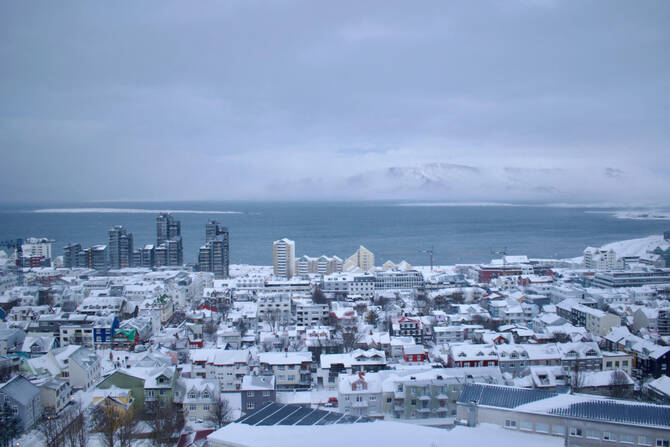
Iceland will hold a referendum on Aug. 29 on whether to resume EU membership negotiations. Should Icelanders vote “yes”?
As a member of the European Economic Area, the Schengen Area, and the European Free Trade Association, Iceland already enjoys the EU’s free movement of goods, services, people, and capital. It applies the same regulatory standards to its financial sector as EU member states do, and Icelanders and visitors to Iceland can travel throughout most of Europe without a passport check.
But Iceland does not participate in EU decision-making; it is exempt from the EU’s Common Agricultural Policy and Common Fisheries Policy; and it retains its own currency. If Iceland, with its roughly 400,000 people, were to join the EU, it would have a seat on the European Council, where its vote would have equal weight with that of the EU’s most populous countries.
That is no small matter. As a country with a small population, it would have little power to block ordinary EU decisions. But on many questions that member states view as sensitive, the European Council requires unanimity.
Of course, being required to join CAP is a downside, and Icelanders see the CFP as a serious sticking point. The country would be subject to fishing quotas and fishery management rules determined by the EU, and it would have to accept shared access to certain waters. Its fishing industry and fishing communities could suffer significant losses. Still, since Iceland’s desirable location makes it strategically valuable to the EU, it has some bargaining power, and some have already suggested that accession negotiations might result in an exemption from the CFP.
Adopting the euro does have potential drawbacks
Willem H. Buiter and Anne C. Sibert
Moreover, there are many benefits to joining the euro, the main one being increased financial stability. This is crucial for any central bank, because crises, or even mere uncertainty, resulting from financial instability make achieving monetary objectives impossible. Without an effective lender of last resort and market maker of last resort, even fundamentally sound banking systems can fail from runs or liquidity disruptions.
Given its ability to create domestic currency, the central bank is uniquely positioned to play these last-resort roles, but only if the loans it needs to make and the assets it needs to buy are denominated in its currency. If most of the banking system’s assets and liabilities are denominated in foreign currency, it is powerless. The canonical example of what can go wrong is Iceland’s own banking crisis in 2008.
The problem has not gone away. Iceland’s banking system has shrunk — its assets are about 127 percent of Icelandic gross domestic product, down from about 900 percent in early 2008, and it is subject to more stringent regulation. But there are no capital controls, and the banks have significant long-term liabilities denominated in foreign currency. If Iceland joins the eurozone, the eurosystem can act as a lender and market maker of last resort, preventing another crisis. For a country with an internationally active banking system, this alone may be sufficient reason to join the EU.
Joining the eurozone would also give Iceland access to the European Stability Mechanism, which provides low-cost loans to countries experiencing severe economic distress as part of a macroeconomic adjustment program. It provides financial assistance for the recapitalization of troubled banks and a precautionary credit line for fundamentally sound eurozone member states. It can act as a market maker of last resort by buying members’ sovereign bonds when liquidity dries up.
Adopting the euro does have potential drawbacks. Iceland would lose its ability to conduct monetary policy and use the exchange rate as a shock absorber. Currently, if Iceland is hit by a negative shock that requires lower real, or inflation-adjusted, wages, exchange-rate depreciation achieves this instantly. Without an independent exchange rate, nominal wage adjustments can be slow and cause relative price distortions. The eurozone’s one-size-fits-all monetary policy might not suit Iceland if the external shocks it faces are not positively correlated, and if its business cycle is not synchronized with the eurozone as a whole.
Iceland’s location makes it strategically valuable
Willem H. Buiter and Anne C. Sibert
In evaluating these trade-offs, it is important to recognize that shocks are not independent of the exchange-rate regime. That is why eurozone membership should reduce the shocks associated with financial instability, making the cost of membership smaller than what past data suggest.
Consider a recent report on Iceland’s options, prepared by the finance ministry. It applauds the stabilizing role of an independent exchange rate, noting its beneficial effect following the post-2008 bank failures. But that shock might never have occurred if Iceland had been in the eurozone. If Iceland adopts the euro, its economy may gradually become more flexible and more like the eurozone’s, while future shocks can be mitigated. As long as the public-sector debt-to-GDP ratio remains modest, Iceland has the means to use fiscal policy to respond to shocks and fluctuations.
At the same time, an independent exchange rate could be less an adjustment mechanism and more a source and amplifier of shocks. Bubbles, bandwagons, irrational exuberance, and a host of other phenomena can cause large and persistent misalignments in foreign exchange rates, and very small economies can do little to offset them. Of the two Nordic EU members that have retained their own currencies — Denmark and Sweden — even the smaller one, Denmark, has a population almost 15 times that of Iceland and a GDP almost 12 times as large.
Aside from whatever other benefits EU membership may bring, Icelanders should accept that it makes no economic sense for a tiny country like theirs to have its own currency.
BY: Writer Willem H. Buiter, a former chief economist at Citibank and former member of the Monetary Policy Committee of the Bank of England, is an independent economic adviser.
- Anne C. Sibert is Professor Emerita of Economics at Birkbeck, University of London.
Disclaimer: Views expressed by writers in this section are their own and do not necessarily reflect The Times Union‘ point of view