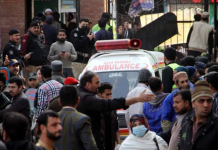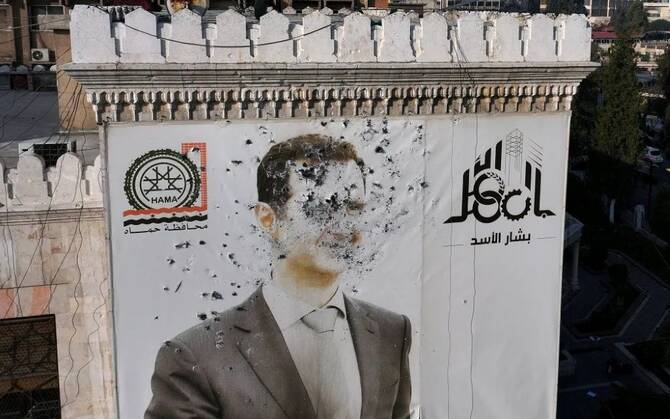
While there was an extraordinary outpouring of joy among Syrians last week, it appeared somewhat transitory. The trial of nine members of the former regime and resulting death penalty verdicts were widely welcomed. Yet there was a sense of what might have been, a missed opportunity. For others, it was yet another moment to reflect on all the horrors of the five decades of the Assad regime, some 20 months after Bashar Al-Assad was ousted.
Few Syrians think Assad and his henchmen, including his brother Maher, are not guilty of serious crimes. Loyalists to the regime even acknowledge this. A proper court and a fair trial are prerequisites to officially determining that guilt — but in the court of public opinion, the debate is really not there.
So why the hollow and fleeting feeling of joy? Eight of the nine were tried in absentia. Will any of them ever see the inside of a Syrian court, let alone jail? Few are optimistic, especially when it comes to the former president and his brother. They are both in Russia under the protection of President Vladimir Putin, who is extremely unlikely to hand either of them over to Syria, absent major international pressure. The lives of these Assads are no doubt lubricated by billions of stolen dollars of Syrian treasure. These were symbolic verdicts and genuine justice is a million miles away.
Najib was tried on an ad hoc basis. No witnesses were heard. No victims were recognized.
Chris Doyle
The exception was Atef Najib. He is the maternal first cousin of the former president, an army brigadier general who was head of political security in Deraa. Najib was charged on 10 counts, including the kidnapping and torture of 15 boys accused of painting graffiti slogans calling for the government’s downfall. His actions triggered the wave of nationwide protests in 2011. Seeing him in prison fatigues in court mattered. This is why in-person trials are so vital.
Here again there were limitations. The court case was rushed, having only started in April of this year. It took place amid an immature domestic legal situation and in the absence of a proper legislative framework. Najib was tried on an ad hoc basis. No witnesses were heard. No victims were recognized. None of them were able to narrate the suffering of their loved ones in the sort of detail the horrors demanded. The 300-plus-page verdict has yet to be published. Human rights groups question whether the trial achieved fair trial standards.
But what about the others? Assad deserved a trial on his own, not as part of a group. He is ultimately responsible for all the regime’s crimes after he came to power in 2000. These included mass killings, forced disappearances and the torture of hundreds of thousands of Syrians, including children, and multiple uses of chemical weapons. That legacy can be seen physically in Syria today in the pummeled areas of major cities, but it is also experienced in the acute trauma of nearly every single Syrian.
Assad’s victims deserve the respect of a proper and full trial, especially for the former president. Some Syrians believe that only The Hague could facilitate the scale of trial the situation merits. European courts, such as in Germany and the Netherlands, have used the legal principle of universal jurisdiction that permits defendants to be prosecuted for crimes under international law, even when committed overseas. But this will never be at the scale required.
The new authorities have been under massive domestic pressure. Assuming power in a country where the legal system was not independent but the tool of a murderous regime was never going to be easy. The pressing demand for transitional justice was huge.
Yet transitional justice has a purpose that should be above revenge. It is also a process of healing, in which truth-telling is as vital as the verdict. This requires proper trials but also a process of reconciliation. Not every person involved in the regime’s crimes needs to be prosecuted but a reconciliation process matters.
The transitional justice mechanisms need to be established on a proper basis. They need to be independent and seen to be as such.
Assad’s victims deserve the respect of a proper and full trial, especially for the former president.
Chris Doyle
Just as importantly, the new authorities have to demonstrate that the rule of law applies to all. It was not just the Assad regime that was guilty of crimes. What about certain members of the then-Syrian opposition who committed crimes, though obviously not at the same scale? What about those responsible for the coastal massacres of March 2025, when an estimated 1,400 people were killed? The current authorities must demonstrate that they will hold their own forces to account as well.
How to deal with the Assad regime and its legacy lies at the heart of the future trajectory of Syria. Syrians deserve a proper process, not a quick-fix solution that glosses over the issues. These verdicts will feel good momentarily — hence the celebrations — but they risk being a nonevent unless they become part of a proper judicial process.
BY: Writer Chris Doyle is director of the Council for Arab-British Understanding in London.
Disclaimer: Views expressed by writers in this section are their own and do not necessarily reflect The Times Union‘ point of view