The US midterm elections in early November promise to be exceptional in every sense of the word. They will amount to a series of major tests taking place on a single day — tests that could lead to a different set of calculations for President Donald Trump’s second term and redefine the interests of the various factions, or what remains of them, within the two major parties, Republican and Democratic.
At the top of the Republicans’ priorities, undoubtedly, is solidifying the master of the White House’s position in the face of an opposition whose resentment grows in parallel with Trump’s. Meanwhile, the hard-line right-wing faction that supports him hopes to tighten its grip on the three powers — executive, legislative and judicial — which have rarely been dominated by not just one of the two parties but a specific faction within the dominant party.
There is no longer any coexistence between the two wings of the Republican Party — one moderate and the other more hard-line. This is because any dissenting or critical voice that is capable of pushing for internal dialogue or advocating a change in course that may be uncomfortable for broad segments of the American public has effectively faded away.
Things were not always this way for the Republican Party, particularly following the American Civil War in the second half of the 19th century. Indeed, by many measures, most Republicans — particularly those in the Northeastern US — were to the left of Democrats in the agrarian Southern states.
During that period, Democrats, driven by their interests as owners of vast agricultural lands, were keen to maintain slavery, which provided them with cheap Black labor brought from Africa. Religiously, they were predominantly conservative Protestants (especially Southern Baptists).
In contrast, Northern Republicans built their wealth through industry, trade, banking, education and fostering innovation and technological progress. With the growth of cities and the prosperity of industry, services, finance and the transport and communications revolution, Northern cities, especially in the Northeast, became attractive for ambitious and active European immigrants of various religions and cultures.
In short, this equation continued until the late 19th century, with the only change being the gradual collapse of the Democratic Party in the secessionist Southern states, which lost the Civil War at the hands of the great Republican President Abraham Lincoln.
Another major turning point came with the New Deal in the first half of the 20th century, during the presidency of Franklin Roosevelt. This marked a significant expansion of government intervention in the economy in the aftermath of the Great Depression, whose causes had accumulated during a period when Republicans had largely monopolized the White House.
There is no longer any coexistence between the two wings of the Republican Party — one moderate and the other more hard-line.
Eyad Abu Shakra
For clarification, it must be noted here that Democratic President Woodrow Wilson, who was in office from 1913 to 1921, might not have governed at all had it not been for the Republican split at the time between former Presidents Theodore Roosevelt and William Howard Taft. Indeed, after Wilson, Republicans held the White House throughout the presidencies of Warren Harding, Calvin Coolidge and Herbert Hoover between 1921 and 1933.
After the Second World War, the US experienced the Cold War and the era of McCarthyism (named after the hard-line Republican Sen. Joseph McCarthy). Then came the period of the Vietnam War and the civil rights movement and, with it, the ideological content of both the Republican and Democratic parties began to change.
After the fall of the Berlin Wall and the collapse of the Soviet Union, the new identities of the two major parties became entrenched. The Republican Party became the platform for the conservative right and the Democratic Party became a haven for a spectrum of opposing forces, from centrist liberals to left-wing democratic socialists.
In the recent battles over nominations for the midterm elections, it is fair to say that a kind of silence has prevailed within the Republican camp. No serious candidate — or significant faction — was willing or able to break ranks and put forward an explicit alternative to the Trumpism that dominates every level of the party. This was underscored in the recent vote to confirm the new attorney general, Todd Blanche, Trump’s former lawyer.
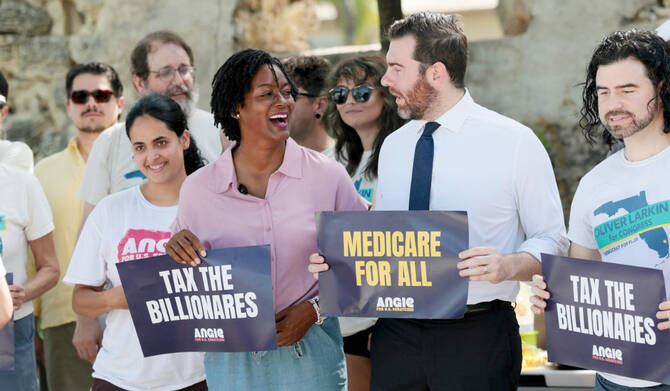
On the Democratic side, the picture was markedly different. Here, while the word “liberal” was almost an insult in the lexicon of President Ronald Reagan and his conservative Republican movement, the Democratic left no longer shies away from using the word “socialism” in its election campaigns. In fact, the de facto leader of this left, Sen. Bernie Sanders, considers himself a socialist before being a Democrat, while the Democrats in Congress include members who describe themselves as “democratic socialists.”
In key northern states such as Michigan, Wisconsin and Minnesota, the internal contests for Democratic nominations were particularly intense. Commentators and analysts followed them closely, seeking to assess the extent to which a more radical, reformist current is gaining ground within the party in opposition to its centrist leaders, who remain confident in the support of traditional lobbies.
In Michigan, socialist Senate candidate Abdul El-Sayed won despite opposition from Gov. Gretchen Whitmer and the Democratic establishment, both of which had backed his opponent. In Minnesota, lieutenant governor and socialist Senate candidate Peggy Flanagan, who is Native American, also won by a wide margin.
The opposite happened in Wisconsin, where socialist candidate Francesca Hong, who is of Asian descent, narrowly lost to her African American opponent. What was particularly striking, however, was that some of the Democratic Party’s most prominent left-wing leaders — including Sanders — declined to endorse her in this race.
Based on this, the picture is still far from complete. I expect plenty to happen between now and November and I would rule nothing out — particularly given the algorithms controlled by the oligarchs, lobby money and a media landscape rife with incitement, polarization and disinformation.
BY: Writer Eyad Abu Shakra is managing editor of Asharq Al-Awsat, where this article was originally published.
Disclaimer: Views expressed by writers in this section are their own and do not necessarily reflect The Times Union‘ point of view