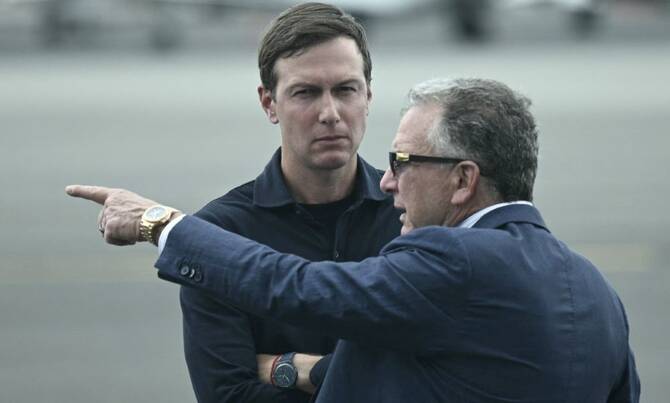
It took Jared Kushner just one day to move from a rare meeting with the Hamas leadership to nearly four hours of talks with Benjamin Netanyahu. Between Cairo and Jerusalem, diplomats, regional mediators and American and Israeli officials waited to see what could be achieved by a man with no Cabinet post or conventional role in the US administration.
To say Kushner has no official standing requires qualification. He has a presidential mandate as a peace envoy and sits on the Board of Peace’s founding board and the Gaza executive board. Yet his authority comes from a position no appointment could create: he is Donald Trump’s son-in-law and is among the few people the president trusts to speak for him. He has a mandate but operates outside the normal bureaucratic chain of command.
This ambiguity is the first source of his influence. Those who meet him care less about the limits of his authority than whether he can reach Trump, secure a decision or persuade him to apply pressure. In a relationship-driven administration, proximity to the president can matter more than office and trust can outweigh formal hierarchy.
Kushner’s latest talks therefore ended without a breakthrough on the central question: who moves first?
Dr. Abdellatif El-Menawy
The second is Kushner’s first-term network. A principal architect of the Abraham Accords, he established direct relationships with Netanyahu, Gulf leaders, Arab officials and discreet intermediaries. He approaches the region less like a diplomat beginning with treaties than a businessman seeking overlapping interests and a deal each side can present as a victory.
That method advanced normalization but exposed a fundamental weakness. It attempted to postpone the Palestinian question while building Arab-Israeli ties around shared economic and security interests. Gaza demonstrated that the issue pushed aside did not disappear. A stable regional order without a viable Palestinian settlement amounts to only temporary management of a continuing crisis.
Kushner now returns to the hardest part of the equation. In late July, Hamas accepted a road map providing for weapons to be catalogued and gradually stored, the disclosure of production sites, stockpiles and tunnels, and the transfer of Gaza’s administration to a technocratic Palestinian committee without Hamas representation.
Yet this was not unconditional surrender. Hamas tied its commitments to an end to Israeli attacks, the deployment of the committee and an International Stabilization Force, and a phased Israeli withdrawal. Netanyahu insists Hamas must be fully disarmed before Israel withdraws or reconstruction begins. Kushner’s latest talks therefore ended without a breakthrough on the central question: who moves first?
American supervision of the weapons handover, with disarmament and verification groups, is meant to turn promises into measurable action. But the dispute runs deeper. Does disarmament mean destruction or monitored storage? Does it include personal firearms? Who ensures the tunnels are not rebuilt? And who guarantees Israel will withdraw once Hamas has surrendered its final leverage?
Hamas’ change of course reflects not a sudden conversion but a new reading of the balance of power. Militarily depleted, it faced sustained pressure from Egypt, Qatar and Turkiye and it failed to secure the Iranian umbrella it hoped would place Gaza within a broader regional settlement. It also wants to preserve its political presence, possibly through the Palestinian elections scheduled for November.
Here, Mohammed Dahlan’s reemergence matters. His rapprochement with Hamas is not historic reconciliation but a convergence of interests. Hamas needs a route to Washington and Arab capitals and an exit preserving its political future. Dahlan sees an opportunity to return and challenge the Palestinian Authority’s leadership. He reportedly mediated between Kushner and Hamas and proposed Gaza technocrats while his movement prepared for elections.
This informal network gives Kushner unusual flexibility but carries risks. If the Gaza arrangements exclude the Palestinian Authority without creating a broader national framework, he may establish an interim administration while deepening the Palestinian divide. Israel could then argue that it still lacks a unified Palestinian partner.
Kushner’s motives appear to combine loyalty to Trump, a desire to complete a project begun during his first term and an ambition to become the architect of a new regional order. He believes economics and investment can alter political behavior. In 2019, he presented the “Peace to Prosperity” plan; today, he again speaks of free markets and turning Gaza from an aid-dependent economy into an investment destination. But jobs, towers and ports cannot answer questions of land, sovereignty, security, justice and political representation.
There is nevertheless room for hope. Kushner possesses what many previous envoys lacked: direct access to Trump, working relationships with Israel and the mediating states, and experience of closing deals once considered impossible. Hamas’ conditional acceptance of relinquishing power and placing its weapons under control also represents a significant shift.
Jobs, towers and ports cannot answer questions of land, sovereignty, security, justice and political representation.
Dr. Abdellatif El-Menawy
Yet success will not be measured solely by whether Kushner can disarm Hamas. The real test is whether he can persuade, or compel, Netanyahu to accept a synchronized withdrawal, halt targeted killings, permit a legitimate Palestinian administration to emerge, and open a political horizon beyond reconstructing Gaza’s buildings. The impasse shows how distant that outcome remains, especially as Netanyahu heads into an October election and resists concessions that could be used against him at home.
Kushner may succeed where traditional diplomats failed because he is not a traditional diplomat. But unconventional status alone cannot make peace. That depends on whether the US will use its leverage over the stronger party and turn promises into reciprocal obligations backed by enforceable guarantees. Without that, Kushner’s achievement will remain a road map, an agreement to a disarmament process yet to begin and a blueprint for rebuilding Gaza before anyone has agreed who is entitled to shape its future.
BY: Writer Dr. Abdellatif El-Menawy has covered conflicts worldwide. He is the author of “The Copts: An Investigation into the Rift between Muslims and Copts in Egypt.
Disclaimer: Views expressed by writers in this section are their own and do not necessarily reflect The Times Union’ point of view