For much of modern history, one of the greatest advantages governments possessed over insurgencies was control of the sky. Rebel movements could acquire rifles, explosives and artillery. With sufficient foreign support, some obtained sophisticated missiles and armored vehicles. But building an air force required resources almost exclusively available to states. Combat aircraft cost millions of dollars, while pilots, airfields, maintenance, fuel and logistics created an even greater barrier. That distinction is beginning to disappear.
From Ukraine to Myanmar, inexpensive drones and improvised aircraft are dramatically reducing the cost of projecting military power from the air. The result is not simply another technological development in warfare. It represents a structural shift in the balance between states and the armed groups fighting them.
Myanmar provides an important glimpse of where this revolution may lead. UN investigators recently reported an intensification of aerial attacks by Myanmar’s military, including the use of relatively inexpensive technologies such as motorized paragliders alongside conventional aircraft and drones. Resistance organizations have themselves become increasingly sophisticated users of commercially available drones.
Myanmar’s conflict is therefore particularly significant because it demonstrates that the transformation of air warfare is no longer confined to technologically advanced militaries.
The country is poor, its infrastructure has deteriorated after years of conflict and many resistance organizations operate with extremely limited resources. Yet the battlefield is becoming increasingly vertical. That should concern governments far beyond Southeast Asia.
Inexpensive drones and improvised aircraft are dramatically reducing the cost of projecting military power from the air.
Dr. Azeem Ibrahim
The fundamental change is economic rather than technological. Modern combat aircraft can cost tens of millions of dollars even before weapons, maintenance and training are considered. Even relatively inexpensive precision-guided munitions can cost sums beyond the reach of most armed movements.
Commercial drones fundamentally alter that calculation. A relatively inexpensive unmanned aircraft equipped with a camera and modified to carry explosives can conduct surveillance or attack targets at a fraction of the traditional cost. First-person view drones can potentially destroy equipment worth hundreds or thousands of times more than the weapon used against it.
Ukraine has demonstrated the consequences at enormous scale. Drones costing relatively modest sums have been used against tanks, artillery systems, air defenses and infrastructure worth millions. But Myanmar may ultimately tell us more about the future of many conflicts.
Ukraine receives billions of dollars in military assistance and possesses a substantial industrial and technological base. Most of the actors involved in the world’s civil wars do not.
Myanmar demonstrates what happens when similar technologies diffuse downward into conflicts involving poorer governments, militias and insurgencies. The result is the democratization of air power.
This does not mean that a commercial drone suddenly provides an insurgent organization with capabilities comparable to a modern air force. Fighter aircraft can travel farther, carry vastly larger payloads and operate with levels of sophistication that cheap drones cannot replicate.
But insurgents do not need parity. They just need sufficient capability to impose costs. That distinction could fundamentally alter the dynamics of civil war.
Historically, technological superiority allowed governments to attack insurgents from positions of relative safety. Aircraft could strike bases, supply routes and concentrations of fighters, while rebel forces possessed few means of responding. Cheap drones erode that asymmetry.
An armed organization can now observe troop movements from above, attack military positions, disrupt logistics and threaten expensive equipment without possessing anything resembling a conventional air force. More importantly, these capabilities are extraordinarily difficult to monopolize.
Commercial supply chains provide cameras, batteries, motors and electronic components. Software and technical knowledge circulate internationally. Civilian technologies can be modified in workshops rather than specialized weapons factories. Innovation therefore occurs from the bottom up. That has profound implications for conflicts in the Middle East, Africa and Asia.
Armed groups in Sudan, Yemen, Somalia, the Sahel or eastern Congo do not need to replicate the sophisticated drone programs developed by major powers. They need only adapt inexpensive technologies sufficiently to local conditions.
The barrier to entry will continue falling. One consequence may be longer wars. Civil wars frequently end when one side establishes overwhelming military superiority or when both sides conclude that victory has become impossible. Cheap technology complicates the first pathway.
The falling cost does not necessarily make warfare more precise or humane. It can simply make attacks more frequent.
Dr. Azeem Ibrahim
If weaker forces can continually acquire inexpensive systems capable of destroying expensive government assets or disrupting offensives, states may find it increasingly difficult to translate superior resources into decisive victories. A government can destroy dozens of drones. Its opponent may simply build or purchase dozens more.
War therefore becomes a contest not only of military sophistication but of manufacturing, adaptation and cost. The decisive question may increasingly be less about who possesses the best weapon and more about who can replace weapons faster and more cheaply.
This creates what economists would recognize as a radically different cost-exchange ratio. Destroying a $1,000 drone with a missile costing hundreds of thousands of dollars may be tactically successful but economically unsustainable. Likewise, losing a multimillion-dollar vehicle to an inexpensive drone imposes costs far beyond the immediate battlefield damage. Quantity begins competing with quality.
There is also a darker consequence for civilians. The falling cost of aerial warfare does not necessarily make warfare more precise or humane. It can simply make aerial attacks more frequent.
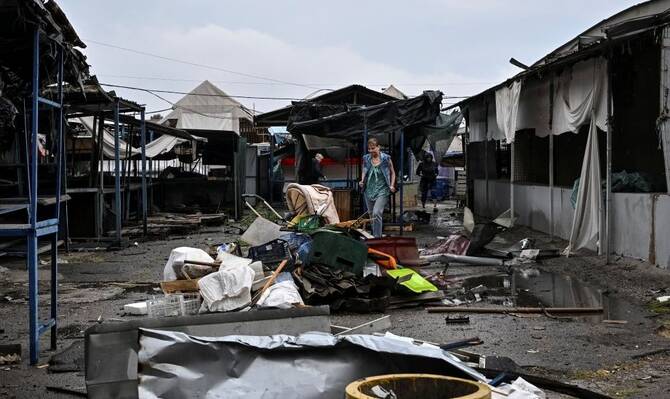
When aircraft and munitions are scarce and expensive, commanders must prioritize targets. When strike capabilities become cheap and abundant, the economic threshold for using them falls. Villages, markets, schools and medical facilities far from traditional front lines can become increasingly vulnerable to surveillance and attack.
Myanmar is already demonstrating the dangers of increasingly accessible aerial warfare in a conflict where civilians have repeatedly borne the consequences. The international response has not caught up.
Much of the debate about autonomous weapons and military artificial intelligence remains focused on sophisticated systems developed by major powers. Yet the more immediate transformation may come from technologies that are already commercially available.
Governments will consequently need to rethink air defense. Protecting military bases alone will not be enough. Critical infrastructure, civilian facilities and urban areas may require defenses against threats costing a tiny fraction of the systems designed to stop them.
International arms control faces an even greater problem. Fighter aircraft and ballistic missiles can be tracked, regulated and subjected to export controls. Many drone components are also ordinary civilian products. Controlling their proliferation will therefore be extraordinarily difficult.
The history of warfare is often told through increasingly sophisticated weapons: the tank, the jet aircraft, the precision missile and now AI. The next transformation may follow the opposite trajectory.
The technologies reshaping warfare are becoming cheaper, easier to manufacture and available to a much wider range of actors. Ukraine demonstrated what inexpensive drones can accomplish in a major interstate war. Myanmar is showing what happens when the same revolution reaches a fragmented civil conflict. That may ultimately prove more consequential.
The future of warfare is not simply becoming more technologically advanced. It is becoming affordable.
BY: Writer Dr. Azeem Ibrahim is the director of special initiatives at the New Lines Institute for Strategy and Policy in Washington.
Disclaimer: Views expressed by writers in this section are their own and do not necessarily reflect The Times Union‘ point of view