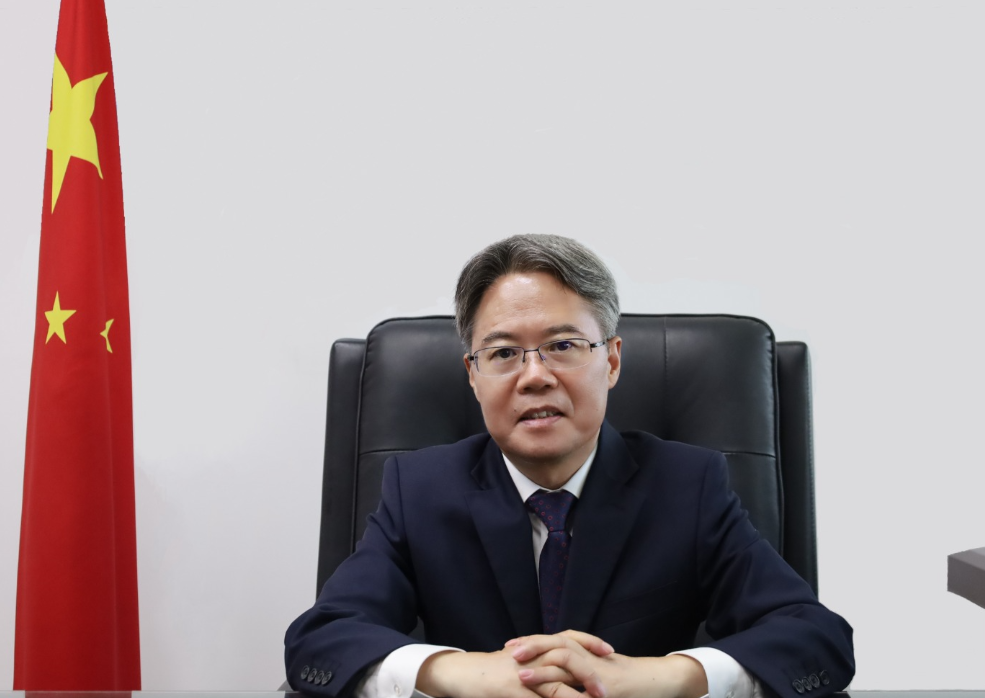
- Beijing Says Global Governance Initiative Offers Roadmap for Stronger Multilateralism and Greater Voice for Global South
ISLAMABAD: China has called for a more inclusive, equitable and representative international order, saying its Global Governance Initiative (GGI) provides a practical framework for strengthening multilateralism, upholding international law and giving developing countries a greater voice in global decision-making.
The initiative was proposed by Chinese President Xi Jinping at the Tianjin Summit of the Shanghai Cooperation Organization (SCO), at a time when the international community was marking the 80th anniversary of the victory in the World Anti-Fascist War and the founding of the United Nations.
According to Beijing, the GGI seeks to respond to growing global challenges by reinforcing the principles of sovereign equality, international rule of law, multilateral cooperation, people-centered development and action-oriented governance.
Five Principles at the Heart of the Initiative
China says the GGI is built around five interconnected principles.
Sovereign equality calls for all countries, regardless of their size, economic strength or level of development, to participate equally in global governance and benefit from its outcomes.
International rule of law emphasizes the equal and consistent application of international law, while rejecting double standards and the imposition of unilateral rules on other states.
Multilateralism remains the initiative’s principal pathway, with China advocating extensive consultation, joint contribution and shared benefits while emphasizing the central role of the United Nations in international affairs.
The initiative also places a people-centered approach at the core of global governance, calling for development outcomes to be distributed more fairly and for greater efforts to narrow the North-South development divide.
The fifth principle is an action-oriented approach, under which global institutions are expected to translate broad commitments into practical cooperation and tangible results.
China says the initiative has attracted growing international interest since its launch, with nearly 160 countries and international organizations expressing support or responding to the proposal.
The Group of Friends of Global Governance has subsequently been established in New York, Geneva and Vienna, with more than 60 countries participating in discussions on issues related to global governance.
Beijing has also issued a Concept Paper on the GGI and published a white paper outlining its principles, proposals and actions.
China has linked the initiative to developments in emerging areas of global cooperation, including artificial intelligence, climate change, international mediation and data governance.
The establishment of the International Organization for Mediation in Hong Kong, as well as new international cooperation mechanisms in data and artificial intelligence, has been presented by Beijing as part of its broader effort to strengthen multilateral approaches to emerging global challenges. China argues that the expanding role of platforms such as the SCO and BRICS reflects a broader shift in international relations, with developing countries seeking greater representation and influence in global decision-making.
Beijing maintains that a more balanced international system requires developing nations to have a stronger voice in determining global economic, security, technological and environmental rules.
The GGI, China says, is intended to contribute to that process by promoting what it describes as a more just and equitable system of global governance. Pakistan has emerged as a prominent supporter of the initiative.
Following President Xi’s proposal of the GGI, Prime Minister Shehbaz Sharif expressed strong support, describing the initiative as significant for global peace, development and stability.
Islamabad has viewed the GGI as consistent with its longstanding emphasis on multilateralism and the need for greater consideration of the interests and concerns of developing countries.
China and Pakistan have also sought to translate their shared diplomatic positions into practical initiatives, particularly in efforts aimed at promoting peace and stability in the Middle East.
Beijing has highlighted Pakistan’s diplomatic and mediation efforts, while the two countries have jointly advanced proposals concerning peace and stability in the Gulf and wider Middle East region.
Pakistan and China to Deepen Cooperation Through SCO
China has also welcomed Pakistan’s role as the current rotating president of the Shanghai Cooperation Organization, pledging support for Islamabad during its tenure.
Beijing has expressed its readiness to work closely with Pakistan and other SCO members to strengthen cooperation based on dialogue, partnership and mutual benefit.
China says the SCO can serve as an important platform for implementing the principles of the GGI by promoting equal participation among member states and encouraging cooperation rather than confrontation.
The two countries are also expected to use Pakistan’s SCO presidency to advance cooperation on regional connectivity, economic development, security and people-to-people exchanges. Alongside diplomatic cooperation, China has placed economic development at the center of its future partnership with Pakistan.
Beijing has expressed its readiness to accelerate CPEC 2.0, with greater emphasis on industrial development, agriculture, mining and information technology. The next phase is expected to focus on five broad areas: growth, livelihoods, innovation, green development and openness.
China has also emphasized the importance of combining major infrastructure and investment projects with smaller, community-focused initiatives designed to produce direct benefits for ordinary citizens.
Among the initiatives highlighted is a proposed programme in Balochistan involving the construction of water facilities, upgrading of classrooms and distribution of school supplies. China says its cooperation with Pakistan is increasingly linked to a broader vision of South-South cooperation and a more representative international system.
The two countries are positioning their longstanding relationship not only as a bilateral partnership but also as a platform for cooperation on issues affecting the wider developing world.
For Beijing, strengthening China-Pakistan cooperation is therefore closely connected with its vision of a community with a shared future for humanity, based on dialogue, development, sovereign equality and mutual benefit.
China-Pakistan Partnership Seen as Anchor of Stability
As geopolitical tensions, economic uncertainty and emerging technological challenges reshape the international landscape, China says closer cooperation with Pakistan can contribute to greater stability and development.
Beijing has pledged to work with its “ironclad friend” to promote the principles of the GGI, strengthen the voice of the Global South and support reforms aimed at making global governance more inclusive and equitable.
The message from Beijing is clear: China sees the future of global governance as requiring stronger multilateral institutions, broader participation and practical cooperation — while viewing the China-Pakistan partnership as an important example of that approach in action.
BY: The Times Union