- After first day of calm in some 2 weeks, Jerusalem sources tell Hebrew media that diplomacy is sure to fail, leaving US president no choice but to order major attack
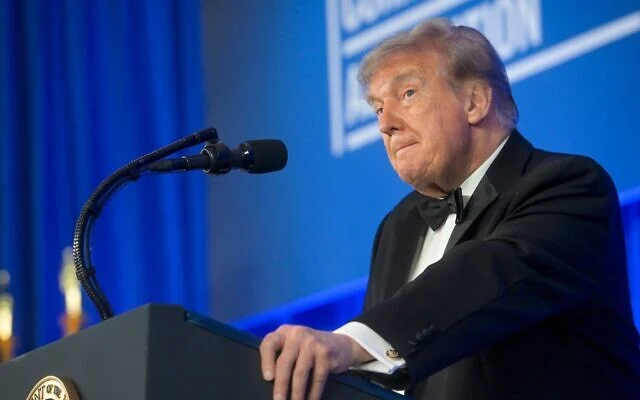
After the United States refrained from striking Iran overnight Friday-Saturday for the first day in two weeks, Hebrew media reported Saturday that Jerusalem had been prepared for a major escalation in the war over the weekend, which never came. Despite the pause, Israeli leaders still estimate that US President Donald Trump would soon be compelled to step up military action, the reports said.
After the quiet night in Iran, there were also no reports on Saturday of attacks by Iran on its Gulf neighbors, which have been taking place daily as well.
Trump personally ordered the US military not to strike Iran on Friday and Saturday, Axios reported, citing two sources with knowledge of the directive.
Kan reported that the Israeli military had prepared for a significant escalation in the conflict. Channel 12’s diplomatic corespondent Yaron Avraham reported the same, while Barak Ravid, who reports for both Channel 12 and US outlet Axios, said that according to his information, the strikes the US military had planned for Friday night, before Trump nixed them, had been no different in scale than those it had carried out over the previous 13 nights.
Multiple outlets, including Axios and Kan, cited sources as saying that the US was still intending a major expansion of the fighting, but that Trump was now favoring allowing more time for negotiations.
Kan reported that the US military has continued to send significant forces to Israel, including dozens of warplanes, refueling planes, air defenses and munitions. It said some 90 refuelers had arrived over the past few weeks and were stationed at Ben Gurion Airport and the Ramon and Ovda airbases — a similar deployment to the one that took place just before the US-Israeli war against Iran was launched in late February.
A senior Israeli official told Channel 12 that “the chances of reaching an agreement between the United States and Iran are virtually nonexistent,” calling an eventual escalation in the conflict “inevitable.”
Sources cited by Channel 13 and Ynet similarly predicted that diplomacy would fail and that Trump, who prefers negotiations, would eventually have “no choice” but to order a major attack.
Trump has threatened in recent days to widen the range of targets to include Iran’s energy plants and bridges, send ground forces to seize its central oil hub on Kharg Island, and bomb a deep-underground nuclear site known as Pickaxe Mountain.
On Friday, however, Trump said he had not yet made a decision on new major strikes.
“We are talking to them,” he told reporters at the White House. “I think they’re being serious. I think… they are being by far the most serious that we’ve seen them, but that doesn’t mean we get there.”
Concerns over depleted interceptor stockpiles were the focus of discussions between Trump and his top advisers before the administration decided to hold off on escalating its campaign, according to The New York Times.
Joint Chiefs of Staff chairman Gen. Dan Caine privately said that while the military was capable of launching major combat operations against Iran, interceptors available to CENTCOM would be exhausted, anonymous officials told the Times.
Another senior US official told the outlet that there were doubts in the administration that an intensified campaign would pressure Iran into talks; rather, recent strikes have kept Iran united and focused on a foreign threat.
Prime Minister Benjamin Netanyahu will meet Trump on Tuesday at the White House, the offices of both leaders have said.
Channel 12 reported Saturday that Netanyahu and his team plan to present Trump with fresh intelligence on Iran’s efforts to rebuild its military and nuclear program during their meeting, including what Israeli officials believe are accelerated efforts under new Supreme Leader Mojtaba Khamenei to advance toward a nuclear weapon.
The report, citing Israeli sources, did not elaborate on the alleged moves or the intelligence Israel intends to present, though recent reports have detailed some. Previous private presentations by Netanyahu to Trump on Iran’s nuclear activities and alleged violations of its commitments reportedly played a significant role in the US decision to strike Iran.
Meanwhile, Yemen’s Iran-aligned Houthi rebels fired on Saudi oil installations in two ports on the Red Sea coast on Saturday, in a sign that the war that has disrupted energy supplies from the Gulf could be spreading to a second major shipping route, and reigniting Yemen’s own civil war.
Houthi military spokesperson Yahya Saree said the group had successfully struck sites belonging to Saudi state oil giant Aramco in Jizan and Yanbu. Video shared on social media and verified by Reuters showed a large column of smoke rising from the direction of the Aramco refinery in Jizan.
Two Asia-based trading sources said that they had been informed of potential damage to fuel and oil storage sites at Jizan. Aramco did not respond to requests for comment.
In Yanbu, two ballistic missiles aimed at oil installations were intercepted by a US-made Patriot battery operated in Saudi Arabia by the Greek military under an agreement with Riyadh, Greek security sources said.
Yanbu is Saudi Arabia’s main Red Sea oil port, where millions of barrels a day are loaded, and has become the main route out for Saudi oil skirting the Strait of Hormuz, which has been essentially closed off by Iran. Jizan, on the Red Sea close to the Yemeni border, is the site of a refinery with a capacity of 400,000 barrels per day.
In Yemen, the air force of the Saudi-backed, internationally recognized government, which has opposed the Houthis for more than a decade, struck Houthi missile and drone launch sites and arms depots in the Marib and al-Jawf provinces, Yemeni officials said.
The Saudi-led military alliance said it had bombed Houthi military positions on Friday in the Red Sea port of Hodeida.
The Yemeni officials said both sides in Yemen’s civil war were mobilizing forces along the front.
Saudi Arabia led an Arab coalition against the Houthis after the Iran-aligned fighters captured Yemen’s capital, Sanaa, in 2014, though the alliance and the conflict had been largely dormant in recent years.
The Yemeni civil war, during which hundreds of thousands of people died from fighting and famine, has been paused under a ceasefire since 2022. But that truce broke down this month, with the Houthis effectively joining the wider war their Iranian allies have waged since being attacked by the US and Israel.
The Houthis have declared a naval blockade of Saudi Arabia over the past week, and Houthi leader Abdul Malik al-Houthi said all Saudi oil facilities could be targets.
The move has contributed in recent days to one of the war’s sharpest rises in global oil prices, with Brent crude spiking above $100 a barrel for the first time since May.
BY: Nava Freiberg – and Agencies