- French President Hosts US Leader at Palace of Versailles Amid G7 Tensions and Global Disputes
PARIS: US President Donald Trump summed up his admiration for the Palace of Versailles in a single phrase: “Versailles is not gold leaf — Versailles is the real deal.”
For French President Emmanuel Macron, that symbolism was exactly the message he wanted to deliver.
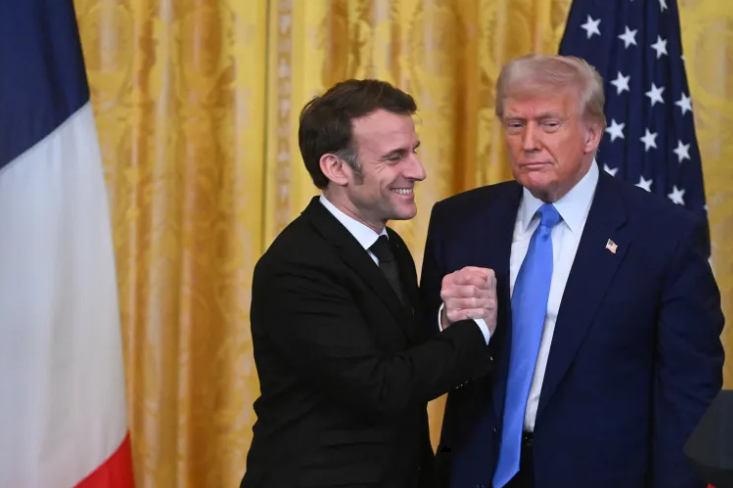
On Wednesday evening, Macron opened the doors of the historic palace to Trump for a private reception, cultural presentation and dinner celebrating the 250th anniversary of American independence. The carefully planned event came at a sensitive moment for trans-Atlantic relations, as the two leaders continue to navigate disagreements over Iran, Ukraine and trade tariffs.
The grand welcome also served a strategic purpose: persuading Trump to remain at the Group of Seven summit until its conclusion, unlike his early departure from the previous year’s meeting in Canada.
Trump told reporters he had originally intended to leave earlier but accepted the invitation after what he described as a gesture from a “very nice man.” Upon arriving at Versailles, he posed for photographs in front of the palace’s iconic golden gates.
Versailles as France’s Ultimate Diplomatic Instrument
The invitation was part of Macron’s broader effort to maintain personal communication with Trump while protecting French diplomatic interests.
Earlier in the week, Macron said in an interview that Trump “needs to stay until the end” of the summit to help finalize agreements among world leaders.
Versailles represents one of France’s most powerful tools of influence — a palace associated with royal authority, historical grandeur and centuries of diplomacy.
“Versailles is a diplomatic tool and an instrument of influence,” Macron said, comparing international diplomacy to football.
“Whether I’m playing at home or away, my goal is to score goals. And when I host other teams, I try to give them a good welcome.”
With limited ability to influence Washington through economic or military power, France often relies on cultural prestige and diplomatic symbolism to strengthen its position on the world stage.
A Relationship Built on Ceremony and Personal Diplomacy
Macron and Trump have frequently disagreed on major international issues, but their relationship has survived partly due to Macron’s emphasis on personal engagement and carefully designed diplomatic gestures.
Their first meeting in 2017 produced a tense handshake that quickly became a symbol of their competitive but strategic relationship.
Later that year, Macron hosted Trump for dinner at the Eiffel Tower and gave him a prominent place at France’s Bastille Day military parade.
The Versailles reception raised the level of symbolism even further, allowing Macron to frame modern political discussions against the backdrop of French history.
“It is a soft-power display based on hard buildings,” said Denis Lacorne, a professor of American studies at Sciences Po.
Macron has previously used Versailles for major diplomatic events, including hosting Russian President Vladimir Putin in 2017 and welcoming Britain’s King Charles III and Queen Camilla for a state dinner.
The palace has long served as a stage for French diplomacy, remaining “a place in the service of French diplomacy,” according to Versailles officials.
Trump’s Attraction to Grandeur and Architecture
The choice of Versailles carried special significance for Trump, who has long viewed architecture as a symbol of strength, success and legacy.
During his second term, Trump has promoted several major construction projects intended to shape his historical image, including plans for a new White House ballroom and a large ceremonial arch inspired by Paris’s Arc de Triomphe.
Versailles also holds personal resonance for Trump, who has previously said the ballroom at his Mar-a-Lago estate was influenced by the French palace.
The Hall of Mirrors: A Palace Designed for Power
The evening reportedly included a visit to the famous Hall of Mirrors and possible fountain displays, though the full schedule was not publicly released.
The Hall of Mirrors was once considered a technological achievement, featuring 357 mirrors arranged across 17 arches along a 73-meter gallery. The design demonstrated French craftsmanship and rivaled the celebrated glassmaking traditions of Venice.
The hall was also created to amplify royal authority, reflecting the king’s image repeatedly throughout the space.
“Visitors see themselves reflected many times, from one mirror to another,” Lacorne explained.
For Trump, whose political image has often embraced luxury and spectacle, the setting carried obvious appeal.
A Tradition of Hosting Trump With Grand Displays
Trump has repeatedly responded positively to elaborate diplomatic ceremonies.
During his 2017 visit to France, the Bastille Day parade featured military vehicles, horses, marching bands and fighter jets flying overhead in the colors of the French flag.
Trump later described it as “one of the greatest parades” he had ever witnessed and said the United States would need to organize something similar.
China also used a historic setting to impress Trump during his 2017 state visit, arranging a rare tour of the Forbidden City.
Britain followed a similar approach during Trump’s second state visit in 2025, featuring ceremonial troops, a carriage procession and a state banquet at Windsor Castle.
Symbolism May Not Guarantee Political Results
While diplomatic ceremonies have clearly appealed to Trump, they have not always produced major policy breakthroughs.
The once-close Macron-Trump relationship has become increasingly transactional, with disputes emerging over trade, Iran and support for Ukraine.
Trump has threatened heavy tariffs on French wine and Champagne as part of broader trade tensions. France has also opposed US military action against Iran while urging continued support for Ukraine.
The Versailles dinner has also faced criticism inside France, with opposition figures questioning the value of hosting Trump.
Despite the criticism, analysts say Versailles gives Macron several advantages: a historic diplomatic setting, a venue aligned with Trump’s preference for spectacle, and a place already familiar to millions of visitors from around the world.
History, however, offers a reminder of the limits of ceremony. Former US President Ronald Reagan also dined under the same mirrors during the 1982 G7 summit, yet major disagreements between allies continued long after the grandeur faded.
BY: The Times Union