- Move Comes as Lawmakers Seek Answers Over Conditions Aboard USS Abraham Lincoln
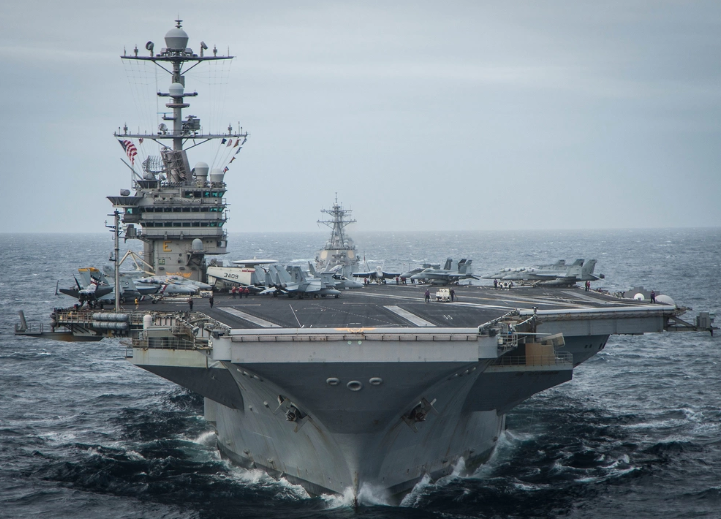
WASHINGTON: The U.S. Navy has begun moving the aircraft carrier USS George Washington toward the Middle East, amid growing concerns over prolonged deployments, supply shortages and reported mental-health challenges aboard the long-deployed USS Abraham Lincoln.
The Lincoln has been supporting U.S. military operations against Iran and has spent more than 260 consecutive days at sea, setting a record for uninterrupted deployment. The extended mission has prompted Democratic lawmakers to call for greater Pentagon accountability over conditions faced by sailors aboard the carrier.
U.S. Defense Secretary Pete Hegseth, however, has rejected reports portraying conditions aboard the Lincoln as severe, describing some accounts as “completely misrepresented.”
George Washington Moves From Asia-Pacific Toward Indian Ocean
The USS George Washington departed Da Nang, Vietnam, last week, according to the U.S. Navy. The carrier has since been observed, alongside a cruiser and destroyer, transiting the Singapore Strait.
A U.S. Navy official, speaking on condition of anonymity because of the sensitivity of the vessel’s movements, confirmed that the Washington had entered the Strait of Malacca, placing it on a course toward the Indian Ocean and potentially the Middle East.
The Wall Street Journal previously reported that the George Washington was expected to replace the Abraham Lincoln as one of two U.S. aircraft carriers deployed to the region.
The deployment could temporarily leave the Pacific without a U.S. aircraft carrier, although the duration of that absence remains unclear.
Prolonged Middle East Operations Raise Operational Concerns
The Lincoln departed San Diego on November 21 and reached the Middle East in January, ahead of the launch of the U.S. war against Iran on February 28.
The Navy has acknowledged that the conflict created a “highly contested environment” in which traditional supply hubs in the Middle East were disrupted by combat operations. The disruptions contributed to shortages of certain supplies and delays in mail delivery aboard the carrier.
According to the Navy, commanders prioritized mission-critical supplies in the following order: food, hygiene items and mail. The service has since said sailors have access to clean drinking water and adequate meal options.
The prolonged deployments have also renewed broader concerns about the physical and psychological strain placed on service members, as well as the impact of sustained combat operations on ships and equipment.
Although the intensity of U.S.-Iran hostilities has eased in recent weeks, the U.S. Navy has reimposed a blockade on Iranian ports in the strategically vital Strait of Hormuz. The Trump administration has yet to provide a clear timetable for ending the conflict.
Hegseth has said the United States could maintain the blockade “indefinitely.”
Democratic Lawmakers Demand Greater Oversight
Several Democratic lawmakers have called for investigations and detailed information about conditions aboard the Lincoln, which had originally been scheduled to return home in May.
Connecticut Senator Richard Blumenthal, a member of the Senate Armed Services Committee, has asked Navy leadership to respond to questions concerning the carrier’s extended deployment and the welfare of its crew.
“The Lincoln’s prolonged deployment is especially significant,” Blumenthal said, citing the continuing military operations against Iran and the possibility that substantial U.S. naval forces could be required in the region for an extended period.
Arizona Senator Ruben Gallego, a Marine Corps veteran, has also said he is seeking to organize a bipartisan congressional delegation to conduct an official oversight visit aboard the carrier. He described concerns over the treatment of sailors as both unacceptable and potentially dangerous.
Hegseth Defends Sailors and Navy Leadership
During a visit to Panama, Hegseth said he wanted Lincoln personnel to return home and crews to be rotated as quickly as possible, while defending the Navy’s efforts to support the carrier.
He praised sailors for operating for extended periods in difficult conditions with fewer opportunities for port visits, saying their performance had been “incredible.”
Navy leaders, including Acting Secretary Hung Cao, also held a town hall meeting with families of personnel aboard the Lincoln. Senior Navy commanders reportedly assured families that efforts were underway to provide additional support and relief to the carrier.
The Navy had previously rejected reports of food shortages aboard the ship when concerns first surfaced in April, describing those reports as false.
Mental-Health Concerns Come Under Scrutiny
More recent reports have focused on the mental health and overall welfare of sailors aboard the Lincoln.
The Navy said it had not observed an increase in suicidal thoughts or suicide attempts aboard the carrier. Officials nevertheless declined to release specific data, citing operational security and patient privacy considerations.
A Navy official also confirmed that a sailor went overboard in early August but was quickly recovered, treated by the ship’s medical personnel and subsequently transferred off the vessel for further care. The official did not disclose whether the incident was being investigated as a possible suicide attempt.
U.S. Central Command has defended the resilience of personnel serving with the Abraham Lincoln Carrier Strike Group.
The command said the sailors and Marines remained committed after more than 260 days at sea, approximately 10,000 aircraft sorties and the expenditure of about 1.5 million pounds of ordnance.
Long Deployments Have Affected Other U.S. Carriers
The Lincoln is not the only U.S. aircraft carrier to face concerns linked to exceptionally long deployments.
The USS Gerald R. Ford returned to the United States in mid-May following an 11-month deployment—the longest U.S. carrier deployment since the Vietnam War. During its mission, the carrier supported U.S. operations against Iran and participated in operations related to the capture of Venezuelan leader Nicolás Maduro.
The Ford also experienced a fire in a laundry area that forced the vessel to turn around and return to the Mediterranean for repairs. The incident left hundreds of sailors temporarily without sleeping accommodations.
Questions Over Readiness and Crew Welfare
Concerns about the demands of sustained combat operations and the risks associated with prolonged deployments predate the Iran conflict. The U.S. Navy experienced several incidents involving ships operating against Houthi forces in Yemen during 2024 and 2025, including an extended deployment by the USS Harry S. Truman.
The movement of the George Washington toward the Middle East therefore comes at a time when the U.S. Navy is balancing operational requirements with mounting questions about crew welfare, equipment readiness and the sustainability of prolonged carrier deployments.
The planned transition also underscores the broader strategic challenge facing Washington as it seeks to maintain a significant naval presence in the Middle East while continuing to deter potential adversaries and preserve its military posture across the Indo-Pacific.
BY: The Times Union