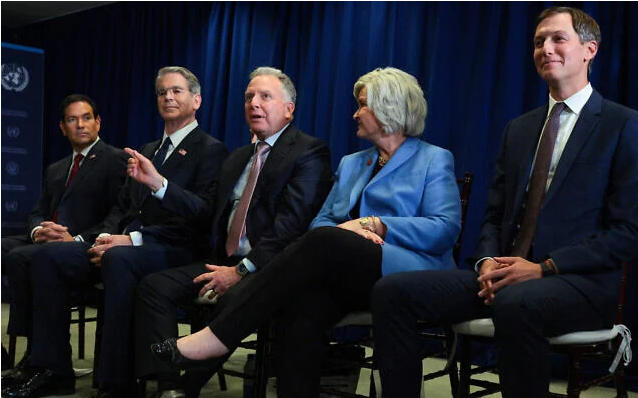
- Witkoff clarifies that mediators ‘shuttled’ between the sides; Trump gripes that members of Iran’s delegation were ‘not the highest level,’ as Rubio says US president open to meeting his Iranian counterpart while he’s in NYC for General Assembly
US President Donald Trump said Tuesday that his envoys Steve Witkoff and Jared Kushner met with members of an Iranian delegation for three hours on the sidelines of the UN General Assembly and that another meeting was set for the “very near future,” hours after threatening to “annihilate” Iran if a deal between the countries is not reached.
“It went very well,” Trump told reporters during a meeting with Ukrainian President Volodymyr Zelensky, later adding that the Iranian officials were “not the highest level, but it’s something.”
“I can’t imagine why they wouldn’t want to [make a deal]. It’s potential greatness, or obliteration,” Trump said of Iran’s options, in another thinly-veiled threat against the Islamic Republic.
Asked how he felt about the talks, Witkoff initially refrained from commenting before telling reporters, “I feel very good right now.”
Pressed how he would feel Wednesday, Witkoff responded, “I think very good.”
Witkoff later indicated however that he and Kushner did not meet directly with the Iranians as Trump suggested.
“Today, on the sidelines of the United Nations General Assembly, we engaged in lengthy talks with the Iranian delegation through the mediators, who shuttled between the two sides throughout the day,” Witkoff wrote on X.
“They successfully completed a round of discussions that we hope will prove constructive and promising. The mediators will continue their work,” he added.
Confirming the negotiations, Iranian state media said Foreign Minister Abbas Araqchi conveyed to Witkoff what Iran’s conditions are for reopening the strategic Strait of Hormuz. Those demands include “the immediate lifting of the (US) naval blockade, the prompt payment of all Iranian assets that have been frozen, and an end to the war on all resistance fronts,” according to the state news agency IRIB.
Earlier Tuesday, Secretary of State Marco Rubio said that Trump was open to meeting with Iran’s president, Masoud Pezeshkian, while he was in New York for the General Assembly. Pezeshkian was slotted to address the UN General Assembly Wednesday morning.
“This is a president that will meet with anybody for the most part, because he believes that engaging with people is important if you’re going to solve problems,” Rubio said on NBC’s “Today” show. “It doesn’t mean you’re going to end up agreeing with them, but it’s important.”
‘Not seeing a lot of activity’ at Pickaxe Mt.
Trump also met on Tuesday with leaders and senior officials from Gulf Cooperation Council nations — Bahrain, Kuwait, Oman, Qatar, Saudi Arabia, and United Arab Emirates — as well as several other Middle Eastern countries to discuss the way ahead with the war in Iran.
In his remarks to reporters, the US president largely repeated his remarks from earlier in the day regarding how well the US is doing against Iran. He again said the US may bomb the Pickaxe mountain nuclear site, while clarifying that “we’re not seeing a lot of activities there.”
Trump reiterated his belief that the US will reach a deal with Iran to end their ongoing conflict by the upcoming midterm elections, if not before. “We will see what happens with that. I think there’s a lot of momentum for them to make a deal. That’s what we are hearing from everybody.”
Along with representatives of the GCC countries, top officials from Jordan, Egypt, Turkey, Iraq, Lebanon and Syria were also in attendance at the roundtable.
He thanked the leaders around the table for their partnership, including in securing a ceasefire and hostage release deal between Israel and Hamas last year, even though progress on the agreement has since largely stalled.
Trump reiterated his administration’s support for the India–Middle East–Europe Economic Corridor. He did not note that the corridor incorporates Israel. Saudi Arabia and Turkey have been advancing an initiative to have the corridor link Syria and Lebanon instead of Israel.
Trump also made no mention of the Abraham Accords, which countries have been increasingly reluctant to join amid what they view as Israel’s expansionist policies in the region.
BY: Jacob Magid