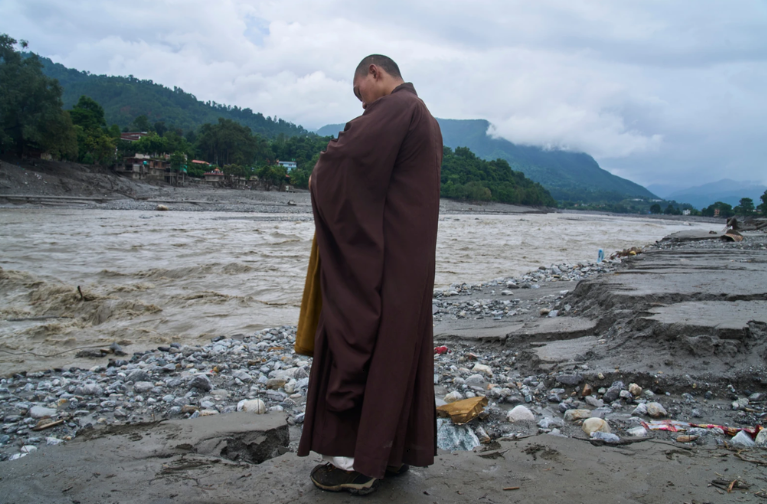
The catastrophe on the Nepal-Tibet border is another terrible warning of the dangers facing communities living beneath the world’s great mountain ranges. It is tempting to view every such event through the prism of climate change or unknown factors. The lack of clarity, however, should not obscure the disaster’s larger lesson.
On Aug. 26, a massive collapse of rock and glacier ice on the Tibetan side of the border sent debris into the river system below, unleashing a devastating flash flood. The scale of the disaster was so great that the collapse generated a seismic signal initially interpreted as an earthquake. By the end of August, more than 900 people had been reported dead and around 5,000 missing.
Undoubtedly, there is overwhelming evidence that the planet is warming, that glaciers are retreating, and that thawing permafrost is potentially making mountain slopes less stable. But the precise cause of the latest disaster has not been established yet. Little is known about conditions on the Tibetan side of the glacier or exactly what led to its collapse. Scientists will need time and access in order to determine what happened.
There will inevitably be arguments about responsibility for global warming. Nepal’s per capita carbon emissions are tiny compared with those of industrially advanced countries that produced the bulk of historical emissions. That disparity is not in question. But dwelling on that supposed injustice will neither move a single village in Nepal out of the path of a flood or avalanche nor protect vulnerable communities elsewhere from disasters that could strike tomorrow.
As many experts have argued, for too long climate policy has focused overwhelmingly on mitigation — reducing emissions to limit future warming — while spending far less on protecting people from, or preparing them for, the dangers that already exist. In 2023, known global climate finance reached about $1.9 trillion, out of which around $1.78 trillion went to mitigation, compared with just $65 billion to adaptation. In other words, roughly $27 went to mitigation for every $1 that went to adaptation.
Spending on adaptation and resilience building is harder to identify, but the imbalance is too glaring to gloss over. Developing countries are estimated to need $310 billion to $365 billion a year for adaptation by 2035, while international public adaptation finance flowing to them amounted to only $26 billion in 2023. What this shows is that the world is spending enormous sums on climate change but not enough of that money is being directed toward saving people who are already in harm’s way.
Consider what happened in Blatten, Switzerland, last year. Authorities monitoring the mountains above the village detected accelerating movement using radar, GPS and cameras, recognized the danger, and evacuated about 300 residents and their livestock on May 19. Nine days later, some 20 million tonnes of rock and ice crashed down the slopes and wiped out most of the village. But only one person died.
Clearly, the authorities could not prevent the mountain from collapsing, but what they succeeded in doing was to prevent the collapse from killing hundreds of people.
There are other encouraging examples of adaptation success. In 1970, Cyclone Bhola killed an estimated 300,000 people in what is now Bangladesh. In the ensuing decades, investment in cyclone shelters, forecasting, warning systems, and evacuation planning have vastly improved Bangladesh’s ability to survive such storms. So, when Cyclone Amphan approached in 2020, some 2.4 million people were moved to safety and about 20 died in Bangladesh.
Building safer houses, warning sirens, and sometimes relocating an entire community are steps that actually work and save lives.
Arnab Neil Sengupta
Before Cyclone Fani struck the Indian state of Odisha in 2019, about 1.2 million people were evacuated and 64 people died. The deaths were a tragedy but still a tiny fraction of the toll that a Bay of Bengal cyclone of comparable power might once have inflicted.
Next, consider adaptation against heat. After a deadly heat wave in 2010, the western Indian city of Ahmedabad introduced South Asia’s first Heat Action Plan, combining forecasts, public warnings, hospital coordination, and changes in working practices. A subsequent credible evaluation estimated that the measures prevented about 1,190 deaths a year.
None of the above examples is intended to argue that mitigation must be deprioritized or abandoned. If global temperatures continue to rise indefinitely, the hazards — particularly in many parts of the Middle East and North Africa — will become more severe and adaptation increasingly difficult, if not impossible.
Even then, the arguments for rebalancing climate priorities are numerous and compelling. For one, the Global Commission on Adaptation calculated that investing $1.8 trillion between 2020 and 2030 in five areas — early-warning systems, resilient infrastructure, dryland agriculture, mangrove protection, and resilient water systems — could generate $7.1 trillion in net benefits. For another, those investments could save lives now, not only in the future.
The Nepal-Tibet event is merely the latest case in point. The 2021 Chamoli disaster in India killed or left missing more than 200 people after millions of cubic meters of rock and glacier ice broke away from a Himalayan peak. In Pakistan in 2022, catastrophic floods affected 33 million people and killed more than 1,700. In Libya the following year, extreme rainfall and the collapse of two dams above Derna killed thousands. In the future, climate change may increase the probability or severity of such events, but every glacier collapse or flood will not become a catastrophe unless it encounters people, homes and infrastructure that are unprepared.
Governments of vulnerable countries can take many steps instead of simply asking for more money. They can map danger zones and stop construction in them. They can relocate communities where risks have become too great to ignore. They can monitor glaciers and unstable mountains. They can strengthen dams and drainage systems, build cyclone shelters and flood barriers. They can improve weather forecasting and ensure that warnings reach people in time to act.
Although not appealing, building stronger bridges, safer houses, better drainage, evacuation routes, warning sirens, and sometimes relocating an entire community are steps that actually work and save lives. Shisir Khanal, Nepal’s minister of foreign affairs, was right to emphasize collective preparedness over climate blame games when he said: “All three countries — China, India, and Nepal — face and share similar environmental ecosystems … Our call is for them to come together to be better prepared.”
Going forward, the arguments over who caused climate change, who should pay for it, and how quickly the world should reduce carbon emissions will likely continue. But they should not become a distraction from the practical measures that can protect people today. For Nepal, Maldives and countless other vulnerable places, the issue is not an academic exercise but a matter of survival.
The sooner the focus of global climate policy shifts from mitigation toward adaptation and resilience building, the better it will be for people living in harm’s way everywhere.
BY: Writer Arnab Neil Sengupta is a senior editor at Arab News.