- Supreme Court forum places judicial wellbeing, institutional support and performance recognition at the heart of justice-sector reform
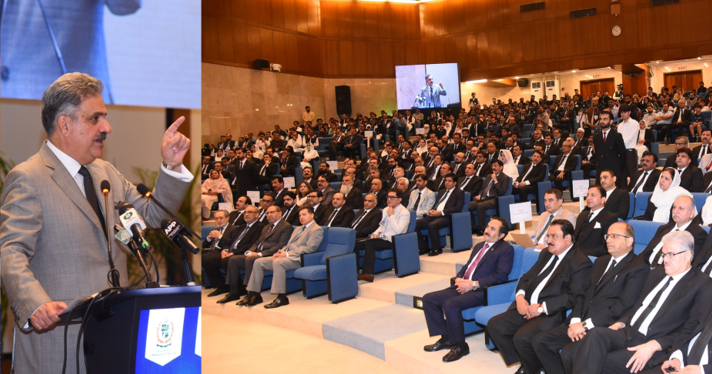
ISLAMABAD: The National Judicial Wellbeing Conference, titled “From Reform to Recognition: Building a Responsive District Judiciary,” was held at the Supreme Court of Pakistan under the auspices of the National Judicial (Policy Making) Committee (NJPMC), bringing judicial wellbeing, institutional support and recognition of excellence in the District Judiciary to the forefront of Pakistan’s justice reform agenda.
The high-level conference was attended by the Chief Justice of Pakistan, Judges of the Supreme Court and Federal Shariat Court, Chief Justices of all Provincial High Courts and the Gilgit-Baltistan Chief Court, District and Sessions Judges, leading-performing judicial officers from across the country, representatives of the Bar and key stakeholders from the justice sector.
District Judiciary Described as Backbone of Justice System
Addressing the inaugural session, the Chief Justice of Pakistan described the District Judiciary as the backbone of the country’s justice system, noting that it is the first formal point at which most citizens encounter the administration of justice.
He observed that public confidence in the justice system is shaped significantly at the district level, making it essential to ensure that judicial officers are not only capable of delivering timely justice but are also professionally supported, adequately equipped and valued by the institutions they serve.
The Chief Justice emphasized that a truly responsive justice system requires a balanced approach combining judicial efficiency, professional dignity, institutional support and the wellbeing of judicial officers.
Reforms Driven by Ground Realities
Recalling his visits to some of the country’s most remote and underserved districts shortly after assuming the highest judicial office, the Chief Justice said these visits provided an opportunity to observe first-hand the gap between existing institutional arrangements and the practical requirements of judges, lawyers, litigants and other court users.
The observations subsequently informed a broad-based reform programme aimed at improving working conditions, professional resources, court infrastructure, public facilitation and institutional support across the District Judiciary.
Among the initiatives undertaken under the reform programme are the solarisation of court complexes, establishment and strengthening of e-libraries, provision of internet connectivity and clean drinking water, and establishment of Women Facilitation Centres.
These projects have been successfully completed across Punjab, Khyber Pakhtunkhwa, Sindh and Islamabad Capital Territory.
In Balochistan, implementation has been completed in 18 districts, while work in the remaining districts is progressing. The Chief Justice noted that logistical difficulties arising from challenging terrain and the prevailing law-and-order situation had affected implementation, but expressed confidence that the remaining work would be completed shortly. The conference also highlighted the importance of creating a justice system that responds effectively to the specific needs of women litigants.
The Chief Justice announced that 2026–27 has been earmarked for the Gender-Responsive Justice Initiative, with particular emphasis on strengthening support and facilitation for women accessing the courts.
Under the initiative, Women Facilitation Centres are being developed to provide essential services under one roof, with a focus on dignity, privacy, safety, accessibility and a more responsive court environment.
To promote uniformity and quality, standardized designs for the Centres are also being developed through a nationwide architectural design competition in collaboration with the Institute of Architects Pakistan.
District Courts Make Significant Progress in Case Disposal
The NJPMC appreciated the substantial progress achieved by the District Judiciary in time-bound disposal of cases, reduction of pendency and improved performance of Model Criminal and Civil Courts.
Between September 2025 and July 2026, more than 1.46 million time-bound cases were decided, while Model Criminal and Civil Courts disposed of more than 133,000 cases.
The figures were cited as evidence of sustained institutional efforts by judicial officers and court administrations to improve case-flow management, accelerate adjudication and strengthen public access to justice.
Chief Justices Highlight Institutional Strengthening
In keeping with the conference theme, the Chief Justices of all Provincial High Courts, along with the Chief Justice of the Gilgit-Baltistan Chief Court, addressed participants and outlined reforms undertaken within their respective jurisdictions.
Their presentations focused on judicial wellbeing, institutional strengthening, digitisation, accountability and transparency, improved court administration, case-flow management, welfare measures, professional support and service-related benefits for judicial officers and court staff.
The deliberations reinforced the view that judicial reform cannot be measured solely through case-disposal figures or administrative efficiency. The human dimension of justice delivery—including the wellbeing, professional dignity, working environment and institutional security of judicial officers—is equally vital to sustaining meaningful reform.
Performance Linked with Recognition
A central message of the conference was that judicial excellence should be accompanied by meaningful institutional recognition.
The conference therefore linked measurable judicial performance with recognition, emphasizing that sustainable improvements in justice delivery require both strong institutional outcomes and the wellbeing of the individuals responsible for administering justice.
At the conclusion of the event, Commendations for Judicial Excellence were conferred upon top-performing judicial officers in recognition of their exceptional services and contributions towards timely, efficient and responsive justice delivery.
District Judiciary to Remain Central to Reform Agenda
Concluding the conference, the Chief Justice reiterated that the District Judiciary would remain a central priority of the judicial reform agenda.
Future efforts will continue to focus on judicial wellbeing, professional support, time-bound adjudication, improved court infrastructure, technology-enabled judicial services, institutional accountability and citizen-centric public facilitation.
The conference marked an important step towards a more responsive and people-centred justice system, reinforcing the principle that strong institutions depend not only on effective reforms and measurable performance, but also on the dignity, wellbeing and professional empowerment of those entrusted with delivering justice.
BY: Nadeem Faisal Baiga