- Supreme Court delegation highlights Pakistan’s digital transformation, judicial independence and commitment to accessible justice in Samarkand
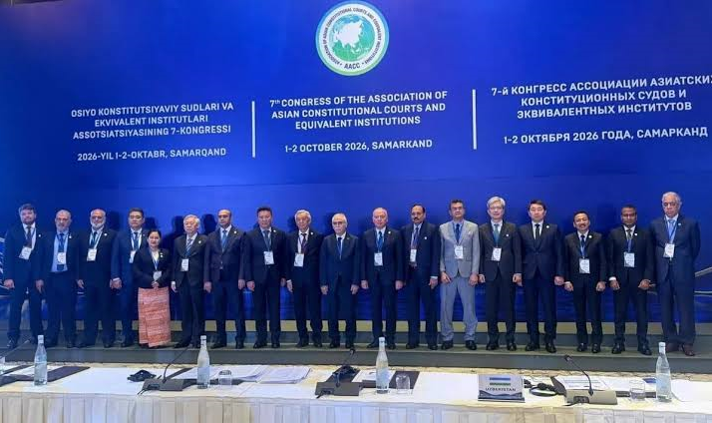
Islamabad : A delegation of the Supreme Court of Pakistan, comprising Hon’ble Mr. Justice Irfan Saadat Khan and Hon’ble Mr. Justice Naeem Akhter Afghan, represented Pakistan at the 7th Congress of the Association of Asian Constitutional Courts and Equivalent Institutions (AACC) in Samarkand.

The high-level gathering brought together senior judicial representatives from across Asia and other participating jurisdictions to exchange experiences and strengthen international cooperation in constitutional and judicial matters.
Pakistan Highlights Digital Transformation in Justice System
The Congress focused on the rapidly evolving role of technology and artificial intelligence (AI) in the administration of justice, with discussions covering judicial independence, human rights, the rule of law, digital transformation and procedural safeguards.
During the opening ceremony, Justice Irfan Saadat Khan, who headed the Pakistani delegation, delivered welcome remarks on behalf of the Supreme Court of Pakistan, highlighting the importance of international judicial dialogue and institutional cooperation.
The Pakistani delegation actively participated in plenary discussions and shared the Supreme Court’s ongoing efforts to integrate technology and innovative digital tools into the justice system.
These initiatives are aimed at improving access to justice, institutional efficiency, transparency and the timely delivery of judicial services, reflecting Pakistan’s growing emphasis on modernizing its judicial institutions.
Samarkand Declaration Reaffirms Constitutional Principles
The Congress concluded with the adoption of the Samarkand Declaration, reaffirming constitutional supremacy, judicial independence, human rights and the rule of law as fundamental pillars of justice and democratic governance.
The Declaration also recognized the significant potential of digital technologies to improve the transparency, timeliness and quality of judicial proceedings while promoting equal access to justice.
At the same time, the participating institutions emphasized that artificial intelligence should serve only as an auxiliary tool and must not replace the independent judgment, constitutional responsibilities or decision-making authority of judges.
Strengthening Pakistan’s International Judicial Engagement
The Pakistani delegation also participated in meetings of the Association’s Secretaries General and Board Members, as well as bilateral and multilateral engagements designed to deepen judicial cooperation and facilitate the exchange of institutional knowledge and best practices.
Pakistan’s participation at the Samarkand Congress underscored the Supreme Court’s commitment to international judicial cooperation, institutional learning, technological innovation and the strengthening of an efficient, transparent and accessible justice system.
The engagement also provided an important platform for Pakistan to share its judicial reform and digital transformation experience with peer institutions across Asia while contributing to the broader global dialogue on the responsible use of emerging technologies in the administration of justice.
BY: Nadeem Faisal Baiga