- Landmark 54-Billion-Dirham Project to Strengthen Morocco’s Global Trade Connectivity, Industrial Growth and Regional Development
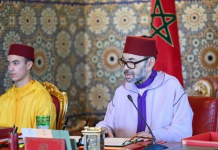
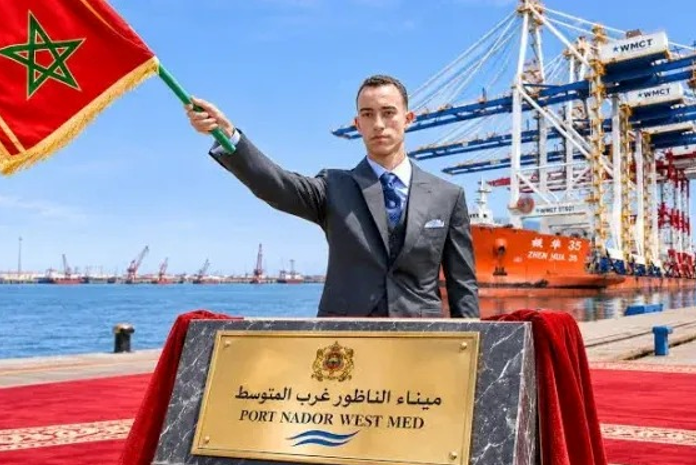
NADOR, Morocco : Under the High Instructions of His Majesty King Mohammed VI, His Royal Highness Crown Prince Moulay El Hassan on Saturday officially launched operations at the first container terminal of the Nador West Med port complex in the province of Nador, marking a major milestone in Morocco’s strategy to strengthen its maritime infrastructure, expand international trade and accelerate industrial development.
The commissioning of the first terminal signals the beginning of operations at a strategic port and industrial complex that has mobilised 54 billion dirhams in public and private investment. The project is designed to enhance Morocco’s position as a major regional and international logistics hub while generating new economic opportunities for the Oriental region.
During the ceremony, Crown Prince Moulay El Hassan inaugurated the first container-unloading operation from a commercial vessel at the port’s East terminal, situated in the municipality of Laâzzanène. The milestone represents an important step towards expanding the country’s port capacity, strengthening supply chains and attracting further industrial and logistics investment.
A New Gateway for Global Maritime Trade
The East terminal, the first facility to become operational at Nador West Med, features 1,520 metres of quayside, a water depth of 18 metres and 70 hectares of reclaimed land. Its container-handling capacity is expected to reach 3.5 million twenty-foot equivalent units (TEUs) by 2030.
Developed with an investment of approximately 5 billion dirhams, the terminal will be operated and maintained for 25 years by a consortium comprising Marsa Maroc and Terminal Investment Limited (TIL), a subsidiary of the MSC Group, one of the world’s leading container shipping groups.
The second container terminal, known as the West terminal, is scheduled to enter service in April 2027. The project, involving an investment of approximately 3 billion dirhams, has been awarded to a consortium comprising Marsa Maroc and CMA CGM.
With 900 metres of quayside and 38 hectares of reclaimed land, the West terminal is designed to handle 1.8 million TEUs annually. Once both facilities are fully operational, their combined announced capacity will reach 5.3 million TEUs, significantly expanding Morocco’s ability to accommodate international container traffic.
Integrated Port Infrastructure to Diversify Economic Activity
Nador West Med is being developed as a comprehensive maritime, industrial and energy platform extending well beyond container shipping.
The complex includes a roll-on/roll-off (Ro-Ro) terminal, delivered in September 2026, with a handling capacity of 400,000 units. A bulk terminal designed to handle 7 million tonnes is scheduled for delivery in June 2027, while a general cargo terminal with a capacity of 3 million tonnes is expected to begin operations in December 2028.
The project also incorporates a dedicated energy hub featuring liquefied natural gas (LNG) and hydrocarbon facilities. The hydrocarbon terminal, designed for a capacity of 25 million tonnes and equipped with three 125-metre berths, is expected to become operational in April 2027.
These complementary facilities are intended to strengthen Morocco’s capacity to handle diverse categories of maritime cargo, support energy logistics and improve the resilience and efficiency of national supply chains.
Industrial Investment and 34,000 Expected Job Opportunities
Beyond its maritime infrastructure, Nador West Med is expected to become a catalyst for industrial expansion, employment and regional economic transformation.
The complex includes a 700-hectare industrial and logistics platform associated with private investments of 12 billion dirhams. In the short term, the project is expected to generate approximately 14,000 direct jobs and 20,000 indirect jobs, creating employment opportunities across logistics, transport, industrial services and related economic sectors.
In line with Royal Directives, specialised training programmes will be introduced to equip young people with skills suited to the needs of businesses operating within the complex. These initiatives are intended to strengthen professional qualifications, facilitate access to employment and ensure that local communities benefit from the project’s economic impact.
The development of the port is also being supported by major transport infrastructure projects designed to improve connectivity with Morocco’s national logistics network.
A 49-kilometre railway link will connect Selouane to Nador West Med, while a 105-kilometre highway will provide a connection from Guercif, facilitating the movement of goods and strengthening links between the port, industrial centres and inland markets.
Complementing Tanger Med and Strengthening Morocco’s Global Position
The launch of operations at Nador West Med represents another significant step in Morocco’s long-term ambition to establish itself as a leading maritime, logistics and industrial centre linking Europe, Africa and international markets.
Complementing the established Tanger Med port complex, Nador West Med is expected to broaden the country’s maritime capabilities, attract new industrial investment and reinforce Morocco’s role in international supply chains.
The project also carries strategic significance for the Oriental region, where improved transport connectivity, industrial development and employment opportunities are expected to stimulate economic activity and support more balanced regional growth.
Under the leadership of His Majesty King Mohammed VI, Morocco has continued to invest in major infrastructure projects aimed at enhancing economic competitiveness, modernising logistics networks and attracting international investors.
With the commissioning of its first container terminal, Nador West Med is moving from development to operations, laying the foundation for a new phase of industrial expansion, maritime connectivity and sustainable regional development.
As additional terminals and supporting infrastructure come into service, the complex is poised to become an important pillar of Morocco’s economic strategy and a growing gateway for international trade across the Mediterranean and beyond.
BY: The Times Union