Iran has used Iraq to launch attacks on Kuwait, Saudi Arabia and Bahrain, as well as targeting the vicinity of Emirati nuclear facilities. Iraq, as an Iranian front, is a growing danger, transforming into an international issue and signaling a new regional situation that will require concerted efforts to confront it.
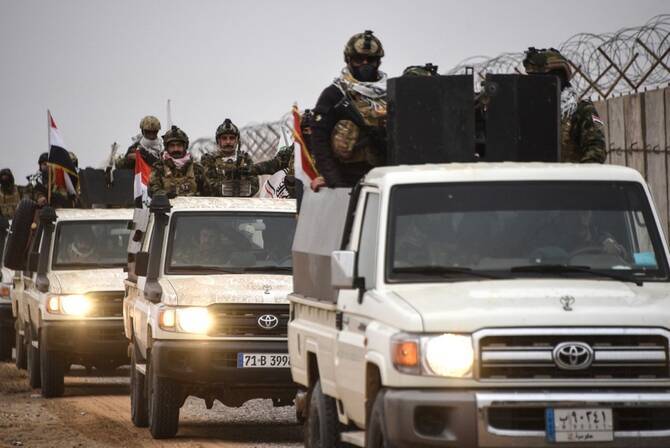
Turkiye has arrested and extradited to the US Mohammed Baqer Al-Saadi, a commander in the Iranian-backed Kata’ib Hezbollah militia in Iraq. He was transferred to a prison in New York, which prompted the Iraqi government to break its silence and distance itself from Iran’s actions on its soil, without naming Iran directly.
This places Baghdad squarely in the crisis and puts the threatened regional states into confrontation with Iran’s Iraq. The crisis perimeter includes Gulf states, as well as Syria, Jordan and Israel, which are all facing a new situation created by Iran, similar to what it has done with the Strait of Hormuz.
From a strategic perspective, the picture becomes increasingly clear: Tehran does not treat Iraqi militias as mere temporary pressure tools for this war, but as an integral part of its long-term security doctrine based on offensive depth beyond its borders.
After the Iran-Iraq War, Tehran decided to shift any confrontation away from its own territory by establishing ideologically, financially and militarily linked local forces, transforming them into advanced lines of attack and centers of political influence simultaneously.
This places Baghdad squarely in the crisis and puts the threatened regional states into confrontation with Iran’s Iraq.
Abdulrahman Al-Rashed
Iran is also destroying everything Iraqis have built and are trying to build: institutions governing civilians and services, a private sector, and regional and international relations. This makes the Iraqi people, in all their diversity, a natural ally against Iranian encroachment rather than an adversary to be targeted with boycotts and sanctions.
The situation in Iraq is that we are facing a hybrid state, much like in Lebanon, where militias attack and the government disavows responsibility. The danger of militias lies not only in their possession of weapons but in their transformation into a parallel state structure with financial resources, political influence and partial legitimacy. Naturally, they have also gained the ability to manage or obstruct sovereign Iraqi decision-making.
The Iraq front has opened, with Iran activating its Iraqi militias to circumvent the ongoing ceasefire. Washington has responded with a two-pronged approach: first, pursuing their leaders, who believe they are untouchable, and, second, beginning to dry up their financial resources.
Al-Saadi, one of Iraq’s most important militia leaders, is accused of orchestrating cross-continental terrorist operations. He heads Kata’ib Hezbollah, a prime example of Iran’s regional influence. It is a local armed force loyal to Tehran, similar to the Hezbollah model in Lebanon, but it took a shorter time to establish and is being funded by the government.
Iran’s infiltration stood on the shoulders of the weak Iraqi democratic institutions, which gave it the upper hand in decision-making.
The danger of militias lies not only in their possession of weapons but in their transformation into a parallel state structure.
Abdulrahman Al-Rashed
Another aspect of this new development is that Tehran’s activation of its Iraqi militias during the truce suggests it is determined to open a military front against its neighbors, even if a peace agreement is reached to end the war with the US and Israel.
Tehran wants to return to the strategy of proxies, increasing the role of Iraq’s militias to compensate for its three losses: the Assad regime, the curtailment of Hezbollah in Lebanon, and the collapse of Islamic Jihad in Gaza.
The postwar phase is no less dangerous should US military operations cease, whether as a result of commitments from a potential agreement to end the war or due to the US administration’s desire to reduce its military activity in the region if it achieves a solution for nuclear enrichment that does not include an agreement on proxy weapons.
The current war between Iran, America and Israel has proven what was expected. Lebanese and Iraqi militias are part of Iran’s cross-border military system and deserve to be treated like the nuclear enrichment issue.
Tehran has grown accustomed to circumventing direct understandings by escalating conflicts through proxy arenas, which makes the militia file an organic part of the regional security equation, not a separate issue.
BY: Abdulrahman Al-Rashed is a Saudi journalist and intellectual. He is the former general manager of Al-Arabiya news channel and former editor-in-chief of Asharq Al-Awsat, where this article was originally published.
Disclaimer: Views expressed by writers in this section are their own and do not necessarily reflect The Times Union‘ point of view