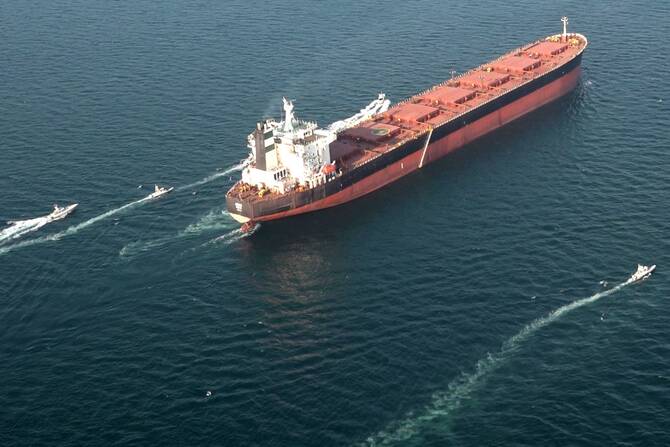
The Strait of Hormuz has once again become one of the most sensitive geopolitical flashpoints in the world. Yet the current escalation should not be read as an unavoidable consequence of regional tensions. It is, in fact, the result of a long-standing pattern, in which Iran has repeatedly leveraged its geographic position along this vital waterway to advance strategic and political objectives.
Tehran’s approach to the strait has gone beyond the conventional logic of territorial security. Over time, it has increasingly treated the narrow waterway as an instrument of pressure — linking maritime stability and freedom of navigation to broader regional and international disputes. Through periodic threats to shipping routes and energy flows, Iran has sought to turn geography into leverage, positioning itself as an unavoidable actor in any equation concerning Gulf security.
This strategy is inherently destabilizing. The Strait of Hormuz is not a national asset to be instrumentalized, it is an international maritime corridor upon which global energy security and trade depend. More importantly, the Arab Gulf states — Saudi Arabia, the UAE, Kuwait, Qatar, Bahrain and Oman — are not external observers to this crisis. They are the principal stakeholders whose economic stability and national security are directly affected by any disruption in these waters.
The security of the Strait of Hormuz cannot be contingent on concessions extracted under pressure
Hani Hazaimeh
Any serious diplomatic effort to address tensions in the strait must therefore include Arab interests at its core. Excluding the Gulf Cooperation Council states from meaningful participation would produce an incomplete and ultimately fragile outcome. These states are the most exposed to escalation and the most invested in stability. Their role cannot be reduced to that of secondary consultees in negotiations shaped elsewhere.
A recurring feature of Iran’s regional behavior is the use of escalation as a bargaining mechanism. The pattern is familiar: heightened tension, increased uncertainty and then an attempt to translate de-escalation into political or strategic concessions. This is not traditional diplomacy grounded in mutual restraint — it is statecraft that relies on manufactured instability to create negotiating leverage.
Such an approach raises a fundamental problem. No state can simultaneously threaten international commerce and endanger global energy security, then seek political reward for restoring the stability it undermined. The security of the Strait of Hormuz cannot be contingent on concessions extracted under pressure.
At a broader level, the critical question is not only how to manage immediate tensions but who is entitled to shape the long-term security architecture of the Gulf. Iran’s apparent assumption that it can negotiate directly with global powers while imposing strategic realities on its Arab neighbors reflects a misreading of the regional balance of interests.
Gulf states are central actors in this equation. Their security concerns and strategic priorities define the stability of the entire system. Any agreement between the US and Iran that seeks to address the current crisis without full Arab participation would lack both legitimacy and durability.
In strategic terms, Iran’s use of the strait as leverage carries significant internal costs that cannot be ignored
Hani Hazaimeh
Arab Gulf countries have consistently pursued stability, secure trade routes and predictable regional relations. Their involvement in shaping any framework for the Strait of Hormuz is essential not only to protect their own interests but also to ensure that broader principles — such as sovereignty, noninterference and freedom of navigation — are upheld in a balanced and enforceable manner.
At the same time, the assumption that the strait can remain a permanent pressure point is increasingly questionable. Gulf states have, over time, invested heavily in reducing strategic vulnerability through diversification of export routes, expanded pipeline infrastructure and strengthened access through alternative maritime corridors. While the Strait of Hormuz remains critical, it is no longer an exclusive chokepoint upon which the entire region depends without options.
Iran itself is not insulated from the consequences of escalation. Its economy remains deeply reliant on maritime access and energy exports. Any prolonged disruption in the Strait of Hormuz not only destabilizes regional trade but also intensifies Iran’s own economic pressures, compounding existing sanctions and reducing its fiscal flexibility. In strategic terms, the use of the strait as leverage carries significant internal costs that cannot be ignored.
This exposes a key contradiction in Tehran’s approach. A tactic intended to increase bargaining power risks accelerating long-term strategic isolation. As regional actors diversify infrastructure and international stakeholders reassess risk exposure, reliance on coercive control over maritime chokepoints becomes less effective over time.
The path toward sustainable security in the Gulf cannot be built on threats or episodic escalation. It must rest on a framework grounded in international maritime law, mutual restraint and inclusive regional engagement that reflects the realities of all principal stakeholders. Above all, it must recognize that Gulf security is inseparable from Arab sovereignty and economic stability.
Arab states are not seeking confrontation. Their overriding interest lies in maintaining open trade routes, regional stability and a security environment free from coercive disruption. Their inclusion in any meaningful diplomatic process is therefore not optional — it is essential to the credibility and success of any agreement.
Iran, like any sovereign state, has legitimate national interests. However, pursuing those interests through the destabilization of a global economic artery carries consequences that extend far beyond the region. Normalizing such behavior would establish a precedent that incentivizes recurrence rather than restraint.
Ultimately, this crisis is not only about maritime access. It is a test of whether regional security can be governed through balance and law or whether it will continue to be shaped by coercion. Iran may have contributed to the escalation but it cannot be allowed to unilaterally define its resolution.
A durable outcome will require a framework that places Arab interests at its center, acknowledges the interdependence of regional security and rejects the logic of strategic hostage-taking. Only through such an approach can the region move beyond recurring instability toward a more sustainable and balanced order.
BY: Writer Hani Hazaimeh is a senior editor based in Amman.
Disclaimer: Views expressed by writers in this section are their own and do not necessarily reflect The Times Union ‘ point of view