For 20 years, the people of Gaza were denied the right to choose their representatives through parliamentary, legislative, local, municipal and union elections. An entire generation came of age without experiencing the ballot box as a normal part of Palestinian public life. That long rupture began after the 2006 legislative elections, when Hamas won 76 seats and then shut down the possibility of renewed elections in the territory it controlled. The result was not only political division between Gaza and the West Bank but also the effective disenfranchisement of two generations of Palestinians in the Strip.
That is why last Saturday’s municipal elections in Gaza’s Deir Al-Balah matter. They were not just a local contest over service delivery, council seats or municipal management. They were a political and national event of far wider significance: a declaration that democratic life in Palestine can still be revived, even under catastrophic circumstances, and that Gaza cannot remain excluded from the Palestinian political system if any credible national future is to be built.
The significance of Deir Al-Balah lies partly in what it represents. It was the only city in Gaza to undergo this democratic process, while local elections were also being held across the West Bank. That alone gives the vote a symbolism that transcends municipal boundaries. It affirms the unity of the Palestinian people, the unity of the land and the idea that there must be one political system rather than two disconnected spheres of authority.
It also mattered because of the conditions in which it took place. These were not ordinary elections held in ordinary times. They came amid destruction, displacement and the collapse of normal civic infrastructure.
It shows that Palestinian institutions can administer democratic life even in the harshest imaginable setting
Daoud Kuttab
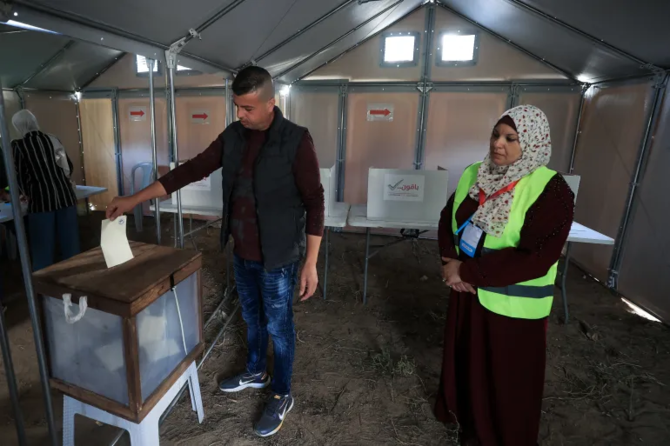
In Deir Al-Balah, just over 70,000 people were eligible to cast votes in 12 polling centers. The 22 percent turnout was much lower than the overall 53 percent turnout, but successfully holding an election in Gaza was the breakthrough.
Because of the extraordinary conditions in the Strip, suitable voting sites had to be improvised, including empty plots and tents, since many schools that would normally host polling stations are now shelters or have been damaged. Election boxes were created from recycled wood and the local committee improvised the printing of ballots. The Central Elections Commission managed to organize the process with 292 observers from 10 monitoring institutions, 45 journalists and 675 election workers.
That achievement matters. It shows that Palestinian institutions, working with local resources and determination, retain the capacity to administer democratic life even in the harshest imaginable setting. It also delivers a powerful message to the world: Palestinians are not merely victims of war and occupation, they are a people determined to exercise agency, preserve public institutions and insist on political rights.
Palestinian Prime Minister Mohammed Mustafa captured the importance of the moment when he said the local elections took place at a very important time and “in light of complex challenges and exceptional circumstances.” He stressed that the success of holding them in the West Bank and partially in the Gaza Strip constitutes “a first and important step within a broader national path, aimed at consolidating democratic life, strengthening the resilience of national institutions and ultimately completing other national obligations and achieving national unity.”
These elections should not be seen as an isolated event, nor merely as a symbolic concession to democratic procedure. They are the beginning of a broader national path. If sustained, they can help restore confidence in Palestinian institutions, reconnect Gaza to the national political system and give renewed legitimacy to the Ramallah-based Palestinian Authority at a moment when legitimacy is desperately needed.
The broader context makes this even clearer. Across the Occupied Territories, some 1.03 million people were eligible to vote in 381 municipal and local councils. More than half of these councils, 196, were filled by acclamation, while 183 councils went to the ballot box because more than one list was competing. According to the Central Elections Commission, 321 electoral lists competed in 90 municipal councils, with about 3,773 candidates, both male and female, while 1,358 candidates contested 93 village councils. These are not trivial administrative figures. They point to a living, breathing Palestinian appetite for representation, accountability and civic participation.
Sarah Johnson, associate director of the Democracy Program at the Carter Center, put it well: “Today’s elections are significant not only for democratic governance in the occupied Palestinian territories, but also because the Central Elections Commission was able to hold elections in Deir Al-Balah, where displaced and suffering residents have not voted in 20 years.” She added: “The inclusion of Gaza is essential for any credible path to self-determination and for affirming the national and territorial unity required for any political horizon.”
These elections point to a living, breathing Palestinian appetite for representation, accountability and civic participation
Daoud Kuttab
Her words should be taken seriously. No Palestinian political project can be credible if Gaza is absent from it. No path to self-determination can succeed if millions of Palestinians are cut off from electoral participation. And no PA can convincingly claim to represent the whole people while Gaza remains politically frozen or institutionally detached.
One voter, Mohammed Salman, 56, expressed that sentiment powerfully as he cast his ballot on Saturday. “Our hope in these elections, God willing, is that they will reaffirm Palestinian nationalism, prevent the erasure of Palestinian identity and strengthen our connection to this land, our roots and our ancestors,” he said. In that single statement lies the deeper meaning of the vote.
For the PA in Ramallah, this is a rare opening. If handled wisely, Gaza’s partial return to the ballot box can strengthen the PA’s insistence on national relevance and institutional seriousness. It offers a chance to show Palestinians and the wider world that it can still anchor a unified political framework, deliver a democratic process and prepare the ground for broader elections, including legislative and national council votes.
But this opportunity will mean little if it ends in symbolism alone. The real task now is to build on Deir Al-Balah, expand electoral life to the rest of Gaza and move toward comprehensive national elections. That would not solve every Palestinian division overnight. But it would restore something essential: the principle that Palestinian legitimacy must come from the people.
Deir Al-Balah broke a long taboo. It proved that, even in the shadow of war, democracy remains possible. Now the challenge is to make sure this breakthrough is not remembered as an exception but as the beginning of a Palestinian democratic renewal and the insistence of the unity of Palestine.
BY: Writer Daoud Kuttab is an award-winning Palestinian journalist and former Ferris Professor of Journalism at Princeton University. He is the author of “State of Palestine Now: Practical and Logical Arguments for the Best Way to Bring Peace to the Middle East.”
Disclaimer: Views expressed by writers in this section are their own and do not necessarily reflect The Times Union‘ point of view