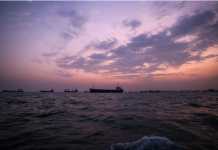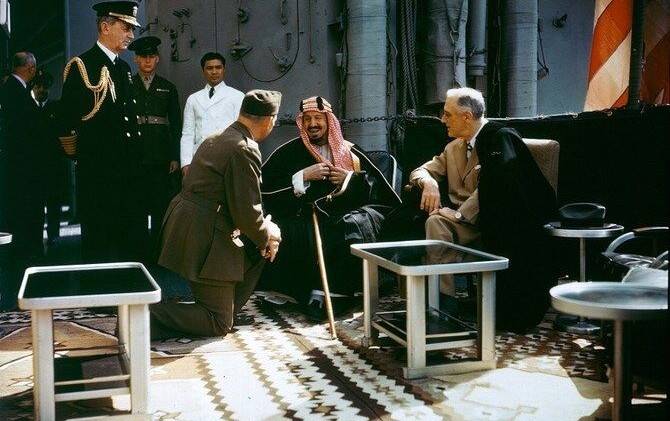
On Feb. 14, 1945, in the Great Bitter Lake of the Suez Canal, President Franklin D. Roosevelt met King Abdulaziz aboard the USS Quincy. The American president was returning from Yalta. The Saudi king had never been to sea. The two men spent one day together. The ship carried a transaction: American security in exchange for the steady flow of oil. It was necessary. It was consequential. And, for most of a century, those ties stood largely alone.
America’s 250th anniversary next month will be marked at home with parades and speeches. It should also be marked abroad with something more permanent. The deepest American partnership outside the Western alliance is the one with Saudi Arabia and, after 80 years, it is overdue for the commitment its peoples have already made and its diplomats have been reluctant to name. The anniversary is the moment to make a deposit on the next 80 years, in writing, with named programs that bind the next generation of Americans and Saudis to one another. The transaction that Quincy carried is no longer enough. The ship needs new cargo.
We have called this a partnership built on oil and security for 80 years and, on the surface, it was. Underneath, something deeper was holding: a recognition between two peoples of faith that neither side has fully acknowledged.
What the diplomats have struggled to name, the people themselves have always understood. Americans who travel to the Kingdom and Saudis who travel to America have spent eight decades discovering in one another a recognition of shared humanity that surpasses the categories the foreign policy desks assigned to them. The relationship has survived three generations of strategic friction not because the oil arrangements were sound but because the deeper recognition was real.
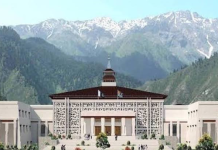
The Kingdom of 1945 and the Kingdom that exists today are not the same country. Under Vision 2030, Saudi Arabia is opening to the world in ways its founders could not have imagined, hosting visitors of every faith, building museums and universities, and welcoming dialogue with cultures it had no relationship with a generation ago. The Kingdom remains the custodian of the Two Holy Mosques. The Kingdom remains itself. What has changed is the confidence with which it engages the world.
Consider what the children of the Gulf are now being taught: and that is tolerance. When a nation changes what it teaches the young, it is not adjusting a curriculum. It is changing what it believes about its own future.
The deepest change is the willingness, on both sides, to love the stranger — to build across the boundaries of faith rather than retreat behind them. I have said this everywhere, in Riyadh, in Doha, in Manama, in Baku: the children of Abraham were never meant to agree on everything but we were always meant to recognize one another. That recognition is no longer a hope. It is being built in stone.
I am not naive. This region carries ancient wounds. But it is the work of this generation to build what the next will inherit.
The US-Saudi relationship has survived three generations of strategic friction because the deeper recognition was real.
Rabbi Marc Schneier
The 250th anniversary of the signing of the US’ Declaration of Independence should spur a commitment, publicly and in writing, to expanded educational exchanges between American and Saudi universities; to interfaith initiatives that bring rabbis and imams into sustained engagement; to cultural diplomacy that lets each country’s artists and scholars present themselves to the other directly; and to youth leadership programs that prepare the next generation of Americans and Saudis to lead an interconnected world. These are not concessions. They are investments. Every program that brings an American student to Riyadh or a Saudi scholar to Washington strengthens the relationship in ways no treaty can.
America was founded on a proposition: that human dignity is God-given and that no government may extinguish it. The nations of the Gulf, in their own idiom and on their own timetable, are reaching for that same truth. We do not share a creed. We do not share a history. But we share a faith in the possibility of human dignity and a common fate if we fail to defend it.
More than 80 years ago, a ship carried oil in one direction and security in the other, and that was enough to change the world. It is no longer enough. The question before America and the Gulf is not what we can extract from one another. The question is what we are willing to build together and whether we have the courage to carry it.
That is the cargo worth crossing the water for.
BY: Writer Rabbi Marc Schneier is President of the Foundation for Ethnic Understanding and a noted adviser to many Gulf states.
Disclaimer: Views expressed by writers in this section are their own and do not necessarily reflect The Times Union‘ point of view