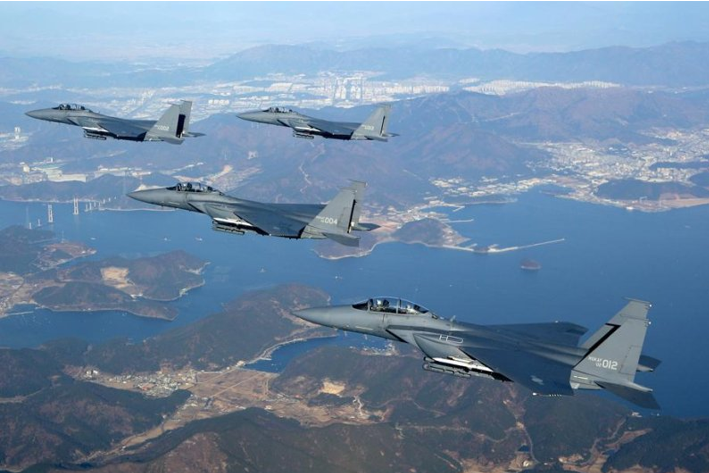
- Seoul Monitors Russian Aircraft Over East Sea, Takes Precautionary Measures
SEOUL: South Korea deployed Air Force fighter jets and conducted tactical maneuvers on Tuesday after several Russian military aircraft entered its Korea Air Defense Identification Zone (KADIZ), prompting heightened military vigilance in the region.
According to South Korea’s Joint Chiefs of Staff (JCS), an unspecified number of Russian military aircraft entered and subsequently exited the KADIZ over the East Sea, also known as the Sea of Japan, during the early hours of Tuesday.
South Korean Military Maintains Air Defense Readiness
In a statement, the JCS said South Korean forces had detected the Russian aircraft before they entered the identification zone and dispatched fighter jets to take precautionary measures.
“Our military detected the Russian aircraft before they entered the KADIZ and deployed Air Force fighter jets, taking tactical measures to prepare for any contingency,” the JCS stated.
Seoul clarified that the Russian aircraft did not violate South Korea’s sovereign airspace.
Understanding the Air Defense Identification Zone
An Air Defense Identification Zone (ADIZ) is an area beyond a country’s sovereign airspace where approaching aircraft are monitored and identified for national security purposes.
Although military aircraft are generally expected to notify the relevant authorities before entering such zones, international law does not impose a universal legal requirement for prior notification.
Previous Chinese-Russian Air Patrols Raise Regional Attention
The latest incident follows a similar development in June, when more than 10 Chinese and Russian military aircraft entered South Korea’s air defense identification zone, prompting Seoul to scramble fighter jets.
Those aircraft also remained outside South Korea’s sovereign airspace.
At the time, Beijing described the joint operation with Russia as a “strategic air patrol” over the Sea of Japan, the East China Sea and the western Pacific Ocean, saying the exercise was intended to maintain regional peace and stability.
China did not specifically refer to South Korea or its air defense identification zone.
The latest development underscores continuing military activity and security sensitivities in Northeast Asia, where air defense operations and strategic military cooperation remain closely monitored by regional powers.
BY: The Times Union