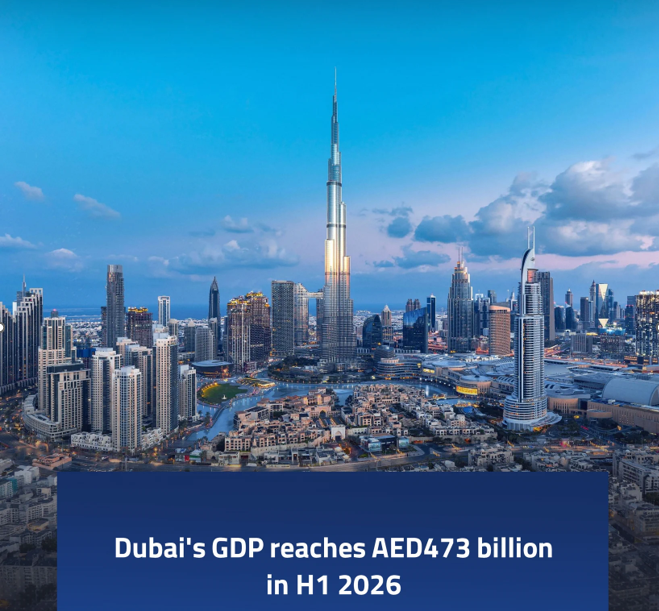
- H1 2026 Economic Results Highlight Dubai’s Diversified Economic Strength, Investment Appeal and Long-Term Vision Under the Dubai Economic Agenda D33
DUBAI / ISLAMABAD, October 18, 2026 — Dubai continues to demonstrate the strength of its diversified economic model, its capacity to adapt to global economic shifts and its commitment to building a competitive, innovation-driven future, according to the emirate’s economic performance results for the first half of 2026.
Data released by the Dubai Data and Statistics Establishment at Digital Dubai showed that Dubai’s real Gross Domestic Product (GDP) reached approximately AED473 billion during the first six months of 2026. While real GDP declined by 2.3 per cent compared with the corresponding period in 2025, GDP at current prices edged up by 0.2 per cent to approximately AED505 billion, reflecting differing trends across economic activities.
The results highlight the growing importance of high-value sectors, particularly financial and insurance services, healthcare, information and communication, and construction. Their performance reinforces Dubai’s strategic focus on economic diversification, technological advancement and the development of an attractive environment for investors, businesses and skilled professionals.
Guided by the emirate’s long-term development vision and the objectives of the Dubai Economic Agenda D33, Dubai continues to strengthen the foundations of a future-ready economy, expand opportunities for private-sector growth and reinforce its standing as an international centre for trade, finance, innovation and enterprise.
Financial Services Strengthen Dubai’s Global Economic Standing
Financial and insurance activities emerged among the strongest-performing sectors, recording real growth of 8.8 per cent in H1 2026. Value added at constant prices increased to approximately AED65.9 billion, compared with AED60.6 billion during the same period last year.
The sector’s contribution to real GDP rose to 14 per cent, up from 12.5 per cent a year earlier, underscoring its increasing significance within Dubai’s economic structure.
At current prices, the sector generated approximately AED64 billion in value added, representing growth of 8.1 per cent.
This performance reflects the importance of financial services in supporting investment, business expansion and capital flows, while strengthening Dubai’s role as a regional and international platform for financial activity. Continued expansion in this sector also supports the emirate’s ambitions to attract global enterprises, investors and specialised talent.
Healthcare and Social Services Record Strong Growth
Human health and social work activities recorded real growth of 14.3 per cent during the first half of 2026, while growth at current prices reached 16.7 per cent.
Value added at constant prices rose to approximately AED6.2 billion, compared with AED5.4 billion in the corresponding period of 2025.
The sector’s performance highlights the expanding contribution of healthcare and social services to Dubai’s economic development, complementing the emirate’s wider efforts to strengthen essential services, improve quality of life and support sustainable growth.
Digital Economy and Technology Continue to Advance
Information and communication activities maintained a positive growth trajectory, recording 2.7 per cent real growth and 1.6 per cent growth at current prices.
Value added at constant prices increased to approximately AED24.7 billion, compared with AED24 billion in H1 2025, reflecting the continued importance of digital services, communications and technology-related activities within the emirate’s economic ecosystem.
Dubai’s emphasis on digital transformation and artificial intelligence is central to its ambition to enhance productivity, strengthen business competitiveness and accelerate the development of emerging industries. By fostering an integrated digital environment, the emirate is working to enable businesses and public institutions to harness advanced technologies and capture new opportunities in the global digital economy.
Construction and Infrastructure Support Economic Development
Construction recorded real growth of 2.4 per cent, with value added at constant prices reaching approximately AED33.2 billion. At current prices, the sector’s value added stood at approximately AED35.3 billion, representing growth of 8.6 per cent.
The sector remains an important component of Dubai’s broader economic landscape, supporting infrastructure development, urban expansion and the wider ecosystem of investment and commercial activity.
Electricity, gas, water supply and waste management activities also recorded positive results, achieving real growth of 5.4 per cent. Value added at constant prices reached approximately AED10.2 billion, compared with AED9.7 billion in the same period last year. At current prices, the sector generated approximately AED10.6 billion, an increase of 7.4 per cent.
Government services grew by 2.9 per cent in real terms and 5.7 per cent at current prices, while education activities recorded growth of 1.2 per cent and 1.5 per cent, respectively.
These results demonstrate that several essential services and infrastructure-related activities continued to expand amid a changing international economic environment.
Dubai’s Economic Leadership Focuses on Resilience and Future Growth
His Excellency Helal Saeed Almarri, Director General of the Dubai Department of Economy and Tourism, said the emirate’s H1 2026 performance reflected the adaptability of an economy designed to navigate significant global uncertainty.
He highlighted the continued growth of several strategic and future-oriented sectors as evidence of the depth of Dubai’s economic fundamentals and the importance of maintaining a sustained focus on long-term growth opportunities.
Almarri emphasised that the emirate would continue advancing the objectives of the Dubai Economic Agenda D33, with priorities including accelerating investment, encouraging innovation, attracting talent and strengthening international competitiveness.
He expressed confidence that the foundations being developed today would help Dubai maintain its long-term growth trajectory and emerge from the current period of global uncertainty with renewed momentum.
Digital Dubai Highlights the Importance of Economic Diversification
Hamad Obaid Al Mansoori, Director General of Digital Dubai, identified the breadth and diversity of the emirate’s economic base as key strengths in responding to international economic changes.
He noted that continued growth across several strategic sectors reflected a long-term approach to developing emerging industries, strengthening established activities and enhancing the economy’s ability to adapt to changing circumstances.
Al Mansoori also underscored the importance of investing in high-value future sectors, strengthening coordination across the economic ecosystem and creating conditions in which businesses, investors and talent can thrive.
He highlighted digital transformation and artificial intelligence as increasingly important drivers of productivity and competitiveness, adding that Dubai continues to develop an integrated digital ecosystem to accelerate the adoption of advanced technologies across economic sectors.
Reliable Economic Data to Guide Strategic Decision-Making
Younus Al Nasser, Chief Executive of the Dubai Data and Statistics Establishment at Digital Dubai, said the results demonstrated varying performance across economic activities, highlighting the importance of assessing the economy through a comprehensive understanding of GDP, sectoral contributions and individual growth trends.
He explained that while some activities were affected by changes in the global economic environment, other sectors continued to expand, illustrating the breadth and diversity of Dubai’s economic base.
Al Nasser emphasised the continued development of Dubai’s national accounts and economic statistics in line with recognised statistical standards and methodologies. Reliable and comprehensive data, he noted, is essential not only for measuring performance but also for supporting government planning, business decisions and the anticipation of emerging economic trends.
Investment Confidence and Business Competitiveness Remain Central Priorities
Hadi Badri, Chief Executive Officer of the Dubai Economic Development Corporation, the economic development arm of the Dubai Department of Economy and Tourism, highlighted the continued importance of investment, enterprise and innovation in shaping Dubai’s future economy.
He pointed to the 8.8 per cent real growth in financial and insurance activities, alongside continued expansion in information and communication, as indicators of the strategic importance of these sectors.
Badri stressed that the focus would remain on translating investor confidence into tangible economic opportunities by improving the business environment, strengthening market access and ensuring companies can access the infrastructure, talent and services needed to establish, expand and scale their operations.
He also highlighted cooperation between government and industry as an important factor in sustaining investment-led growth during the second half of 2026 and beyond.
Trade, Real Estate and Transport Remain Major Pillars of Dubai’s Economy
Wholesale and retail trade remained Dubai’s largest economic activity by contribution to real GDP, accounting for 20.5 per cent during H1 2026. Financial and insurance activities ranked second at 14 per cent, followed by real estate at 11.8 per cent and transportation and storage at 10.7 per cent.
The results also highlighted differences in sectoral performance. Wholesale and retail trade declined by 6 per cent in real terms, with value added reaching AED96.9 billion, despite a 2 per cent increase at current prices. Foreign trade increased by 4 per cent compared with the same period in 2025.
Transportation and storage generated approximately AED50.6 billion in value added, recording a decline of 7.4 per cent.
Real estate value added increased by 5.4 per cent at current prices to AED65.1 billion, compared with AED61.8 billion a year earlier. In constant-price terms, however, the sector recorded a 2.5 per cent decline, with real value added reaching AED55.8 billion.
Manufacturing generated AED24.1 billion in value added at current prices, an annual increase of 0.5 per cent. At constant prices, the sector recorded a marginal decline of 0.9 per cent, with value added standing at AED23.7 billion.
These contrasting results underline the importance of Dubai’s diversified economic structure, in which the expansion of high-value services and other strategic activities helps broaden the sources of economic activity.
D33 Agenda Supports Dubai’s Long-Term Economic Ambitions
Dubai’s H1 2026 results reinforce the importance of the Dubai Economic Agenda D33, which aims to strengthen the emirate’s global economic standing, attract investment, expand international trade and accelerate the development of future-oriented industries.
The strategy places emphasis on improving the business environment, promoting innovation, developing talent, expanding digital capabilities and enabling companies to establish, grow and compete internationally.
The continued expansion of financial services, healthcare, information and communication, construction and other strategic activities demonstrates the contribution of these sectors to Dubai’s economic diversification, even as several major activities faced headwinds.
By combining investment in infrastructure, advanced technology, public services and business-friendly policies, Dubai is working to strengthen its capacity to respond to changing global conditions and unlock new avenues for sustainable economic development.
A Future-Focused Economy Built on Innovation and Global Connectivity
Dubai’s economic development model continues to place strong emphasis on international connectivity, entrepreneurship, technological advancement and private-sector participation. These priorities support its ambition to serve as a gateway connecting businesses and investors across the Middle East, Asia, Africa and Europe.
The emirate’s continued investment in digital infrastructure and artificial intelligence also reflects a strategic commitment to improving productivity, modernising services and enabling businesses to participate in emerging areas of the global economy.
While the H1 results show that challenges remain across certain sectors, the performance of financial services, healthcare, information and communication, and other strategic activities highlights important areas of continued expansion.
As Dubai moves into the second half of 2026, its priorities remain focused on strengthening competitiveness, attracting investment and talent, and advancing the objectives of D33.
Dubai’s long-term economic ambition remains clear: to build a diversified, innovation-led and globally connected economy capable of creating opportunities for businesses, investors and residents while reinforcing the emirate’s position as a leading international centre for commerce and enterprise.
BY: The Times Union