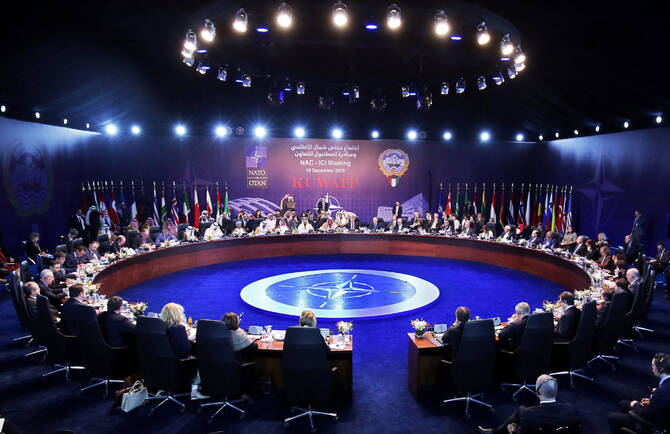
NATO leaders gathered in Ankara, Turkiye, on Tuesday and Wednesday for a major summit. In the run-up to the gathering, it was clear what the No. 1 issue on the agenda would be: burden sharing. US President Donald Trump has been pressuring European allies to invest more in defense and develop concrete plans to reach new spending targets. In this sense, the outcome of the summit was a success.
But there was another notable aspect of the summit that did not get the attention it deserved: the meeting of the foreign ministers of the Istanbul Cooperation Initiative.
The Istanbul Cooperation Initiative, or ICI, was created in 2004, the last time NATO held its summit in Turkiye, to serve as the alliance’s main platform for engaging with Gulf partners. Today, Kuwait, Qatar, the UAE and Bahrain participate in the ICI format.
The fact that this meeting was held at a NATO Summit at the foreign ministerial level is significant. It also shows how one member state can upload a policy priority from the national level to the NATO level. Had this summit been held anywhere else other than Turkiye, it is unlikely that the ICI would have met in this format.
While additional dialogue and engagement between NATO and the Gulf states is positive, the practical outcomes of the ICI over the past two decades have been mixed. At times, interest in the platform has ebbed and flowed depending on geopolitical events and the security environment in the Middle East.
Beyond the creation of a regional center in Kuwait and occasional officer exchanges and training on an irregular basis, the ICI has not met its full potential. Although attempts have been made to bring the two remaining Gulf Cooperation Council members, Saudi Arabia and Oman, into the platform, these efforts have fallen short.
But the gathering in Ankara could inject new life into this increasingly important format. With so much geopolitical and security uncertainty in the Middle East resulting from the war with Iran, NATO leaders may be waking up to an important reality. While the war in Ukraine and the security of Europe must remain the alliance’s top priority, it is also beneficial for NATO to engage more seriously with other regions such as the Middle East.
Looking ahead, NATO and its Gulf partners should take three steps to build on the momentum created in Ankara.
First, there should be a renewed focus on air defense cooperation, including the sharing and development of doctrine and possibly even joint procurement. From the Gulf of Finland in the north to the Gulf of Oman in the south and from Europe to the Middle East, air defense is now a shared priority.
The alliance cannot afford to neglect partners that sit at the crossroads of some of the world’s most important security challenges
Luke Coffey
This is also where Ukraine can serve as a bridge between NATO and the Gulf states. Ukraine is the most pioneering country in the world when it comes to countering the emerging air defense threat from unmanned systems. Every day, Ukrainian forces are learning lessons on the battlefield that are relevant not only to European security but also to the security of the Gulf.
To this end, NATO, Ukraine and the countries of the ICI should consider establishing a NATO-certified center of excellence focused on air defense in the modern age. Such a center could help coordinate lessons learned, develop doctrine and allow partners to benefit from each other’s experiences. Because the focus would be defensive in nature, cooperation in this area should also be less controversial politically.
Second, NATO should appoint a knowledgeable, experienced and well-known statesman to serve as special envoy to the ICI countries and the broader Middle East. Having a respected and senior figure as the alliance’s main point of contact for countries in the region could go a long way toward building the personal relationships that are often essential for meaningful diplomatic progress.
This position should not be symbolic. A special envoy could help maintain regular contact with Gulf leaders, identify new areas of cooperation and ensure that the ICI does not fade from the alliance’s agenda between major summits.
Finally, NATO and its Gulf partners need to develop a regular drumbeat of engagement through the ICI platform. This would make identifying new areas of cooperation and building on existing relations more predictable and routine. Ministerial meetings should not be rare events that depend on the location of a NATO summit. Instead, they should become a regular feature of NATO’s outreach to the Gulf.
This regular engagement could include annual ministerial meetings, more frequent senior official consultations, expanded training opportunities and practical cooperation on issues such as maritime security, cyber defense, critical infrastructure protection and countering unmanned systems. The goal should be to move the ICI from an underused diplomatic format to a practical platform that delivers results.
NATO should also recognize that the Gulf states are not peripheral to European security. Energy markets, maritime trade routes and Iran’s destabilizing behavior all connect the Middle East directly to the interests of Europe and North America. In an era of strategic competition, the alliance cannot afford to neglect relationships with partners that sit at the crossroads of some of the world’s most important security challenges.
As NATO’s leaders return home after a successful summit and focus on the major issues of burden sharing, defense investment and support for Ukraine, they should not miss the opportunity presented in Ankara.
For the foreseeable future, the Middle East will remain important to Europeans and Americans alike. If NATO is serious about adapting to a more dangerous world, then strengthening ties with its Gulf partners through the ICI is a good place to start.
BY: Luke Coffey is a senior fellow at the Hudson Institute.
Disclaimer: Views expressed by writers in this section are their own and do not necessarily reflect The Times Union‘ point of view