- JAXA’s RV-X Demonstration Advances Reusable Launch Technology Ahead of International Callisto Project
NOSHIRO, Japan: Japan’s space agency successfully tested a prototype reusable rocket on Saturday, marking a significant milestone in the country’s efforts to develop cost-effective space launch technology and strengthen its future space capabilities.
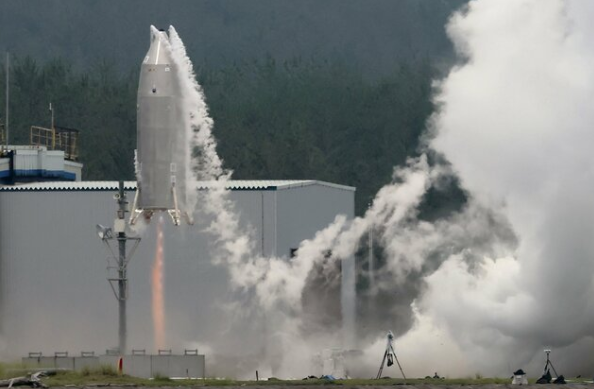
The Japan Aerospace Exploration Agency (JAXA) conducted the test at its facility in Noshiro, Akita Prefecture, where the experimental RV-X rocket completed a controlled vertical take-off, horizontal maneuver and precision landing.
Successful Flight Demonstrates Key Landing Technology
According to JAXA, the RV-X reached an altitude of approximately 11 metres before moving about 16 metres horizontally and landing safely after a flight lasting around 40 seconds.
The successful demonstration validated critical technologies required for reusable launch vehicles, which are expected to significantly reduce the cost of future satellite missions and space exploration.
“The flight test went well. I feel relieved,” Project Manager Takashi Ito said during an online press conference following the test.
Supporting Next-Generation Callisto Rocket
JAXA said data gathered from the RV-X test will contribute directly to the development of the Callisto reusable launch vehicle, a joint project involving Japan, France and Germany.
The Callisto demonstrator is powered by the same engine used in the RV-X prototype and is scheduled to undergo a flight test before next April.
The upcoming trial aims to achieve a higher-altitude flight and a controlled vertical landing, representing another important step toward fully reusable launch systems.
Japan Pursues Reusable Space Technology
Japan has intensified efforts to develop reusable rocket technology as it seeks to lower launch costs and increase the frequency of satellite missions.
The country’s flagship H3 launch vehicle is currently expendable, meaning it can only be used once. By recovering and reusing rocket stages, Japan hopes to improve the competitiveness and sustainability of its space programme.
Reusable launch systems have transformed the global space industry by reducing operational costs and enabling more frequent launches.
Inspired by Global Advances
The commercialization of reusable rocket technology has been led by the United States-based company SpaceX, whose two-stage Falcon 9 rocket routinely returns and reuses its first-stage booster after launch.
Japan’s reusable rocket ambitions have also gained momentum through private-sector innovation.
Last year, Honda R&D Co., a subsidiary of Honda Motor Co., successfully conducted the country’s first private-sector flight test of a reusable rocket, highlighting growing collaboration between Japan’s public and private aerospace industries.
According to JAXA, the RV-X prototype measures approximately 7.3 metres in length, 1.8 metres in diameter and is equipped with four landing legs designed to enable stable vertical landings.
BY: The Times Union – KYODO