Sovereign wealth funds have long been used to support economic diversification but they are now increasingly playing a wider strategic role. As Gulf governments invest in sectors linked to national security, where that money goes can also reveal how they are positioning themselves for future challenges.
In the first half of 2026, regional sovereign wealth funds invested a record $53.9 billion across 108 deals. Nearly half of that capital went to the US, while China and the UK were the second and third-largest destinations. Coming amid the Iran war, these investment trends provide a perspective on the Gulf’s approach to security and strategic partnerships.
The Iran conflict has highlighted familiar challenges for the region, from missile defense to the growing use of drones, while reinforcing the need for resilient supply chains and rapid access to new technologies. As Gulf sovereign wealth funds increasingly invest in sectors linked to national security, the destination of that capital provides another lens through which to examine the region’s strategic partnerships. Economic diversification is likely to continue but investment decisions in security-related sectors may follow a different logic from purely commercial ones.
The strength of the US-Gulf relationship is reflected not only in investment flows but also in defense cooperation. According to the Stockholm International Peace Research Institute, the US accounted for 77 percent of Saudi Arabia’s arms imports between 2021 and 2025, alongside 62 percent of Kuwait’s, 48 percent of Qatar’s and 42 percent of the UAE’s. These figures represent more than arms sales. They reflect decades of military cooperation, joint training, interoperability and intelligence sharing that cannot be replicated overnight. While Gulf states continue to diversify their international partnerships, their security architecture remains firmly anchored in Washington.
Recent events have also highlighted that the nature of defense cooperation is evolving. The conflict with Iran demonstrates the growing importance of affordable interceptors, counterdrone systems and rapidly deployable air defense capabilities alongside traditional high-end platforms such as the Patriot and Terminal High Altitude Area Defense systems.
As a result, Saudi Arabia, the UAE and Qatar have all signed defense cooperation agreements with Ukraine since the beginning of 2026, while Kuwait has expressed interest in a similar arrangement. These partnerships focus on practical areas such as low-cost interception technologies, rapid production, technical training and battlefield experience gained during the war in Ukraine. Rather than replacing existing security relationships, they complement them by addressing operational gaps that have become increasingly evident.
Recent developments also suggest that Washington continues to view the Gulf as an important security partner. In March, the US approved $16.5 billion in arms sales to the UAE, Kuwait and Jordan, followed two months later by a further $8.6 billion package covering Israel, Qatar, Kuwait and the UAE. The announcements came amid continued debate over the extent to which US strategic attention is shifting toward the Indo-Pacific. Yet defense cooperation with Gulf partners has remained active. Speaking after the latest agreements, Defense Secretary Pete Hegseth thanked the UAE, Qatar, Bahrain, Kuwait and Saudi Arabia for their support of US military operations, reflecting the continued importance of these partnerships in Washington’s regional approach.
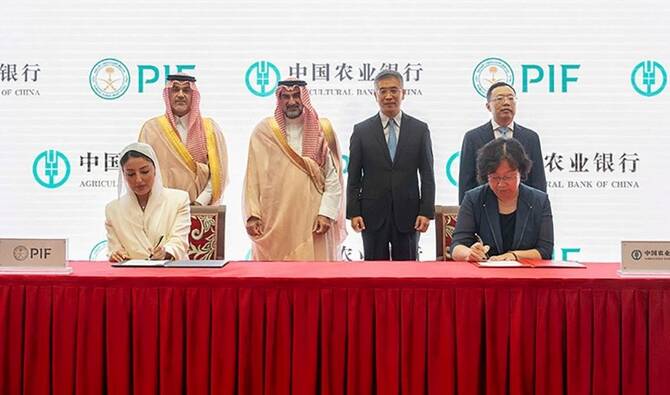
Alongside their long-standing security cooperation with the US, Gulf states have continued to diversify their commercial and industrial partnerships. China has become an increasingly important part of that strategy. Recent examples include deals worth $50 billion between Saudi Arabia’s Public Investment Fund and six Chinese companies, as well as a partnership between Dahua Technology and the PIF-owned Alat to establish a $200 million manufacturing hub in the Kingdom.
These initiatives reflect the Gulf’s broader efforts to diversify its investment portfolio while expanding cooperation in technology and manufacturing. However, the Chinese option remains more limited in sectors where interoperability with existing military infrastructure and broader strategic considerations are important.
The expansion of commercial ties has not, however, been matched by a comparable shift in investment patterns linked to security. Historically, Gulf sovereign wealth funds have maintained a relatively limited presence in Chinese equity markets, with about 80 percent of their overseas investment directed toward North America and Europe. While commercial partnerships have become more diversified, decisions involving defense, strategic technologies and other security-related sectors have tended to follow a different pattern, shaped by long-standing institutional relationships, existing defense cooperation and broader strategic considerations.
The same dynamic can also be seen beyond conventional defense. As artificial intelligence, critical minerals and advanced manufacturing become increasingly relevant to national security, these sectors are beginning to feature more prominently in Gulf investment strategies.
Recent initiatives reflect this broader trend. The UAE’s ADQ has joined the US International Development Finance Corporation as a founding partner of the Orion Critical Minerals Consortium, while the UAE also participates in the US’ Pax Silica initiative and is involved in the Stargate AI campus. Together, these projects illustrate how defense, technology and industrial resilience are becoming more closely connected.
Historically, Gulf sovereign wealth funds have maintained a relatively limited presence in Chinese equity markets.
Zaid M. Belbagi
The Gulf’s approach to security investment reflects a broader strategic shift. Sovereign wealth funds are increasingly being used not only to support economic diversification but also to strengthen technological capabilities, industrial resilience and national security. As these priorities evolve, investment decisions are likely to continue serving multiple objectives at once, balancing commercial opportunities with longer-term strategic considerations.
For Gulf states, this creates opportunities to deepen cooperation with a wider range of international partners. China will remain an important partner in manufacturing, infrastructure and industrial development but security-related investment is likely to follow a different logic.
Despite significant military modernization, China has limited experience conducting large-scale expeditionary operations, while Gulf Cooperation Council armed forces remain deeply integrated with US and other Western defense systems through decades of joint training, intelligence sharing and interoperable equipment. China also continues to maintain a close strategic partnership with Iran, including serving as Tehran’s largest oil customer and expanding economic cooperation under a 25-year strategic agreement.
While Beijing has sought to balance its relationships across the Gulf, these factors are likely to reinforce the attractiveness of the US and its allies as partners for investments in defense, advanced technologies and other sectors with direct national security implications.
BY: Writer Zaid M. Belbagi is a political commentator and an adviser to private clients between London and the Gulf Cooperation Council.
Disclaimer: Views expressed by writers in this section are their own and do not necessarily reflect The Times Union‘ point of view