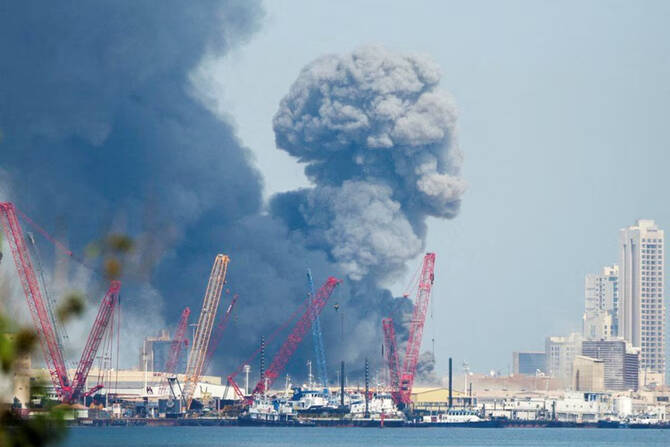
As indirect negotiations between Iran and the US drift without any sign of a resolution, Tehran’s continued missile and drone strikes against Kuwait and Bahrain expose a pattern that is increasingly difficult to disguise as anything other than strategic failure. What is unfolding is not leverage or bargaining power. It is the erosion of diplomatic credibility disguised as regional aggression.
Iran appears to be operating under the illusion that pressure can be manufactured through the targeting of sovereign Arab states that have neither declared hostility nor sought confrontation. This approach is fundamentally self-defeating. Rather than strengthening its hand in negotiations, Tehran is undermining the conditions required for any sustainable agreement. The message it is sending is not one of deterrence but of unpredictability and coercion.
The idea that attacks on Kuwait and Bahrain could somehow translate into concessions from Washington reflects a deeply flawed reading of how diplomacy functions. Negotiations, particularly those of this magnitude, are not advanced through the punishment of third parties. They are advanced through restraint, reciprocity and political maturity. What Iran is demonstrating is the opposite: an escalating reliance on force as a substitute for coherent diplomatic strategy.
The Gulf Cooperation Council states have consistently made their position clear. They are not parties to the Iran-US confrontation and they have not sought to escalate it. On the contrary, the region has repeatedly expressed support for a political settlement that ends the cycle of escalation and restores stability. Yet Iran’s conduct deliberately drags these states into the line of fire, treating their sovereignty as expendable collateral in a broader geopolitical confrontation.
Negotiations, particularly those of this magnitude, are not advanced through the punishment of third parties.
Hani Hazaimeh
This is not strategy. It is strategic distortion.
The repeated violation of Kuwait and Bahrain’s sovereignty represents a dangerous precedent in regional security. It signals that internationally recognized borders and civilian infrastructure can be instrumentalized for external bargaining. That logic, if allowed to persist, does not create leverage — it destroys trust, deepens insecurity and guarantees long-term regional realignment against Iran’s interests.
More importantly, this approach reveals a narrowing of options in Tehran’s decision-making. States that rely on coercive escalation against nonbelligerents are rarely projecting strength; they are exposing constraint. Resorting to such tactics suggests that diplomatic channels are either insufficiently understood or insufficiently valued within Iran’s current strategic calculus.
However, the consequences of this approach will not be temporary. While crises in the Middle East often move through phases of escalation and partial stabilization, the political memory of direct attacks on national territory is far more enduring. Kuwait and Bahrain will not interpret these events as isolated incidents. They will be recorded as structural shifts in threat perception, shaping defense policies and alliances long after any temporary ceasefire is reached elsewhere.
This is the long-term cost Iran appears to be ignoring. Even if a political settlement is eventually achieved between Tehran and Washington, the regional environment will not reset to its previous state. Trust, once broken through repeated violations of sovereignty, is not easily restored. Security doctrines in the Gulf will evolve accordingly and Iran will find itself facing a more consolidated and cautious regional posture.
There is also a broader irony that cannot be overlooked. Iran frequently presents itself as a power resisting external domination and advocating regional independence. Yet its actions against neighboring Arab states contradict this narrative by reproducing the very logic of coercion it claims to oppose. Sovereignty, if it is to mean anything, cannot be selectively recognized depending on political convenience.
Sovereignty, if it is to mean anything, cannot be selectively recognized depending on political convenience.
Hani Hazaimeh
At its core, the current trajectory reflects a contradiction that cannot be sustained indefinitely: the simultaneous pursuit of negotiations with one hand and coercive escalation with the other. These are not complementary tools of statecraft. They are mutually destructive when applied against sovereign states that are not part of the negotiating equation.
The continued reliance on this dual-track approach risks isolating Iran not only from Western negotiating frameworks but also from the regional environment it depends on for long-term stability and economic integration. No state can indefinitely externalize its internal strategic pressures onto its neighbors without generating cumulative diplomatic costs.
If there is any path toward de-escalation, it will require abandoning the notion that regional stability can be manipulated as a bargaining chip. The Gulf is not an auxiliary theater for external negotiations. It is a region with its own security architecture, its own sovereignty and its own political thresholds.
Ultimately, Iran faces a narrowing strategic horizon. It can either recalibrate its approach toward genuine diplomacy grounded in respect for sovereignty or continue down a path on which each act of escalation further erodes its room for maneuver. What it cannot do is sustain both simultaneously.
Until that reality is acknowledged, the cycle will continue: talks without trust and escalation without restraint. And in that cycle, it is not only diplomacy that suffers — but also the credibility of any actor that confuses pressure with policy.
BY: Writer Hani Hazaimeh is a senior editor based in Amman.
Disclaimer: Views expressed by writers in this section are their own and do not necessarily reflect The Times Union‘ point of view