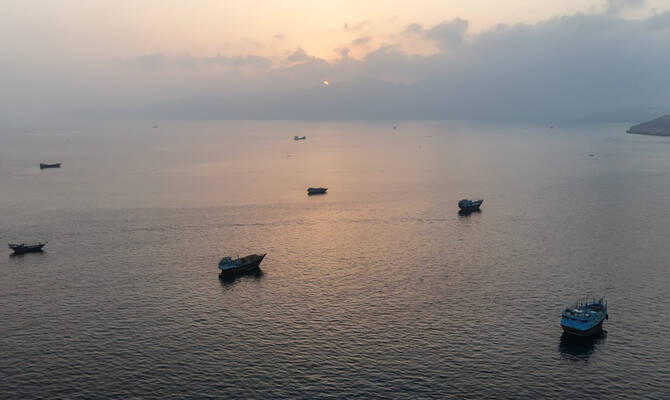
The dramatic escalation in hostilities between the US and Iran over the Strait of Hormuz will ultimately decide the fate of the crucial waterway for decades to come. Until the outbreak of the Iran war in February, the strait was subject to the normal laws of the sea, with merchant ships passing freely through the narrow passageway, including those carrying about 20 percent of the world’s energy needs.
This long-established arrangement, which had operated smoothly save for the disruption caused by the Iran-Iraq war in the 1980s, was brought to an abrupt halt when the US and Israel launched their attacks by killing Supreme Leader Ali Khamenei and senior Iranian army chiefs.
While the war meant the effective closure of the strait, with few merchant vessels willing to risk it, the situation has been further complicated by Iran’s efforts to weaponize the waterway by claiming sovereignty over an international shipping lane, before indicating that it intends to charge tolls on those using it. This was widely seen as little more than blackmail by a regime desperate to survive.
Unsurprisingly, this met strong opposition from both the US administration and key regional powers, which insist that the strait should return to its normal neutral status once a peace deal is reached. Guaranteeing freedom of navigation through the strait was one of President Donald Trump’s key demands in his 14-point memorandum of understanding for ending the conflict.
Another top priority for Trump is ending Iran’s nuclear weapons program but, while mediators say progress is being made on both these issues in Geneva and Qatar, Iran has continued to attack shipping in the strait, prompting a firm response from the US, which has a heavy military presence in the region.
What began as tit-for-tat exchanges between the US and Iran’s Islamic Revolutionary Guard Corps now threatens to descend into all-out war. While insisting that Iran remains keen to negotiate, President Donald Trump also boasts that Iran will be destroyed, which would clearly render further negotiations unnecessary.
Guaranteeing freedom of navigation through the strait was one of President Donald Trump’s key demands.
Con Coughlin
Trump has also made conflicting claims about his ultimate objectives regarding the future shipping arrangements for the Strait of Hormuz. Having said that the US will be its “guardian,” for which Washington would charge a 20 percent toll for “protection,” Trump then rowed back, claiming that he had scrapped the plan after “highly productive conversations with Middle East leadership.”
Trump’s threat to impose fees, made during an interview with Fox News, caused consternation after he announced that the US was reimposing its naval blockade of Iranian ports for ships both arriving and departing. “We are reinstating the Iranian blockade, so named because it is only stopping Iran’s ships or customers from entering or leaving,” Trump later wrote on social media.
He added that the US would be, “from this point forward, known as ‘The Guardian of the Hormuz Strait,’ but as such, and as a matter of fairness, will be reimbursed, at the rate of 20 percent on all cargo shipped, for any and all costs necessary to do the job of providing safety and security to this very volatile section of the world. The process and formation will begin immediately.”
Trump’s threat to charge fees certainly prompted a strong response from the UN and regional leaders, who voiced their fierce opposition to the move. A statement issued by the UN’s shipping agency said it opposed any imposition of fees on merchant shipping to cross the strait, while Gulf leaders called Washington to make their thoughts known.
Trump’s U-turn is now being seen as an indication that his preferred option remains a negotiated settlement, despite video and photographic evidence that the US is now attacking civilian Iranian infrastructure, including bridges. Some think this is a negotiating tactic. “They want to settle so badly,” Trump said of the Iranians. “They don’t like what we’re doing. We’ll find out whether we want to settle with them or if we just finish it off.”
Whether the Iranians will accept Trump’s demands regarding the Strait of Hormuz is another matter. Their top negotiator, Speaker Mohammed Baqer Qalibaf, told state media that Tehran had “no reason” to abide by the deal if it did not benefit from it. And he insisted that Iran’s national security depended on maintaining “Iranian arrangements” in the strait. With neither side seemingly willing to compromise on navigation in the Strait of Hormuz, it could still be many months before the fate of this vital waterway becomes clear.
BY: Con Coughlin is one of Britain’s leading journalists and an international best-selling author. His previous posts include Executive Defense and Foreign Affairs Editor with London’s Daily Telegraph. He is a leading expert on global conflict, international security and the Middle East.
Disclaimer: Views expressed by writers in this section are their own and do not necessarily reflect The Times Union‘ point of view