If the reports surrounding what is now being called the “Islamabad Declaration” are accurate, then what we are witnessing is not a fully-fledged peace agreement between Washington and Tehran, but rather an urgent political attempt to pull the region back from the edge of a wider confrontation and return it to the negotiating table.
The outlines emerging from diplomatic leaks suggest a provisional framework, an extension of the ceasefire, the reopening of the Strait of Hormuz, gradual easing of certain sanctions and restrictions, and preliminary Iranian commitments related to maritime security and the nuclear file, while the most contentious issues are deferred to future negotiations.
According to several international reports, the proposed arrangement could include a 60-day extension of the truce, the lifting of restrictions on Iranian ports, and limited sanctions relief, in exchange for Iranian assurances regarding nuclear weaponization, enrichment activities, and parts of its stockpile of highly enriched uranium.
What matters most, however, is that the agreement, at least in its current form, does not resolve the crisis so much as reorganize it. It addresses the urgent headlines, ending hostilities, restoring freedom of navigation, easing economic pressure, and reopening diplomatic channels.
But the deeper and more explosive issues remain untouched: the future of Iran’s nuclear program, enrichment levels, ballistic missiles, Tehran’s regional influence, and the security guarantees demanded by both Israel and the Gulf states.
For that reason, the “Islamabad Declaration” appears less like a final settlement and more like a strategic pause, a carefully managed attempt to buy time.
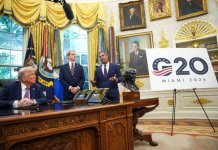
President Donald Trump’s recent calls with regional leaders ahead of the anticipated announcement hardly seem ceremonial. More likely, they were intended to test reactions, contain objections, and secure a degree of regional political cover.
Washington understands that no arrangement with Iran can survive if America’s allies, particularly Israel, Saudi Arabia, and the UAE, feel sidelined. The White House also needs broader regional legitimacy for any deal tied to maritime security and the reopening of Hormuz.
From Washington’s perspective, the proposed framework serves several purposes. It halts a costly military and political escalation the administration has little interest in turning into an open-ended war. It restores a measure of stability to one of the world’s most vital energy corridors.
And politically, it allows Trump to present himself not as a president dragged into another Middle Eastern conflict, but as a leader who used pressure to force negotiations.
Iran, meanwhile, needs the agreement almost as much as it fears it. Tehran urgently needs economic breathing space and relief from mounting military and maritime pressure. Yet the leadership is equally aware that any compromise could be portrayed domestically as a retreat under pressure.
This explains the sharp tone of recent Iranian statements insisting that Tehran “will not bargain away its rights” and does not trust Washington, even as negotiations continue behind closed doors.
Israel remains the most uneasy actor in the equation. From the Israeli perspective, any agreement that does not clearly dismantle Iran’s nuclear capabilities or neutralize its stockpile of enriched uranium merely postpones the threat rather than removes it.
Even if Israel tolerates a temporary arrangement, it may still reserve the right to act unilaterally if it concludes that Tehran is using the pause to regroup strategically.
The Gulf states face a more complicated dilemma. They want the war contained, shipping lanes secured, and energy infrastructure protected. But they also fear a scenario in which Iran reenters the economic system without meaningful limits on its regional influence or maritime leverage.
Gulf capitals are therefore likely to support the agreement cautiously — provided it includes credible guarantees on navigation security and enforceable monitoring mechanisms.
China, by contrast, is expected to strongly support the deal. Beijing’s overriding priority is stability in energy markets and uninterrupted Gulf exports. Russia’s position is more nuanced; Moscow does not want Iran weakened or isolated, but neither does it want a full-scale US-Iran rapprochement that reduces Tehran’s dependence on Russian political backing.
The larger question is whether such an agreement can endure. Perhaps, but only if it remains limited, gradual, and tightly monitored. The moment it attempts to leap toward unresolved strategic questions, its fragility will become obvious.
“Gulf capitals are therefore likely to support the agreement cautiously — provided it includes credible guarantees on navigation security and enforceable monitoring mechanisms.”
Abdellatif El-Menawy
Who verifies Iranian compliance? What happens to the uranium stockpile? Will sanctions be lifted gradually or all at once? Does the agreement address Iran’s regional proxies? Can freedom of navigation be guaranteed without implicitly recognizing a special Iranian role in Hormuz?
And perhaps most critically: can Washington restrain Israel if Tel Aviv concludes the agreement falls short?
What has become increasingly noticeable over the past 24 hours is a subtle but important shift in the American tone itself. The language coming out of Washington is moving away from talk of a “comprehensive agreement” toward references to “transitional arrangements” and “interim frameworks” designed primarily to prevent total collapse.
That shift reflects growing recognition inside the US administration that a quick, sweeping resolution with Iran is far more difficult than initially assumed.
At the same time, the crisis around Hormuz is no longer merely a Middle Eastern issue. It has become part of the broader strategic balance between Washington and Beijing.
China, as the world’s largest importer of Gulf energy, can no longer remain detached from the security of maritime trade routes. Meanwhile, the US is increasingly using China’s dependence on Gulf energy as leverage in its wider strategic competition with Beijing.
For that reason, any future understanding between Washington and Tehran will not be viewed solely as a nuclear or regional agreement. It will also be seen as part of a broader effort to reshape the international order itself.
Perhaps this is why the “Islamabad Declaration” feels less like a traditional peace accord and more like an international attempt to stop a historical rupture before it spirals into something far larger, a moment that could reshape not only the Middle East, but the global system as a whole.
BY: Writer Dr. Abdellatif El-Menawy has covered conflicts worldwide. He is the author of “The Copts: An Investigation into the Rift between Muslims and Copts in Egypt.” X: @ALMenawy
Disclaimer: Views expressed by writers in this section are their own and do not necessarily reflect The Times Union‘ point of view