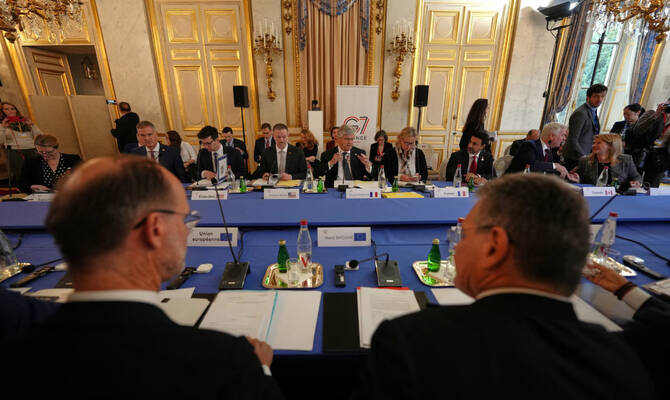
G7 trade ministers met in Paris last week for a key meeting focused on enhancing the West’s critical mineral supplies. However, the really big event in this year’s French presidency comes next month, with the leadership meeting hosted by President Emmanuel Macron.
It is now about half a century since the grouping of industrialized democracies was founded to facilitate shared macroeconomic initiatives in response to the challenges of the 1970s, including the aftermath of the Middle East energy shock and the ensuing international recession. So, today, there is significant historical continuity, with the world again grappling with a crisis in the region.
While there have been periodic tensions within the G7 during the last five decades, this year’s summit could be the most challenging ever. A key question will be how much US President Donald Trump buys into the process after recent intense criticisms of allies — including previous political soulmate Italian Prime Minister Giorgia Meloni — on issues ranging from the future of Greenland to Ukraine.
Macron is already pulling out all the stops to try to bring the US president on board. This includes changing the dates of next month’s summit to June 15-17 to accommodate Trump’s desire to watch an MMA event in Washington on June 14, his 80th birthday.
However, the potential for problems is still significant. From serving as an annual affirmation that the G7 is largely aligned, as in much of the past, this year’s summit may again see splits.
It is also possible, perhaps even probable, that Trump may again call for the return of Russia to the club. However, all other G7 members are strongly opposed to this and there is no clear sign that Moscow, which joined the then-G8 summits from 1997 to 2014, will ever be invited back to the organization while President Vladimir Putin remains in office.
This context makes it very difficult for Macron to frame a “Trump-proof” G7 agenda. However, despite disagreements over multiple issues, the French president may be able to navigate a way through this given his previous ability to befriend the US president at key moments.
Nonetheless, this is likely to be a very high risk G7 year. If it goes badly, this could have wider implications, with the NATO Summit scheduled soon after. Unfortunately, there is an all-too-significant possibility this could also undermine US support for Ukraine, with the Trump team’s resources and attention increasingly diverted to the Middle East.
While there have been periodic tensions, this year’s summit could be the most challenging ever.
Andrew Hammond
Beyond Iran and rebuilding peace and stability in the Middle East, the French G7 presidency is prioritizing a wide range of geopolitical issues. These include preserving Ukraine’s long-term prosperity and security; cooperation to increase security and resilience across the vast Asia-Pacific region; building stability and resilience in South America, including Venezuela; supporting enduring peace in Africa, including Sudan and Congo; and strengthening sanctions and countering hybrid warfare and sabotage.
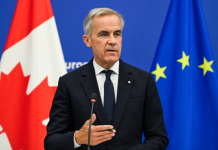
This is a big agenda and one that requires deep global partnerships. This is why Macron is reaching beyond the G7’s leaders (himself, Trump, Japanese Prime Minister Sanae Takaichi, Canadian Prime Minister Mark Carney, UK Prime Minister Keir Starmer, German Chancellor Friedrich Merz and Meloni). Other world leaders playing a role this year have included Australian Prime Minister Anthony Albanese, Ukrainian President Volodymyr Zelensky and Indian Prime Minister Narendra Modi.
One of the key economic agenda items is likely to be cushioning the stagflationary shock being felt around much of the world as a result of the Middle East conflict. The G7’s finance and energy ministers have already said they will take “all necessary measures” to safeguard the global energy market.
Of course, the International Energy Agency already coordinated the release of 400 million barrels of oil in March to mitigate reductions in cargo. Some G7 leaders, including Takaichi, are already asking the organization for an additional coordinated release of oil stockpiles.
This energy crunch is particularly impacting Asia and Europe. In Europe, some nations, including Poland, Hungary and Croatia, have already introduced fuel price caps or comparable measures. At the EU level, European Commissioner for Energy Dan Jorgensen is pushing for wider actions, including reducing fossil fuel exports and boosting renewable energy production.
G7 ministers have also called on all countries to refrain from imposing unjustified export restrictions on hydrocarbons and related products. There was also a call from some of the finance ministers, including the UK’s Rachel Reeves, for no more new trade barriers that could disrupt supply chains and increase costs to be put up during the crisis — a rebuke to the US, which is threatening new trade tariffs in the coming weeks.
Next month’s big event therefore has huge potential for more diplomatic fireworks. While some of the G7’s disagreements pre-date Trump, his presidency has widened these schisms in a “G6+1” fashion, posing the biggest threat to Western unity in living memory.
BY: Writer Andrew Hammond is an associate at LSE IDEAS at the London School of Economics.
Disclaimer: Views expressed by writers in this section are their own and do not necessarily reflect The Times Union‘ point of view