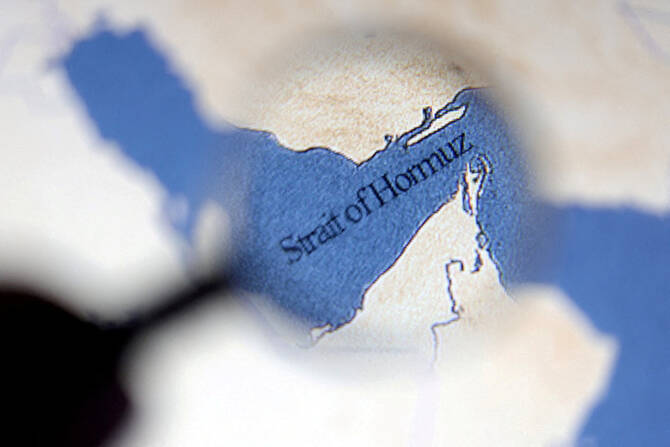
In its recent proposal to the US, Iran suggested first handling the issue of the Strait of Hormuz and the end of the war and leaving discussions on the nuclear issue until later. Iran is creating new hurdles for Washington and is banking on its own resilience and ability to outlast America.
In its asymmetric warfare approach, it was somehow predictable that it would use the Strait of Hormuz card to put pressure on the US and the world to end the war. However, Iran should be careful. It is one thing to use this card to push America to come to the negotiating table, but to insist on it will have the opposite effect in the long run.
Of course, the closure of the strait, compounded by the US blockade, is hurting the global economy. Iran is hoping that this will push the international community to put pressure on America to end the war. On the other hand, with Iran insisting on asserting its dominance over an international waterway indefinitely, the world will not want to be at Iran’s mercy later on. It will look for alternative routes and this will make the Strait of Hormuz card irrelevant, or at least highly ineffective, in the future.
In addition to this strait, Iran has another card it has not yet played: the Bab Al-Mandab Strait. This falls in the area under the control of the Houthis, Iran’s Yemeni allies. It is of great importance. It is a vital maritime channel connecting Asia, Africa and Europe. A significant portion of global trade passes through it. All shipments coming from Asia toward Europe go through the Bab Al-Mandab Strait before reaching the Suez Canal. Some 12 percent to 15 percent of worldwide trade and about 30 percent of global container traffic transits via the Suez Canal. A sizable part of this flow also has to pass through the Bab Al-Mandab Strait.
The world will look for alternative routes and this will make the Strait of Hormuz card irrelevant, or at least highly ineffective.
Dr. Dania Koleilat Khatib
In addition to being an important passage for world trade, it is an important passage for world data. Seventeen submarine fiber-optic cables carry 90 percent of the data traffic between Asia and Europe. Hence, the Bab Al-Mandab Strait provides an essential connection for the world’s information flow and is an important lifeline for the digital infrastructure of the Middle East and Africa.
So far, Iran has not used this card. In fact, there has been an increase in trade flowing through this area. Saudi Arabia has benefited from the infrastructure it built to reroute a big part of the oil extracted from its eastern oil fields to the port of Yanbu on the Red Sea. The pipeline was built in the 1980s during the Iraq-Iran war to mitigate any disruption caused by the Iranians around the Strait of Hormuz.
The East-West pipeline is operating at its full capacity of 7 million barrels per day. Saudi Arabia is using its infrastructure to help the Arab Gulf states that are suffering due to the closure of the Strait of Hormuz. Saudi Aramco’s Asia-Pacific customers are now loading crude at Yanbu and using the Bab Al-Mandab as an alternative to transit oil to Asia. This means the strait has gained importance since the start of the war, which makes it a card Iran will likely play when it feels it needs to. This is a potential risk.
If both the Strait of Hormuz and the Bab Al-Mandab Strait were closed, 30 percent of global container shipments and 25 percent of gas and oil supply could be threatened. This not only involves energy supply, it would also have implications for food security, fertilizer supply and global manufacturing supply chains. As a result, the Arab Gulf states — and the world — are starting to look for alternative routes.
We can already see two alternative routes taking shape that are far from Iran and its areas of influence.
Dr. Dania Koleilat Khatib
We can already see two alternative routes taking shape that are far from Iran and its areas of influence.
The first is a railway line from Saudi Arabia to Jordan, Syria and Turkiye, reviving the old Hijaz Railway. This route would support the movement of goods as it goes through countries that are not subject to Iranian influence, while connecting the Arab Gulf to Turkiye and the Mediterranean. From there, the goods could flow to Europe. Saleh Al-Jasser, the Saudi minister of transport and logistic services, last week announced that joint studies into this project are expected to be completed by the end of the year.
The other route is the Middle Corridor, or the Trans-Caspian International Transport Route. This is a multimodal trade route connecting Europe and China via Kazakhstan, Azerbaijan, Georgia and Turkiye. Though the original concept of a Middle Corridor that competes with the Northern Corridor and the ocean route in linking China to Europe goes back to 2009, its importance started to grow with the Ukraine war. It represents an alternative to trade passing through Russia. Now, even more attention is being paid to this route as it also bypasses Iran and its areas of influence.
Iran must be careful and look beyond the war. It is using the Strait of Hormuz card to the maximum and it might use the Bab Al-Mandab pressure point next. However, the more it chooses to blackmail the world, the more the world will push back by looking into alternative routes.
BY: Writer Dr. Dania Koleilat Khatib is a specialist in US-Arab relations with a focus on lobbying. She is co-founder of the Research Center for Cooperation and Peace Building, a Lebanese nongovernmental organization focused on Track II.
Disclaimer: Views expressed by writers in this section are their own and do not necessarily reflect The Times Union‘ point of view