Last week, I spoke at a seminar organized by the Eurasia Policy Council at the House of Lords in London. The event was hosted by Lord Qurban Hussain and Prof. Shabnam Delfani. The seminar was titled “From ceasefire to lasting peace: What can the United Kingdom do to achieve lasting peace in the Middle East?” The attendees and speakers agreed that peace in our region does not start and end with an agreement between the US and Iran, but rather through an agreement between Iran and its neighbors, namely the Arab Gulf states.
Nasim Far, the deputy head of the Iranian Embassy, stressed that Iran has no hegemonic ambitions in the neighborhood and that the threat perceived by the Gulf states has been fabricated by the Americans. He added that Iran seeks brotherly relations with them. I addressed the key hurdle facing a normal relationship between the two sides of the Gulf: Tehran’s proxies. The Iranian diplomat said they do not call them proxies, as they consider them to be legitimate liberation movements. However, he did strike a conciliatory tone by saying that Iran does not want to undermine neighboring states’ security and is open to discussing security concerns with them.
The big question is how can Iran solve the issue of its proxies with its neighbors? It is important to examine the nature of the proxies in order to know how to handle them.
Iran could use its influence over these groups to contribute to reconciliation instead of being the cause of division
Dr. Dania Koleilat Khatib
Iran has been under sanctions since 1979. It has not been able to make alliances with regional countries or renew its arsenal due to its animosity with the US. So, it resorted to unconventional methods to create deterrence. It built alliances with like-minded groups inside various countries. It mainly engaged with Shiite minorities. However, it did not restrict itself to them. It is also an ally of Hamas in Palestine, even though that group is Sunni. These proxies created a deterrence, as well as becoming tools for pressure and influence. Late Supreme Leader Ali Khamenei used to say that Lebanon’s Hezbollah was on the “front lines” of Iran’s defense against Israel. Iran’s influence in Iraq, which was projected through allied militias, was also used to pressure the US.
However, its relationships with these proxies differ. Hezbollah is a child of the Iranian revolution, while Iran came and engaged with existing movements like Hamas and the Houthis. While these are public movements, it is believed Iran has also been behind many sleeper cells in the region. The UAE last week announced the arrest of members of a group that was operating covertly in the country and plotting terrorist activities.
How can the issue of Iran’s proxies or allies be solved? As I have mentioned in a previous article, Iran does not have an on and off switch for its proxies. They have, at least partly, a domestic agenda. They have grievances against their governments and use Iran’s support against their own states. Here, Iran’s role could change from a spoiler to a facilitator. It could use its influence over these groups to play a positive role and contribute to reconciliation instead of being the cause of division.
Saudi Arabia and Iran could reach an arrangement that brings stability and saves Lebanon from civil war
Dr. Dania Koleilat Khatib
The two proxies that would need immediate attention are the one that is the most important to Saudi Arabia, the Houthis, and the one most important to Iran, Hezbollah. Iran can help Yemen and show goodwill to the Kingdom by encouraging the Houthis to engage in constructive talks with the legitimate Yemeni government that could result in them joining the state under a federal structure. The other issue, which is more complicated, is Hezbollah. On this, Iran needs Saudi Arabia’s help.
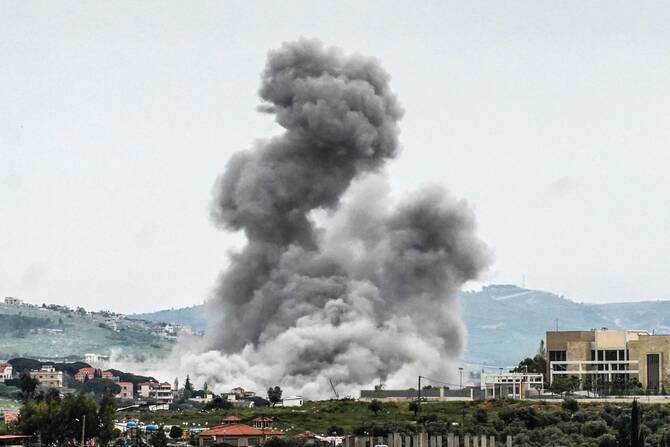
Hezbollah is currently fighting Israel. Today, Iran and Saudi Arabia have more in common on Lebanon than one might think. Neither country wants Lebanon to normalize relations with Israel for free. Saudi Arabia insists that it will not normalize with Israel unless the latter recognizes a Palestinian state. In the meantime, Israel and the US are bullying Lebanon into “peace.” Israeli Prime Minister Benjamin Netanyahu has reportedly threatened Lebanese President Joseph Aoun that, if he does not meet with him in Washington, he will come on the back of a tank and shake Aoun’s hand at the Baabda Palace, alluding to a possible invasion.
Saudi Arabia is adamant on the integrity of Lebanese territory and will not accept it ceding an inch of its soil to Israel. Adviser to the Saudi foreign minister Prince Yazid bin Farhan last week visited Lebanon to make sure it was committed to the Taif Agreement that ended the civil war.
However, once the war is over, what will happen to Hezbollah? For sure, disarmament will be put on the table again. If conducted by force, it could lead to civil unrest and even civil war. The group and Iran need a graceful exit, as part of which Hezbollah can become a political party and relinquish its military activities. On this, Saudi Arabia and Iran could reach an arrangement that brings stability and saves the country from the civil war that Israel has been scheming.
Iran and the US might be negotiating in Islamabad, but on the issue of Tehran’s proxies, the most beneficial move would be for Iran to negotiate with its neighbors.
BY: Writer Dr. Dania Koleilat Khatib is a specialist in US-Arab relations with a focus on lobbying. She is co-founder of the Research Center for Cooperation and Peace Building, a Lebanese nongovernmental organization focused on Track II.
Disclaimer: Views expressed by writers in this section are their own and do not necessarily reflect The Times Union‘ point of view