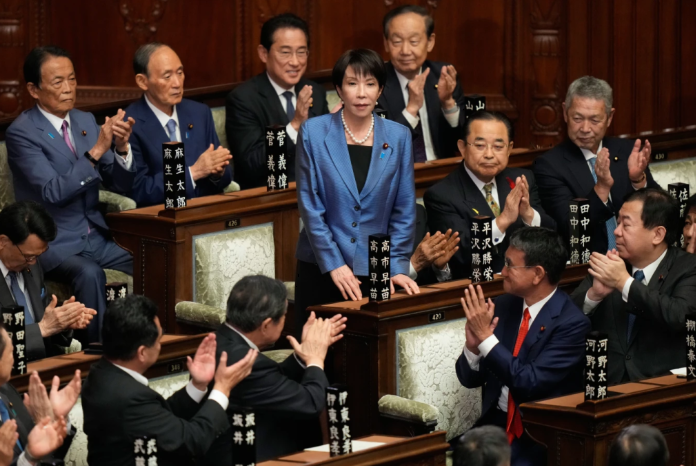
TOKYO – Six months have passed since Prime Minister Sanae Takaichi took office. After her ruling party’s landslide victory in a February general election for the House of Representatives, Takaichi has built a stable power base that could be described as one of unchallenged dominance.
Her ability to maintain high approval ratings likely reflects both her willingness to tackle a wide range of policies and the public’s favorable view of her habit of explaining those policies in her own words.
Looking back over the past half year, on diplomacy she has maintained good relations with the U.S. administration of President Donald Trump. At their first summit meeting, the two leaders projected unity, and at a second meeting held as tensions over Iran intensified, she handled well a moment in which Japan was pressed to contribute to ensuring security in the Strait of Hormuz.
Conditions for exporting defense equipment have also been eased.
On the economic front, the government is accelerating debate around two pillars: “crisis-management investment” and “growth investment.” As the world enters an era of competition through industrial policy, the attempt to spur investment by selecting 17 strategic fields deserves credit.
However, challenges have also come into view.
One is the divided Diet, where the ruling coalition controls the lower house but not the House of Councillors. The prime minister strongly wanted the fiscal 2026 budget to be enacted within fiscal 2025, but proceeding while counting on smooth deliberations in the opposition-controlled upper house was unrealistic from the outset.
It is also questionable whether sufficient communication had been maintained with the upper house caucus of her Liberal Democratic Party.
The split Diet will remain a headache in deliberations over future bills as well. Because overriding the upper house through a second vote by the more powerful lower chamber would consume political capital, it is desirable to build a framework that can stabilize Diet management, such as expanding the coalition or forming issue-by-issue partial alliances.
Relations with the Japan Innovation Party also warrant caution. Given the situation in the upper house, maintaining a coalition with the party is necessary.
For that reason, the government must move forward on implementing what the two parties agreed on, including reducing the number of seats in the lower house and realizing a “second capital” concept, but there are also cautious voices within the LDP.
In particular, cutting the number of the lower house’s proportional representation seats is an issue that could determine the survival of opposition parties such as Komeito and the Democratic Party for the People, and a strong backlash is expected. If pushed through forcefully, it could also provoke public opposition and risk hurting approval ratings.
The most urgent challenge facing the Takaichi administration is responding to the situation over Iran. The prime minister is working hard to procure crude oil and naphtha from alternative import sources, but if things continue as they are, the adverse effects of import stagnation and supply shortages will begin to surface and inflation may accelerate.
This presents a dilemma for the Bank of Japan: raising interest rates to curb rising inflation would cool the economy, but leaving them unchanged risks letting inflation accelerate further.
The prime minister’s launch of a “National Council on Social Security” and the start of discussions toward introducing a refundable tax credit deserve praise. At the same time, the growth-strategy investments she emphasizes and efforts to strengthen defense capabilities will require enormous funding.
If she follows through on her stated intention to make the consumption tax rate on food and beverages zero for two years, revenue is expected to fall by about 5 trillion yen ($31 billion) a year.
Market concerns about Japan’s fiscal condition have become a structural factor behind the yen’s weakness and rising long-term interest rates, forcing the government into difficult steering to reconcile policy promotion with fiscal discipline. Will it really make the rate zero? It should consider alternatives such as withdrawing the plan or setting the rate at 5 percent.
The prime minister’s political style also merits mention. Her willingness to speak in her own words is appealing, but taking on too much work by herself would be a risk for any bid for long-term rule.
“Team building,” in which she trusts those around her and delegates rather than carrying everything alone, is an urgent task.
Whether the prime minister can overcome these challenges and build an even firmer foundation will be tested in the period ahead.
BY: Writer Harukata Takenaka, born in Tokyo in 1971, is a professor at the National Graduate Institute for Policy Studies, specializing in comparative politics. A University of Tokyo graduate, he has worked at the Finance Ministry and has been at the current post since 2010.
Disclaimer: Views expressed by writers in this section are their own and do not necessarily reflect The Times Union‘ point of view