- Threatened without and within, Israel will soon have to decide whether Netanyahu is best placed to defeat enemies bent on our destruction, and whether his policies are shaping or wrecking the Israel we need
The annual transition from Memorial Day to Independence Day is always emotionally complex: Israel moves in a few moments from a day of national mourning for those who lost their lives in our defense to the celebration of our consequent capacity to live here in safety and freedom.
This year, though, the transition is less acute — not so much a shift from deep grief to happiness unbounded, as from anguish to a joy and national pride tempered by trepidation over where our nation is headed. The safety is relative and the freedom is under assault.
For we face two existentially threatening realities, both of which also affect Jews around the world.
First, as throughout our modern history, Israel’s enemies are seeking to destroy it — but in the shape of Iran and its proxies they have lately come closer than ever to attaining the capacity to do so at a stroke, in an often indifferent if not actually supportive international climate.
And second, we are being ripped asunder and morally compromised from within under a leader who has brought Jewish supremacists and violent racists into the heart of government, encouraged the entire ultra-Orthodox community to shirk its national responsibilities, and proven incapable of accepting his own personal culpability in the worst enemy attack since the establishment of the state.
Enemies without
The threat posed by Iran that Prime Minister Benjamin Netanyahu constantly harps upon is not exaggerated. The regime genuinely intends to destroy Israel. As both Netanyahu and US President Donald Trump have stated, were it to attain nuclear weapons, there should be no doubting its readiness to use them.
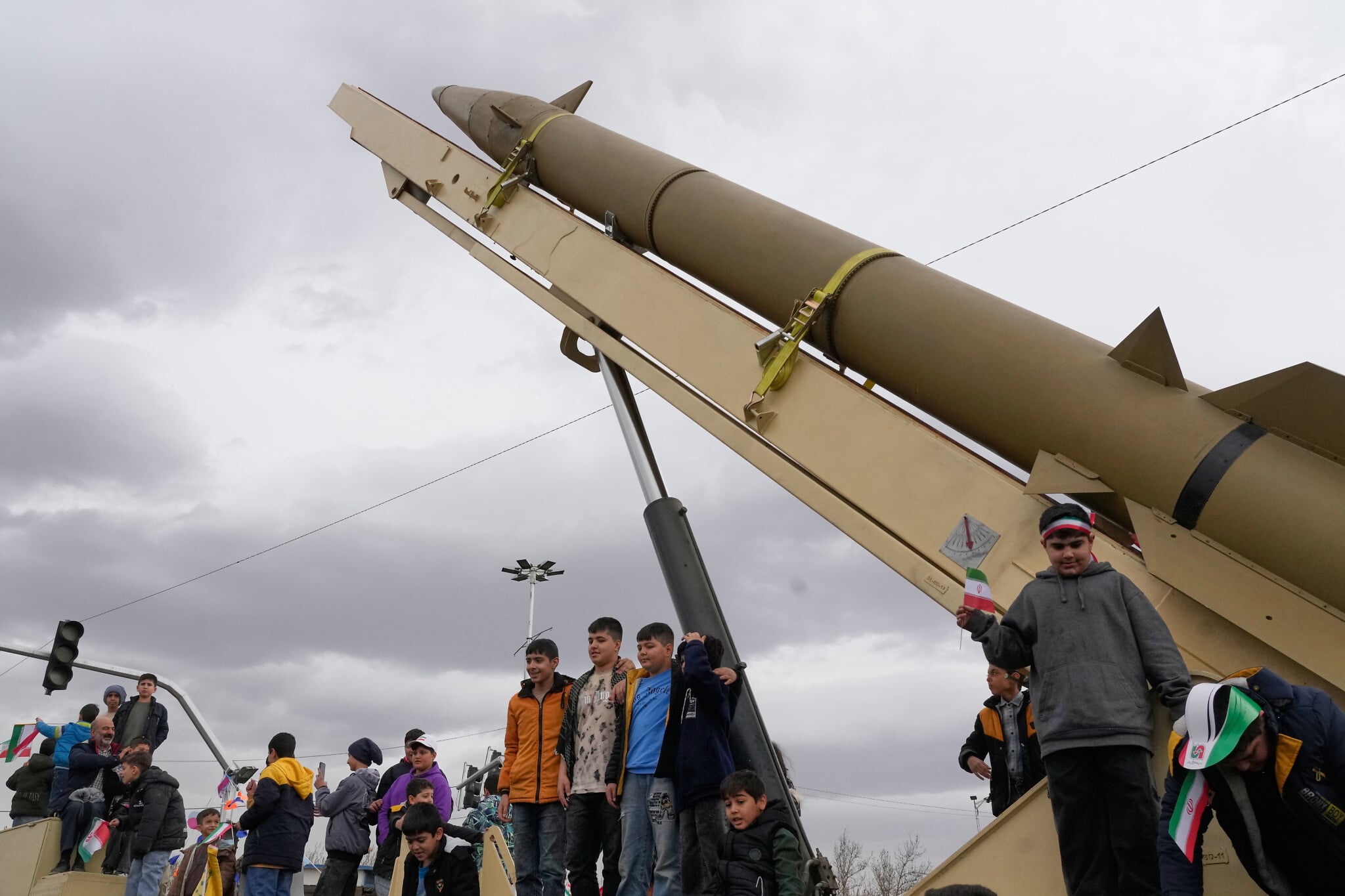
annual rally marking the 1979 Islamic Revolution at the Azadi (Freedom) Square
in Tehran, Iran, on February 11, 2026.
Indeed, if Hamas’s leader Yahya Sinwar had trusted Iran’s leaders sufficiently to tell them exactly when he was planning to send thousands of terrorists bursting through the Gaza border to massacre the residents of our unconscionably unprotected south, he would have enabled the Islamic Republic to muster all its missile, proxy and other forces and join in simultaneously. Then there is no telling where the October 7, 2023, invasion would have ended and what would have been left of Israel when it was over.
If the war that the US and Israel launched against Iran on February 28 comes to a permanent stop with the regime retaining its stockpile of highly enriched uranium, if it still has any path to a bomb, if it is still able to build an arsenal of thousands of ballistic missiles, the existential danger will merely have been temporarily reduced.
Whatever Trump and Netanyahu may wish to say right now, the goal of the war was to bring down the regime. But the challenge was underestimated, and the danger the Islamic Republic poses to Israel and anybody that gets in its way — including its own people — will remain potent for as long as it holds power.
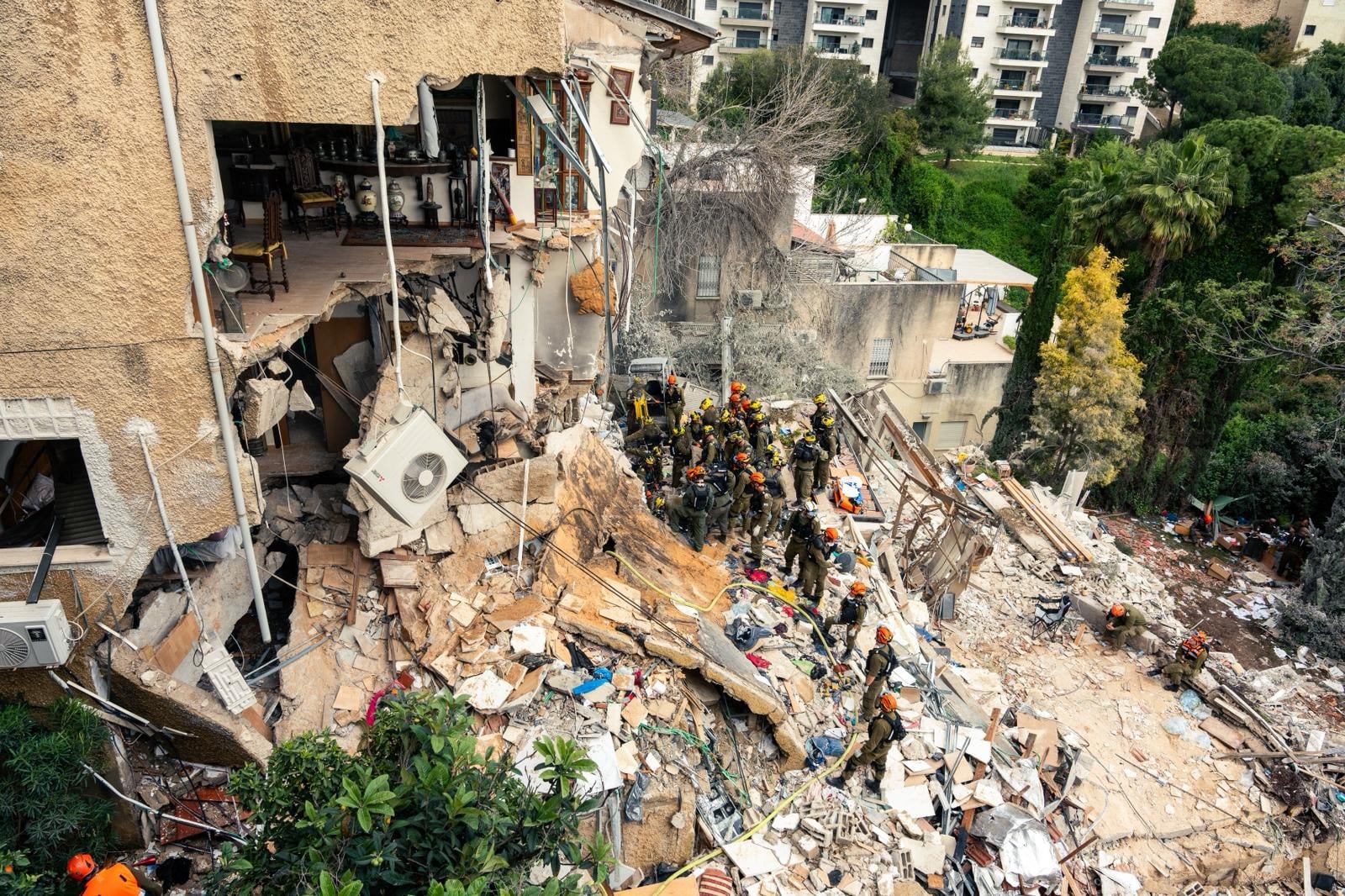
residential building struck by an Iranian missile in Haifa, April 6, 2026. Four Israeli
family members were killed in the attack.
Hamas, too, is much weakened but not finished — retaining control over most of Gaza’s population, quietly reviving, its core goal of destroying Israel undimmed. An Israeli government unfettered by a dominant contingent bent on reoccupying Gaza might have fared better in enabling alternate, stable governance, but there’s no guarantee of that.
Hezbollah, so greatly degraded by Israel in 2024, has risen from the ashes to batter the north. There are glimmers of hope in the current Lebanese government’s ostensible will to marginalize Hezbollah, but it lacks the means to do so.
For now, these two terrorist armies remain real threats to Israel — enemies the IDF has sought to destroy, but has proved able only to constrain.
Corrosion within
Inside Israel, Netanyahu and his ministers are taking a figurative sledgehammer to the rule of law, demonizing the judiciary and talking openly about ignoring Supreme Court rulings as they seek to dismantle the only protector of people’s rights against abuse by the political leadership in a country that has no constitution. They’re also hard at work on legislation to curb freedom of the press.
Meanwhile, Sunday’s literal sledgehammer assault on a statue of Jesus in southern Lebanon by a soldier in the Israel Defense Force dismally emblemized the corrosion in the IDF, and its slide toward some kind of supremacist theocracy, as encouraged by Bezalel Smotrich, Netanyahu’s finance minister and minister in the Defense Ministry.
The IDF takes no meaningful action against soldiers wearing mercenary insignia indicating they are in the service of the Messiah and inciting violence and territorial expansionism. The paramilitary Border Police last week locked up four combat medics for the crime of barbecuing on the Sabbath. And most damningly and relentlessly, IDF troops have failed to tackle, and allegedly indulged if not participated in, rising and often deadly Jewish terrorism against Palestinians in the West Bank.
In one area that combines the external and internal threats, the prime minister has concertedly denounced the Biden presidency and allied Israel with Trump — even as the Democratic Party, increasingly hostile to Israel, is already pulling away, with the Republican Party far from universally supportive. This despite the fairly obvious facts that Trump’s time in office is finite, and Israel’s strategic future is dependent on solid bipartisan support from the world’s only superpower.
Personality cult
The main event marking the jarring passage from Memorial Day to Independence Day, the annual torch-lighting ceremony held adjacent to the grave of Zionism’s visionary Theodor Herzl, was until recently meant to be a broadly nonpolitical affair, presided over by the speaker of the Knesset. Until Israel’s 70th anniversary, in 2018, the prime minister generally didn’t even attend. But that year, ignoring an outcry, Netanyahu insisted on addressing the event, and that has since become the largely unremarked-upon norm.
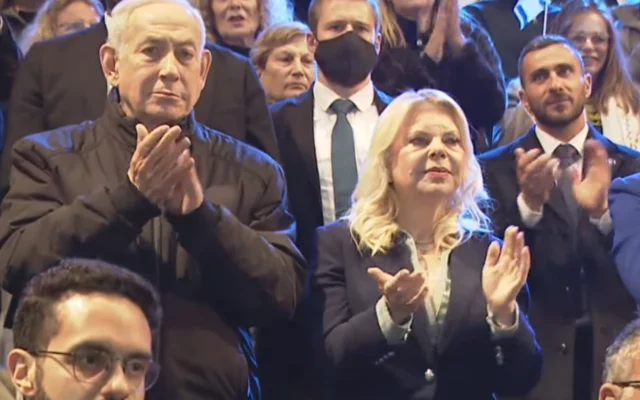
On Tuesday, Netanyahu and his wife Sara were dominant presences at the nationally broadcast live ceremony. They were introduced at the start of the show, together with the speaker and his partner, the state’s cameras followed them as they walked across the stage to their seats, and they were shown repeatedly on screen as the evening wore on. So, too, were audience members shouting their support for “Bibi.” (The prime minister appeared 42 times, according to a count by the Ynet news site.)
Netanyahu spoke, not from a simple podium on stage, but in a polished, personality-cult-style video production, replete with stirring soundtrack and clips of him with ground forces, pilots and at hospital bedsides, and of him and his wife with Trump, in which he trumpeted Israel’s achievements under his leadership, crediting the “heroism of our warriors, the resilience of you citizens of Israel, and the courageous decisions that we made.”
He exulted that Iran’s nuclear and missile threats had been distanced; he evidently judged it would be going too far to say destroyed. He boasted that Hamas was being “grasped,” using an unusual Hebrew formulation, again recognizing that Israelis know Gaza’s terrorist government remains in situ. He celebrated the return of all the hostages, “every last one,” but could not bring himself to acknowledge that dozens of them were killed in captivity.
Indeed, what was striking — though routine and unsurprising in a speech devoted to boosting the notion that he, and he alone, is capable of leading Israel — was his incapacity to admit to any failings at all.
Netanyahu coined the name “War of Revival” to misrepresent the war that Israel launched to try to wipe out Hamas after October 7, 2023. That Orwellian misnomer was adopted last year by his government as the official title of the war, and he employed it twice in his address when hailing Israel’s successes. Enemies have risen up in every generation to try to destroy the Jewish people, he also said, but in what he called the “generation of revival,” Israel now rises up “against our enemies.” Of the Hamas assault on his watch, the searing, horrific event that he failed to prevent and that prompted the “War of Revival,” there was no specific mention at all.

by Qatar, under a policy encouraged by Israeli Prime Minister Benjamin Netanyahu,
at a post office in Gaza City on May 19, 2019.
For two and a half years, Netanyahu has not merely proved incapable of saying, simply, “I’m sorry. I let you down, I failed you.” He actually wants the nation to think that he didn’t.
In his insistent and false narrative, he initiated a “War of Revival” against Israel’s enemies, preventing them from realizing their long-held determination to wipe us out. He wants Israelis to believe that the worst massacre of Jews in the modern history of Israel did not happen, could not have happened, because he preempted it.
Even his best effort at semantic misrepresentation begs a question he cannot answer. Netanyahu was not some neophyte leader in 2023. He has been the prime minister of Israel for all but a year and a half since 2009. “War of Revival” from what?
But a portion of the nation is so blinded by his rhetoric, or so consumed with his three-plus decades of incited loathing of the “dangerous” opposition, or so fearful of placing their trust in anybody other than Netanyahu after all these years, that they do believe his narrative, or want to believe it. (“The Party told you to reject the evidence of your eyes and ears,” wrote George Orwell in 1984. “It was their final, most essential command.”)
A portion, but perhaps not a majority.
And that is why, this Independence Day, with the focus on those we have lost so fresh in the national mindset, we look ahead with trepidation: Sometime in the next six months, Israelis will go to the polls to decide whether the would-be monarchial Netanyahu, our democratic choice for most of a generation, is best able to deter and defeat the external enemies bent on our destruction. And whether his policies, political partnerships and personal goals are safeguarding Israel’s independence, in all the important senses of the word, or doing the very opposite.
BY: David Horovitz
Disclaimer: Views expressed by writers in this section are their own and do not necessarily reflect The Times Union‘ point of view