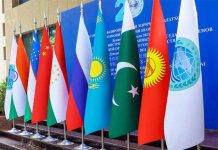
- Shanghai Cooperation Organization summit brings together major Eurasian powers amid deepening geopolitical divisions and competing strategic interests
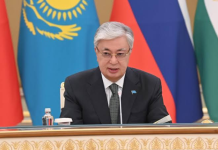
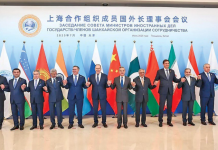
BISHKEK: The leaders of China, Russia and India joined other heads of state in Kyrgyzstan on Monday for the summit of the Shanghai Cooperation Organization (SCO), as the Eurasian grouping seeks to strengthen regional cooperation and expand its influence amid growing global geopolitical competition.
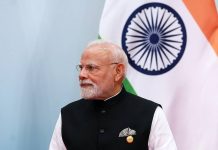
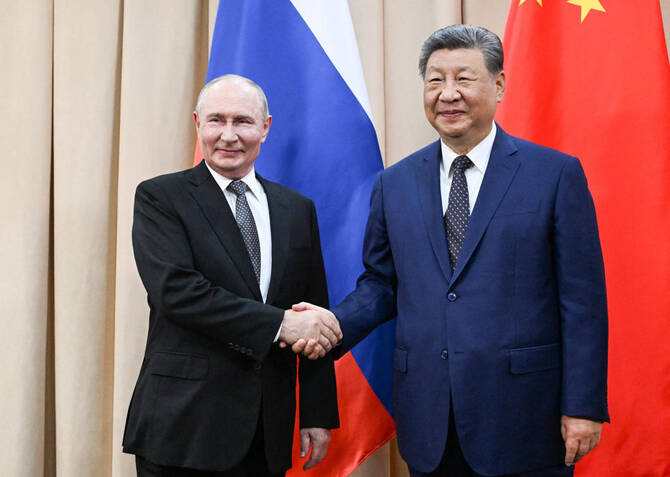
Chinese President Xi Jinping, Russian President Vladimir Putin and Indian Prime Minister Narendra Modi are attending the summit in Bishkek, the capital of Kyrgyzstan, alongside leaders and senior representatives from other SCO member states.
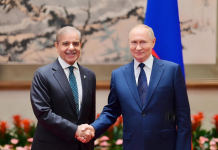
On the sidelines of the summit, Putin and Xi held bilateral talks as part of a series of meetings between participating leaders. Russian state media reported that Putin expressed Moscow’s readiness to make the visa-free travel arrangement between Russia and China permanent, underscoring the increasingly close ties between the two countries.
Putin is also expected to hold talks with Iranian President Masoud Pezeshkian on Tuesday, when the SCO’s formal sessions are scheduled to begin.
For Russia and Iran, the summit provides an important diplomatic platform for strengthening relations with non-Western partners. Moscow is more than four years into its full-scale war in Ukraine, while Tehran remains embroiled in a major regional confrontation involving the United States and Israel.
SCO Expands as Alternative Platform to Western-Led Institutions
Founded in 2001 by China, Russia and four Central Asian states as a regional security forum, the SCO has expanded significantly over the past quarter-century. Despite its growing membership and international profile, the organization continues to face questions over the clarity of its long-term objectives and the extent of its institutional cohesion.
The SCO now comprises 10 member states — China, Russia, India, Iran, Pakistan, Belarus, Kazakhstan, Kyrgyzstan, Tajikistan and Uzbekistan — while a number of other countries participate as dialogue partners.
China and Russia have increasingly promoted the SCO as a platform for strengthening cooperation outside the traditional Western-led international framework, particularly as geopolitical tensions between the major powers have intensified.
Beijing has also sought to broaden the organization’s economic and political role by promoting development initiatives and financial cooperation among member states.
China’s Ministry of Foreign Affairs said last week that the SCO had successfully “explored a new path for regional cooperation,” reflecting Beijing’s broader push for a more multipolar international order, with Moscow emerging as one of its key strategic partners.
Strategic Differences Among Members Remain
Despite their common interest in expanding cooperation beyond Western institutions, SCO members have significant differences in their foreign-policy priorities, security concerns and bilateral relations.
The summit offers many member states an opportunity to demonstrate that they continue to maintain strong international partnerships despite deteriorating relations with Western countries. However, analysts emphasize that the SCO is neither a unified political alliance nor a formal military bloc.
For India in particular, analysts expect the summit to serve largely as a platform for strategic signaling and diplomatic engagement rather than producing major substantive agreements.
The organization is strongly influenced by China and includes Pakistan, with which India has longstanding strategic and political tensions.
Dinakar Peri, a security studies fellow at Carnegie India, said the SCO provides New Delhi with an important platform to engage with a region increasingly shaped by competition among major powers.
According to Peri, the forum enables India to safeguard its interests, monitor evolving geopolitical dynamics and present itself as a dependable regional stakeholder.
While India may not be able to fully shape the SCO’s agenda, he said, participation gives New Delhi a direct understanding of regional developments while allowing it to maintain strategic flexibility and strengthen ties with multiple partners.
Türkiye Seeks Greater Role in Eurasian Framework
Türkiye, which holds dialogue-partner status within the SCO, is also seeking to expand its engagement with the organization and strengthen its influence across Eurasia.
Ankara views closer engagement with the SCO as part of a broader strategy of maintaining a balanced foreign policy — preserving its traditional ties with Western institutions as a NATO member while simultaneously deepening relations with Eurasian powers.
President Recep Tayyip Erdoğan, who secured Türkiye’s status as an SCO dialogue partner in 2012, has repeatedly expressed Ankara’s ambition to become a full member of the organization.
Türkiye’s strategic position is particularly significant as its longstanding economic relationship with the European Union continues under the 1995 customs union, while its EU accession process has remained stalled for more than two decades.
The Bishkek summit therefore comes at a time when the SCO is seeking to translate its expanding membership into greater diplomatic and economic influence, even as divergent national interests among its members continue to limit the extent of their collective alignment.
BY: The Times Union