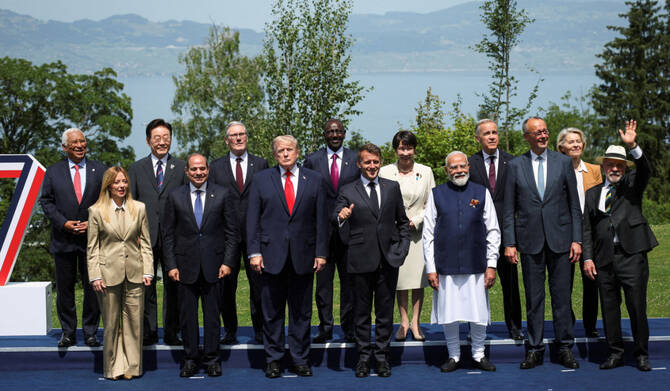
French President Emmanuel Macron this week hosted the G7 summit of leaders from North America, Europe, and Japan. Yet it was the Iran crisis that framed the big event. The new memorandum of understanding between Iran and the US has been widely criticized since its release — not only by politicians, but also by business leaders. For instance, some in the shipping industry are concerned that toll-free access to the Strait of Hormuz may be in jeopardy in the coming months.
Problematic as the deal may prove to be, there were nonetheless sighs of relief from Macron, fellow European leaders, Canadian Prime Minister Mark Carney, and Japanese Prime Minister Sanae Takaichi when US President Donald Trump announced the deal. This is because the vague 14-point framework, which has been called a memorandum of misunderstanding by some, helped shift the diplomatic mood music in Evian.
Before the meeting, G7 leaders had feared that Trump’s frustration might boil over with them at the summit. The US president still perceives a big lack of support from these allies for the US during the Iran war.
In addition to the agreement breakthrough, Macron also skillfully handled Trump at the event. This included closely chaperoning him, including hosting a private, post-summit dinner at the Palace of Versailles to help ensure the US president did not leave the event early, as he had done at several G7 summits in the past, including last year in Canada. Macron also delayed the start of the forum to last Monday so that Trump could celebrate his 80th birthday weekend in Washington.
This double development set the stage for a more positive, productive event than had been widely expected only a few weeks ago. One example is the critical minerals agenda in which the G7 agreed to enhance cooperation to reduce their reliance on China. A new G7 Critical Minerals Resilience and Production Alliance will be created. This initiative builds on a similar one that was formed at the Canadian summit last year.
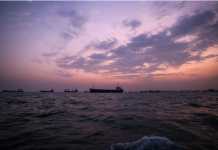
There are growing fears about future navigation of the strait.
Andrew Hammond
This new G7 alliance will work more closely on stockpiling. It will also launch a new platform which will engage with the IEA Critical Mineral Security Programme and the OECD, to provide analytical and data-driven assessments of market developments and supply chain vulnerabilities, facilitate information-sharing, conduct emergency exercises and monitor progress in financing, diversification, and transparency commitments.
The headline goal by 2030 is to reduce dependence on any one supplier for rare earths and permanent magnets to below 60 percent by 2030. In the longer term, an ultimate goal of 50 percent will be realized “as soon as possible.”
There was also a positive discussion on the future of AI with 11 CEOs such as OpenAI’s Sam Altman, Anthropic’s Dario Amodei, and Meta’s Alex Wang. Discussions here included potential creation of a “trusted partners” scheme granting access for G7 allies to advanced US AI models.
Of course, despite all this, G7 relationships with Trump remain fragile. Tensions could easily re-emerge in a big way as soon as next month’s NATO summit in Turkiye. This was shown on Thursday, the day after the G7 ended when US Defense Secretary Pete Hegseth announced a six-month review of the presence of US forces in Europe. He severely criticized some US allies, suggesting they had been “free riding” on Washington for years.
Such tensions will be particularly likely to flare again if the agreement process breaks down in coming weeks as Washington and Tehran now try to agree a permanent deal over the next 60 days of extended ceasefire. It would be no big surprise if this happens.
Huge challenges remain in implementing the agreement, including in the Strait of Hormuz, where returning tanker traffic to pre-war levels will not be easy. Even if attacks by the US and Iran now end, naval mines must be removed to make the waterway navigable again. This process is likely to take weeks, rather than days.
There are also growing business fears about future navigation of the strait. The agreement asserts that Iran agrees to allow tanker traffic to pass unobstructed with no fee or toll, but only for the 60 days covered by the deal. In future, Iran could implement a new system, which would comply with international law, and charge fees for vessels passing through Hormuz.
This would represent a worse position than that before the conflict began when there was more or less complete freedom of navigation without charge. It would surely also raise tensions again within the Western alliance over the wisdom of the war. And all of this is even before the two sides attempt to progress the thorny issue of Iran’s nuclear program. This agenda appears most unlikely to be completely resolved within the next 60 days.
So while the agreement helped improve immediate-term diplomatic atmospherics at the G7, it may have only kicked the can down the road in terms of resolving key outstanding issues between the US and Iran. A permanent deal in coming weeks is not impossible, but enormous political heavy lifting is now needed that took previous US administrations much longer than 60 days to try to resolve.
BY: Andrew Hammond is an associate at LSE IDEAS at the London School of Economics.
Disclaimer: Views expressed by writers in this section are their own and do not necessarily reflect The Times Union‘ point of view