The peace agreement to end the war was signed with much fanfare. It was welcomed across the Middle East and by the international community. US President Donald Trump declared that “a new and beautiful day is rising” — after so much uncertainty, chaos and conflict, the rebuilding could finally begin. Regional powers, who agreed on little else, collectively endorsed it as an imperfect but necessary end to the indefinitely spiraling cycle of violence.
All the above refers to the Gaza peace plan of late 2025, not the memorandum of understanding between the US and Iran. But the parallels between this latest deal and the Gaza agreement are clear and concerning in equal measure. Both defer difficult issues to a later date. Instead, they rely on interim measures over conflict resolution. Gaza sets a dangerous precedent for the memorandum of understanding, where Iran and Israel may copy the same playbook as Israel and Hamas: affirming their support for the agreement while seeking to undermine it through facts on the ground. In short, the Middle East is not in the clear yet.
Though the agreement has not been released in full, the emerging details suggest that it kicks the region’s systemic problems into the long grass. It extends the shaky ceasefire for 60 days. It may well open the Strait of Hormuz but in return Iran will get its long-sought sanctions relief without having to make other concessions. Iran’s leaders could thus be forgiven for thinking that their recent strategy of attacking critical and civilian infrastructure throughout the Gulf worked, however morally indefensible it may be.
The second issue is Israel. Politicians within Israeli Prime Minister Benjamin Netanyahu’s coalition and the centrist opposition alike have condemned the deal. Israel has failed to decisively defeat either Hezbollah or Iran. This sets the stage for Israel’s usual modus operandi of accepting the agreement in principle while working to scupper it in practice. That it launched strikes on Beirut the day the agreement was supposed to be signed — an action that Iran had warned would cross a red line — suggests that Israel sought to render the agreement dead on arrival.
The parallels between this latest deal and the Gaza agreement are clear and concerning in equal measure
Rob Geist Pinfold
Taken together, these present significant impediments to a real peace deal that the region so desperately needs. Iran will resist having to make the difficult choices that any comprehensive deal would demand. Israel will use any provocation as an excuse to escalate and imperil any agreement.
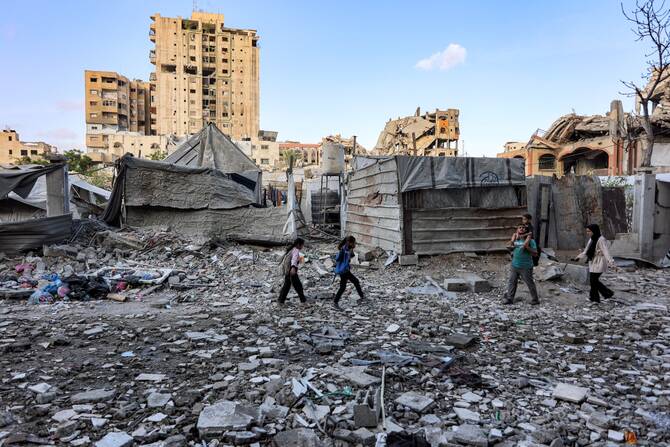
This dynamic is playing out in real time in Gaza. After the Oct. 7, 2023, attacks, Israel sought “total victory” over Hamas. After much cajoling, Israel and Hamas accepted the Gaza peace plan, which was less a comprehensive deal and more an envisioned multistage set of partial accords that deferred difficult issues to a later date. Israel and Hamas agreed to stage one — a ceasefire and partial Israeli withdrawal. The idea was that this would be an interim stage, leading to Hamas’ disarmament, Israel’s exit from the entire Strip and a rehabilitated Gaza.
None of this has come to pass. Hamas refused to disarm, while consolidating its control over 90 percent of Gaza’s residents. Israel not only refused to withdraw, but it also expanded its occupation and now controls up to 60 percent of the territory. Violence has abated but not ended, with Israel killing nearly 1,000 Gazans since the ceasefire came into effect. January saw the US announce the beginning of the plan’s second phase, in which a new Palestinian-led committee would supposedly take over from Israel and Hamas, governing the territory and its people. Instead, both sides have imposed a stalemate.
Gaza’s experience suggests this is a fleeting opportunity for regional transformation; if not taken, it may be lost
Rob Geist Pinfold
This encapsulates the problematic asymmetry of incremental agreements. External actors, such as the US, may be relatively powerful but they often lack resolve. They create the momentum to sign an agreement before pivoting elsewhere. Once that momentum is lost, it is unlikely to return, absent a new crisis. This is evident in Gaza, where the recent regional war distracted everyone except for Israel and Hamas. Both sides continued to play the long game of creating facts on the ground that preclude conflict resolution while publicly continuing to affirm their support for the deal. They are, in short, silent spoilers.
This is scuppering Gaza’s rehabilitation. If replicated by the memorandum of understanding, it could endanger the recovery of the entire Middle East. It is up to the Gulf states to keep the US engaged. They must set clear red lines for what a “day after” might look like. The US’ oft-repeated goal of preventing a nuclear arms race in the Middle East is a noble one. Yet it is a tomorrow problem. The more pressing issue is Iran’s present-day policies, which it propagates through its proxies, drones and ballistic missiles, to coerce its neighbors and undermine their sovereignty.
Similarly, the Gulf Cooperation Council states should pressure the US to rein in the other regional revisionist — Israel — by demonstrating that being a spoiler carries real political costs. Trump’s recent public frustrations with Netanyahu may give them an opening to do so.
The US-Iranian deal is a welcome development. The recent war illustrates that military force will not bring about regime change in Tehran or end its regional revisionism. But the ceasefire was also under unprecedented strain. This is why some form of an accord was necessary to stop the region from slipping back into the cycle of conflict.
Gaza’s experience, however, suggests this is a fleeting opportunity for regional transformation; if not taken, it may be lost. Deferring difficult negotiations empowers spoilers and allows the supposedly temporary to become permanent. Interim agreements might make a return to war less likely in the short term. But they are no alternative to a comprehensive deal. The “no war, no peace” paradigm was not a sustainable status quo. The challenge is not to freeze it in place but to get the region to somewhere better.
BY: Writer Rob Geist Pinfold is a lecturer in Defense Studies (International Security) at King’s College London.
Disclaimer: Views expressed by writers in this section are their own and do not necessarily reflect The Times Union‘ point of view