- US president denies reports that Dan Caine said striking Iran could cause loss of forces, weapons stocks; Netanyahu holds security meeting, hospitals prep for conflict
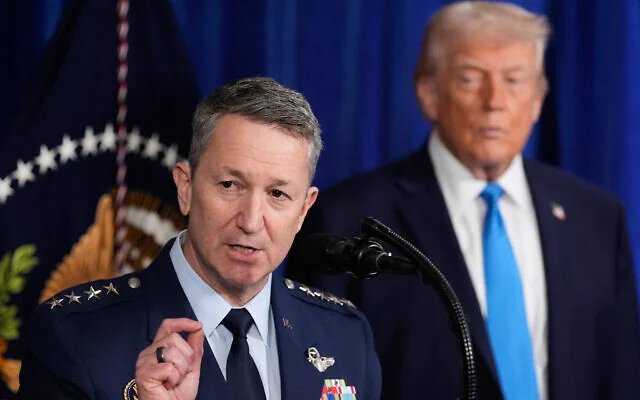
Following multiple reports that the US chairman of the Joint Chiefs of Staff, Gen. Dan Caine, has cautioned against a prolonged attack on Iran, US President Donald Trump said his top general isn’t opposed to such a war.
“Numerous stories from the Fake News Media have been circulating stating that General Daniel Caine, sometimes referred to as Razin, is against us going to War with Iran,” Trump wrote on his Truth Social platform.
“The story does not attribute this vast wealth of knowledge to anyone, and is 100% incorrect,” the president added. “General Caine, like all of us, would like not to see War but, if a decision is made on going against Iran at a Military level, it is his opinion that it will be something easily won.”
Trump’s post came as speculation continues to swirl over whether he will order a US attack on Iran in the coming days. The US president threatened an attack following Iran’s deadly crackdown on mass anti-regime protests last month, and has also conveyed that he would strike if talks between the two countries over Iran’s nuclear program collapse.
US envoys Steve Witkoff and Jared Kushner have reportedly been pressing the president to give negotiations more time and are scheduled to meet Iranian Foreign Minister Abbas Araghchi in Geneva on Thursday.
But the US has also amassed its forces in the Middle East in recent weeks, and concerns about an attack have mounted across the region. On Monday, Prime Minister Benjamin Netanyahu convened top aides for a security meeting amid the tensions.
Multiple US outlets reported on Monday that one of the people raising concerns about an attack was Caine. The reports say Caine feels an extended campaign against Iran could have significant negative effects on the US and its military preparedness.
According to The Wall Street Journal, Caine has warned Trump that an extended conflict “could incur significant costs to US forces and munitions stockpiles.”
The newspaper reported that concerns have also been voiced that if the US “uses up large amounts of air-defense munitions and other items that are in limited supply,” it will limit its capacity to protect regional allies from Iranian counterattack, and curtail its ability to counter China in a future conflict.
And Axios reported, citing sources familiar with internal deliberations, that Caine has cautioned that a military campaign against Iran could carry the risk of the US becoming entangled in a prolonged conflict.
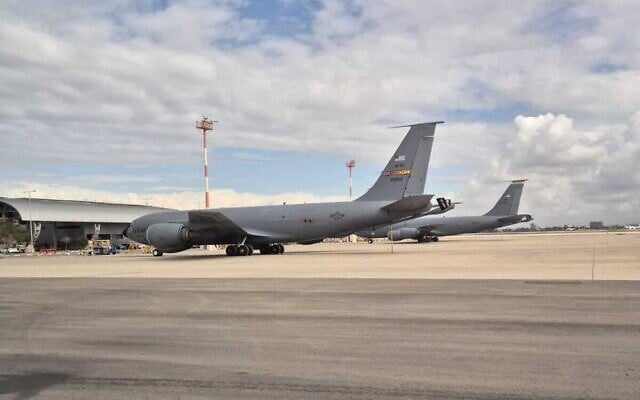
According to the Axios article, which was the first to report Caine’s concerns, the general has warned that the stakes in Iran are higher than in the recent US operation in Venezuela, which saw the capture of the country’s former leader, Nicolas Maduro, and that a strike could lead to significant US casualties and broader regional escalation.
While not opposing military action outright, one source described him to Axios as a “reluctant warrior” on Iran, with another source saying that Caine is “clear-eyed and realistic” in his assessment of what success would look like and what could follow once hostilities began.
Axios reported that Trump has been leaning toward military action in recent days, but agreed to allow the additional diplomatic efforts by Witkoff and Kushner before making a final decision.
Netanyahu has also been pushing for military action, but Axios cited a US source as saying he left a meeting with Trump last week unsure where the president stands, reportedly asking afterward whether Trump is “still with us.”
On Monday, the prime minister left a Knesset session to convene a security discussion in Jerusalem with top aides, senior ministers, and security officials. Opposition Leader Yair Lapid, meanwhile, told the Knesset that if war with Iran comes, “all differences of opinion will be put into deep freeze” until the conflict is over.
And Hebrew news outlets reported that the Israeli health system is preparing for an emergency situation in case of a prolonged war with Iran. The Health Ministry is considering reducing internal medicine departments, which have hospitalized patients who can be transferred to their homes, so that there will be fewer patients in the hospitals.
There is also the possibility of the transfer of doctors from the center of the country, where there are more professionals in relation to the size of the population, to hospitals in the periphery.
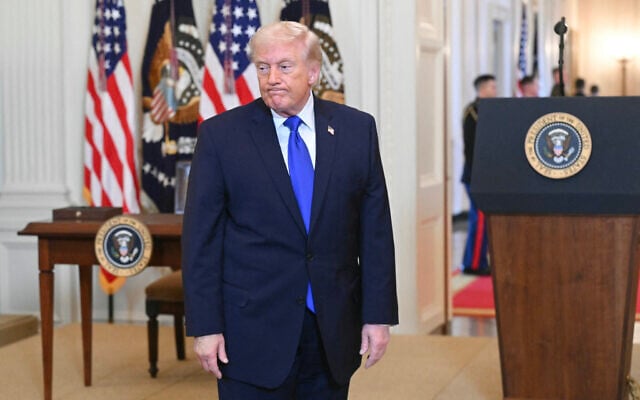
Remembrance Ceremony in the East Room of the White House in Washington, DC,
on February 23, 2026.
In his post pushing back on reports of Caine’s skittishness about a war, Trump also denied reports that he may order a limited strike on Iran to force its hand in the negotiations.
Trump is demanding that Iran end all nuclear enrichment and has asked that it limit its ballistic missile program, conditions the Islamic Republic has refused. A possible compromise that has been floated would see Iran continue token enrichment that would leave it far short of producing a nuclear weapon.
Trump wrote that Caine “is a Great Fighter, and represents the Most Powerful Military anywhere in the World. He has not spoken of not doing Iran, or even the fake limited strikes that I have been reading about, he only knows one thing, how to WIN and, if he is told to do so, he will be leading the pack.”
The US president added, “I am the one that makes the decision, I would rather have a Deal than not but, if we don’t make a Deal, it will be a very bad day for that Country and, very sadly, its people, because they are great and wonderful, and something like this should never have happened to them.”
Iran has consistently denied seeking to acquire nuclear weapons. However, it enriched uranium to levels that have no peaceful application, obstructed international inspectors from checking its nuclear facilities, and expanded its ballistic missile capabilities.
Prior to launching the attack that began the June 2025 Israel-Iran war, Israel said Iran had recently taken steps toward weaponization.
The US joined near the end of that 12-day conflict, striking Iran’s nuclear facilities.
BY: Stav Levaton and Diana Bletter