- Police Use Tear Gas to Disperse Crowds; Parliament Session Disrupted by Growing Movement
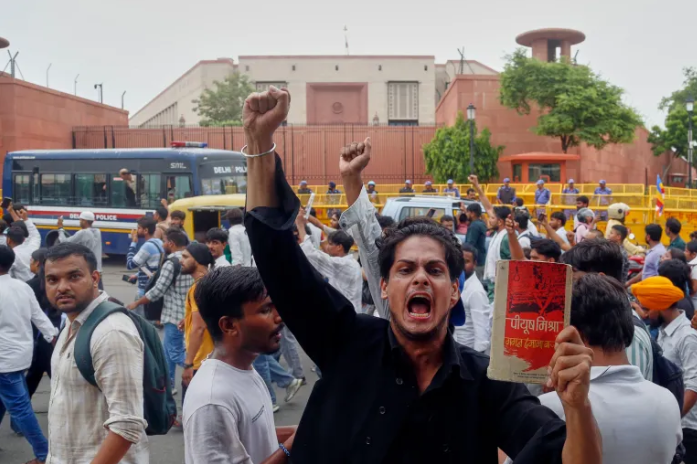
NEW DELHI: Thousands of youth protesters demanding the resignation of India’s Education Minister Dharmendra Pradhan clashed briefly with police in New Delhi late Wednesday, as authorities used tear gas and batons to disperse demonstrators amid escalating nationwide unrest over alleged examination paper leaks.
According to police and eyewitnesses, more than 10,000 protesters gathered at the Jantar Mantar protest site in central New Delhi, with the demonstration emerging as one of the largest youth-led movements against Prime Minister Narendra Modi’s government since he assumed office in 2014.
Movement Fueled by Alleged Exam Paper Leaks
The protests, organized by the self-styled Cockroach Janta Party (CJP), began nearly a month ago following allegations of examination paper leaks that reportedly affected around two million students during national exams held in May.
Demonstrators have vowed to continue their campaign until Education Minister Dharmendra Pradhan steps down, arguing that the government has failed to ensure transparency and accountability in the country’s examination system.
Speaking to supporters, CJP founder Abhijeet Dipke said the movement would not end until its central demand was met.
“It has been 25 days so far. Even if it takes 25 months, that is acceptable, but we will not move from here,” Dipke told protesters.
Violence Erupts as Crowds Swell
Thousands of demonstrators gathered throughout Wednesday, chanting slogans, waving Indian flags, and staging protests near Parliament.
By evening, the crowd had expanded beyond the designated protest area, with local media estimating attendance at more than 10,000 people.
According to Delhi Police, some protesters threw stones and plastic bottles at security personnel, injuring several officers who were later taken to hospital.
Police responded by firing tear gas shells and using batons to disperse the crowd. Videos circulating on social media platform X appeared to show clashes between protesters and security forces, although Reuters said it could not independently verify the footage.
Protests Disrupt Parliament and Metro Services
The demonstrations have spilled into India’s Parliament, where opposition parties have repeatedly disrupted proceedings during the ongoing monsoon session in support of the protesters’ demands.
Earlier this week, tens of thousands of demonstrators attempted to march toward Parliament despite restrictions, leading to similar confrontations with police.
Meanwhile, the Delhi Metro Rail Corporation (DMRC) announced the closure of 16 metro stations across central New Delhi on Thursday until further notice, citing security concerns. It marked the second large-scale metro shutdown this week due to the protests.
Government Offers Talks and Reform Proposals
Facing mounting public pressure, the Modi government has held one round of discussions with CJP leaders and pledged to consider their demands.
The government has also proposed debating the issue in Parliament and introducing reforms to strengthen the examination system and prevent future paper leaks.
However, protest leaders have maintained that the resignation of Education Minister Dharmendra Pradhan remains their primary demand.
Opposition Throws Weight Behind Protesters
India’s opposition parties, led by the Indian National Congress, have expressed support for the youth movement.
Congress leader Rahul Gandhi joined demonstrations outside the Prime Minister’s residence and Parliament, accusing the government of failing to protect the interests of students.
Gandhi said opposition parties would meet on Thursday to determine their next parliamentary strategy, insisting that the demand for the education minister’s resignation was non-negotiable.
Growing Challenge for Modi Government
The rapid rise of the Cockroach Janta Party—from an online satirical campaign to a nationwide youth movement—reflects growing frustration among young Indians over recurring examination scandals, unemployment, and limited job opportunities.
Political analysts say the protests have provided opposition parties with a significant opportunity to challenge the ruling Bharatiya Janata Party (BJP), which has traditionally enjoyed strong support among younger voters despite setbacks in the 2024 general election, when Prime Minister Modi failed to secure an outright parliamentary majority.
BY: The Times Union