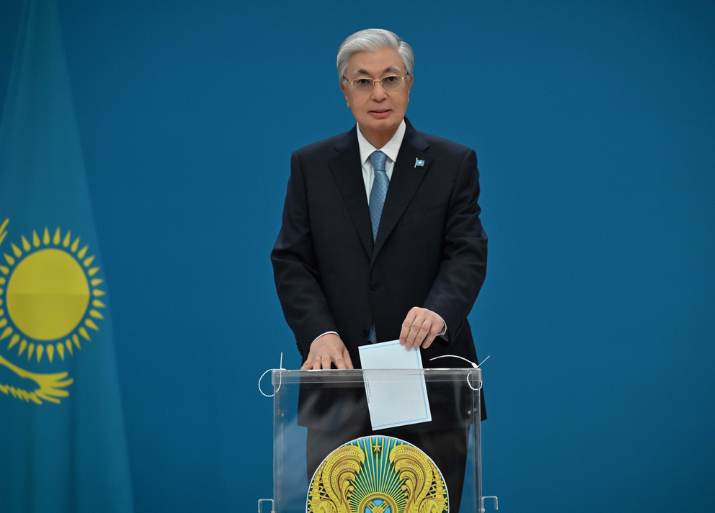
- Adilet Party Secures Overwhelming Majority in Landmark Vote
ASTANA – Kazakhstan completed its first election to the newly established unicameral Kurultai on 23 August 2026, marking a transformative moment in the nation’s political development. The vote, conducted under constitutional reforms approved by referendum in March, saw five parties secure parliamentary representation, with the Adilet Party winning 110 of 145 seats.
The election represents the most significant restructuring of Kazakhstan’s legislative system since independence, replacing the former bicameral Parliament with a single chamber elected entirely through nationwide proportional representation.
Voter Turnout Surpasses Previous Elections
The Central Election Commission (CEC) reported that 9,351,539 of 12,623,289 registered voters participated, yielding a turnout of 74.08%. This figure substantially exceeds the 54.21% recorded in the 2023 parliamentary election and closely approaches the 73.12% turnout observed in the March constitutional referendum.
Voting occurred across 10,423 polling stations, including 79 facilities established in 61 countries for overseas voters. Of 11,402 registered citizens abroad, 9,623 cast ballots, representing an 84.4% participation rate among the diaspora electorate.
Final Results and Seat Allocation
Five parties cleared the statutory 5% threshold to secure representation in the 145-seat chamber:
| Party | Vote Share | Votes | Seats |
|---|---|---|---|
| Adilet Party | 71.17% | 6,528,948 | 110 |
| Auyl Party | 6.26% | 574,621 | 10 |
| Respublica Party | 5.56% | 509,631 | 9 |
| Ak Zhol Democratic Party | 5.21% | 478,083 | 8 |
| Nationwide Social Democratic Party | 5.11% | 469,058 | 8 |
| People’s Party of Kazakhstan | 3.11% | 285,395 | 0 |
| Baytaq Green Party | 1.07% | 97,751 | 0 |
| Against all | 2.51% | 230,446 | – |
Composition of the Inaugural Kurultai
The 145-member chamber demonstrates notable diversity across multiple dimensions:
Gender Representation:
Women hold 49 seats (33.8%), a significant increase from the former Mazhilis where women occupied 18 of 98 seats (18.4%). Men hold 96 seats (66.2%).
Age Distribution:
Eighteen deputies (12.4%) qualify as youth representatives. Members range from 27 to 65 years, with an estimated average age of approximately 46.5 years.
Parliamentary Experience:
At least 36 deputies (24.8%) possess previous national parliamentary experience – 32 from the Mazhilis and four from the Senate. The remaining 109 deputies (75.2%) enter the national Parliament for the first time, though some have served in local maslikhats or public advisory bodies.
All five party leaders represented in the chamber received mandates.
Adilet Faction Profile
The Adilet Party’s 110-member faction includes:
- 37 women (33.6%)
- 13 youth representatives (11.8%)
- Two persons with disabilities (1.8%)
- 21 representatives of other ethnic groups (19%)
- Average age: 46.7 years
The faction’s experience composition comprises 24 members with previous national parliamentary experience (20 former Mazhilis deputies and four former senators), 26 former maslikhat deputies, and 13 former members of the National Kurultai, the presidential consultative body.
Ten members belong to the Presidential Youth Personnel Reserve, four serve on the Council for Youth Policy under the President, and five sit on the National Commission on Women’s Affairs and Family and Demographic Policy. Professional backgrounds include three environmental specialists, two volunteer movement representatives, and four IT professionals.
Electoral Framework and Constitutional Significance
The election implements the Constitution adopted on 15 March 2026, approved by 87.15% of referendum participants on 73.12% turnout. The Constitution entered into force on 1 July, completing the transition from the former Senate and Mazhilis to a single 145-member Kurultai.
All deputies are elected for five-year terms under uniform nationwide rules, with no appointed parliamentary seats or single-member constituency races. The new Kurultai will exercise legislative, budgetary, appointment-consent, and government-accountability powers.
Institutional Transition:
The Government must resign its powers before the newly elected chamber convenes. The Kurultai will consider presidential nominations for positions including Vice President and Prime Minister. The President has convened the first session for 28 August 2026 in Astana.
BY: The Times Union