- Defense Minister Rejects Claims of ‘New Militarism,’ Reaffirms Commitment to International Order
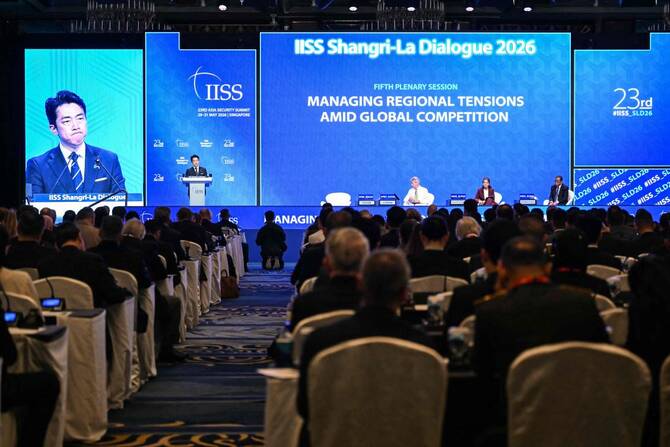
SINGAPORE — Japan has firmly rejected accusations of “new militarism,” with Defense Minister Shinjirō Koizumi defending the country’s security policy and reaffirming its longstanding commitment to peace, international law, and regional stability during a keynote address at the prestigious Shangri-La Dialogue.
Speaking at Asia’s leading security forum, which brings together defense ministers, military leaders, and diplomats from across the world, Koizumi dismissed criticism directed at Japan’s growing defense capabilities and questioned narratives portraying the country as a militarizing power.
Japan Highlights Its Defensive Posture
In remarks widely seen as a response to criticism from China, Koizumi emphasized that Japan remains fundamentally different from major military powers possessing offensive strategic capabilities.
“Think about it. There’s a country that has a huge arsenal of nuclear weapons and strategic bombers. Japan has neither of such weapons, and yet Japan is labelled ‘new militarism’?” he said.
The minister stressed that Japan’s defense policies remain rooted in self-defense and deterrence, consistent with the country’s post-war constitution and its commitment to maintaining peace in the Indo-Pacific region.
Eight Decades of Commitment to Peace and International Law
Koizumi underscored Japan’s record since the end of World War II, highlighting nearly 80 years of adherence to international norms and support for a rules-based global order.
“Since the end of the Second World War, Japan has consistently respected international law, including the Charter of the United Nations, and has made sincere efforts to maintain and strengthen a free and open international order,” he stated.
His remarks reflected Tokyo’s broader strategy of promoting a “Free and Open Indo-Pacific,” a vision aimed at ensuring stability, freedom of navigation, and respect for international law across the region.
Responding to Chinese Criticism
The comments came after China’s Foreign Ministry in May urged Asia-Pacific countries to remain vigilant against what it described as Japan’s “neo-militarism.”
Tokyo has repeatedly rejected such characterizations, arguing that its defense modernization efforts are a response to an increasingly complex security environment and are designed solely to strengthen national defense and regional deterrence.
Japan Calls for Dialogue and Engagement
Despite the sharp exchange of rhetoric, Koizumi expressed disappointment that opportunities for direct engagement with Chinese defense officials were limited during the forum.
The Japanese minister said he felt “sad” that he was unable to meet his Chinese counterparts on the sidelines of the conference, emphasizing the importance of communication and confidence-building measures between regional powers.
Security Forum Highlights Regional Challenges
For the second consecutive year, Chinese Defense Minister Dong Jun did not attend the Shangri-La Dialogue, missing a key platform for direct discussions with regional and international defense leaders.
His absence drew attention at a gathering widely regarded as one of the most important venues for addressing security challenges in the Indo-Pacific, including maritime security, strategic competition, and regional stability.
Japan Strengthens Role as a Security Partner
As geopolitical tensions continue to reshape the Indo-Pacific landscape, Japan has increasingly positioned itself as a responsible security partner committed to peace, cooperation, and the rules-based international order.
Japanese officials maintain that the country’s defense reforms are intended not to project military power, but to enhance deterrence, contribute to regional stability, and protect the security of its citizens while remaining firmly anchored in its post-war pacifist principles.
BY: The Times Union