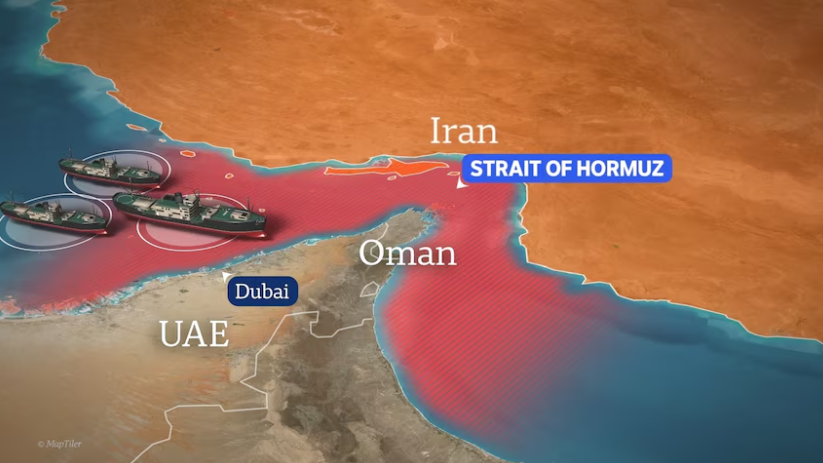
The Strait of Hormuz should not be held hostage to the talks in Islamabad, which appear to be deadlocked. Hundreds of millions of people are seriously affected by its closure. Energy supplies and food security have been the first victims.
The Islamabad talks revealed real divisions between Tehran and Washington, but also within Iran’s leadership. The Islamic Revolutionary Guard Corps is contradicting and attacking formal government representatives for daring to speak out of turn, as well as Iran’s negotiators for what it considered unjustified concessions in the first round of talks. This is despite the fact they were led by parliamentary Speaker Mohammed Bagher Ghalibaf, a hard-liner known to be close to both the IRGC and Supreme Leader Mojtaba Khamenei.
These contradictions were there long before this war, but they have now become more public and sharper in tone. The two sides disagree on whether to resume the talks. Thinking that the US was eager to talk, they sought to extract extra concessions by asking Washington to lift its maritime blockade as a precondition for resuming the negotiations.
The countries affected by the closure of the strait need to find a way to allow commercial shipping to transit normally
Dr. Abdel Aziz Aluwaisheg
Recognizing Tehran’s state of confusion, US President Donald Trump extended the two-week pause beyond the April 22 deadline to give them more time to make up their minds. Tehran unleashed its considerable media machine to mock Trump, portraying him as looking for a quick exit because he is incapable of winning the war.
On Wednesday, just hours after Trump had announced the extension of the truce, Iran upped the ante by seizing two commercial ships and taking them to the coast. These seizures were the first by Iran in this war and they indicate an escalation, as the two countries have doubled down on their respective blockades. Ghalibaf said late on Wednesday that reopening the Strait of Hormuz was impossible while the US and Israel were breaching the ceasefire, referring to the US blockade and Israel’s attacks on Lebanon.
With no end in sight to the war, the countries affected by the closure of the Strait of Hormuz, including the Gulf Cooperation Council states, need to find a way to neutralize the waterway and allow commercial shipping to transit normally.
The GCC states believe that ensuring freedom of navigation through the Strait of Hormuz is an international responsibility, according to the UN Convention on the Law of the Sea. As such, they tabled a draft resolution before the UN Security Council to start the process of neutralizing the waterway. It was regrettable that China and Russia both vetoed the resolution because of confusion over what adopting it would entail and disagreement over the phrasing. The GCC is planning to try again later this month. Hopefully, next time round, China and Russia will allow the resolution to be adopted.
It is highly probable that Tehran will drag out the negotiations, at least until November’s midterm elections in the US
Dr. Abdel Aziz Aluwaisheg
China has been among the countries most affected by the disruption, especially after the US imposed a blockade of its own to counter Iran’s closure of the strait, making it useless for Beijing to try to conclude a bilateral deal with Iran to allow its ships to cross.
Russia’s objection to the resolution was that it supported the US’ intervention, but the opposite is true. The UNSC resolution was intended to persuade Iran to stop interfering with ships crossing the strait and thus obviate the need for the US to impose its blockade. The arrangement for overseeing the security and safety of the strait would be under the UNSC’s supervision, as is the case with other UN peacekeeping forces. Russia is a permanent member of the UNSC and would always be part of the decision-making process regarding the strait if it were allowed to come under the council’s authority.
Allowing Iran to impede international shipping through the Strait of Hormuz would set a dangerous precedent. The last time a country exercised control of this passageway and imposed tolls was Portugal in the 16th and 17th centuries. That system was stopped in 1622, when an international coalition succeeded in driving the Portuguese out. Ironically, Iran was part of that coalition. There has not been any attempt by any state to collect tolls there since then because international law bans such practices.
If the talks in Islamabad were to resume and produce results, that would be welcomed by the GCC if they addressed all the issues of concern, including Iran’s nuclear program, ballistic missiles and drones, support for proxies in neighboring countries, and freedom of navigation.
It is more likely, however, that the talks will stall or produce only a partial agreement. It is also likely that Iran will take advantage of Trump’s open-ended extension of the truce. The extension gives Iran’s competing factions time to either sort out their differences or establish IRGC dominance over the formal government once and overall.
It is thus highly probable that Tehran will drag out the negotiations, at least until November’s midterm elections in the US, knowing that America will likely try to avoid attacking Iran before then. If they think that the US is in a hurry to conclude the war before the elections, Iran’s hard-liners will be tempted to squeeze out more concessions from Washington. Iranians are well aware of Trump’s time constraints.
The so-called Hormuz coalition, a grouping of 51 countries spearheaded by the UK and France, is a good effort to “draw on our collective diplomatic, economic and military capabilities to support freedom of navigation through the Strait of Hormuz,” according to the statement issued at the end of its first leaders’ meeting in Paris last week. However, action will be delayed, only commencing “as soon as conditions permit, following a sustainable ceasefire agreement.”
Since we do not know when a “sustainable ceasefire” will be agreed, the international route through the UNSC is the preferred approach. It can produce a permanent arrangement to guarantee freedom of navigation through the Strait of Hormuz, not subject to the whims of any country, and may also be applied to the Bab Al-Mandab Strait and elsewhere.
BY: Writer Dr. Abdel Aziz Aluwaisheg is the GCC assistant secretary-general for political affairs and negotiation. The views expressed here are personal and do not necessarily represent those of the GCC.
Disclaimer: Views expressed by writers in this section are their own and do not necessarily reflect The Times Union‘ point of view