In the four or so decades since the creation of Iran’s Islamic Republic, the ruling regime has faced numerous challenges from its restive population. The “Green Revolution” in 2009, which many observers regarded as a precursor to the so-called Arab Spring that followed two years later, is still regarded as the most serious attempt to force the regime to undertake wholesale reform.
In what began as a series of mass protests against the outcome of the disputed 2009 presidential election, which resulted in the reelection of the country’s hard-line president, Mahmoud Ahmadinejad, the movement soon developed into a nationwide call for democratic reform and social liberalization. It was only after regime hard-liners launched a brutal crackdown against the demonstrators that order was finally restored.
The crackdown did not entirely succeed in crushing dissent, with more recent protests taking place over the regime’s restrictive policies toward women, which prompted further nationwide demonstrations after a young Kurdish-Iranian woman died in police custody in 2022.
But while the Iranian regime has previously proved to be highly effective at crushing any hint of political opposition that has emerged since the 1979 revolution, the current round of protests has the potential to mount a far more serious challenge to the regime’s authority, not least because it is focused on one issue that the ayatollahs appear incapable of resolving — namely, the dire state of the Iranian economy.
Maintaining a basic level of economic stability has always been a major challenge for the ruling regime, as decades of economic sanctions and international isolation have inflicted significant damage on the living standards of ordinary Iranians.
Nor has the plight of the Iranian people been helped by the vast amounts hard-liners within the regime have invested in expanding Iran’s military presence throughout the Middle East, investing heavily in militias and allies in Iraq, Syria, Lebanon, Gaza and Yemen — to name but a few.
This lethal combination of hard-hitting sanctions and inept economic management on the part of the ayatollahs has now resulted in the regime confronting one of the biggest nationwide protest movements it has faced, with ordinary Iranians taking to the streets to voice their anger at their country’s dire economic predicament.
The primary cause of the unrest, which began when protests and strikes broke out in Tehran’s Grand Bazaar in the closing days of 2025, is the collapse in the value of the rial, the Iranian currency, which, having already seen its value decline significantly in recent years, has now fallen by a further 40 percent since Iran’s war with Israel in June.
As a result, it now takes 1.42 million rials to buy $1. Last year, a dollar could be bought for 820,000 rials. The latest collapse in the currency’s value renders it all but worthless. With inflation running at 50 percent, many Iranian traders, businessmen and ordinary families now face the very real prospect of financial ruin.
The country’s dire economic situation, moreover, is made worse by the fact that Iran is suffering from widespread youth unemployment, with the result that students are joining forces with middle-class traders to demand reform of the country’s economic policies.
The pressure on the regime is compounded by the impact of a nationwide drought the country has suffered in recent months, which many Iranians believe has been exacerbated by years of underfunding in key Iranian infrastructure.
The current round of protests has the potential to mount a far more serious challenge to the regime’s authority. Con Coughlin
With the protests spreading to other major Iranian cities, such as Isfahan, some of the demonstrators have been calling for regime change, while others have focused their criticism on the regime’s wasteful investment in overseas conflict, with one popular chant declaring, “No to Gaza, no to Lebanon, I’d give my life for Iran only.”
The eruption of protests in Iran certainly comes at a difficult time for the ruling regime. It was severely weakened by last summer’s 12-day war with Israel, which resulted in the deaths of many of its top commanders.
The regime’s weakness, moreover, can be seen in the fact that it has been forced to adopt more liberal policies in recent months, granting ordinary Iranians more freedom to articulate their concerns and easing the repressive measures imposed against women.
In a bid to resolve the crisis, Iranian President Masoud Pezeshkian has said he will meet representatives of the protesters. “I have asked the interior minister to listen to the legitimate demands of the protesters by engaging in dialogue with their representatives so that the government can do everything in its power to resolve the problems and act responsibly,” Pezeshkian said, according to the state-run IRNA news agency.
Pezeshkian has also addressed the crisis in a speech to the Majlis, the Iranian parliament, on the country’s proposed 2026 budget, which revealed a steep decrease in oil revenue and an increase in taxes — the result of the latest sanctions imposed by the Trump administration. As a concession to the protesters, Pezeshkian accepted the resignation of the central bank chief and appointed Abdolnaser Hemmati, the former economy minister, to replace him.
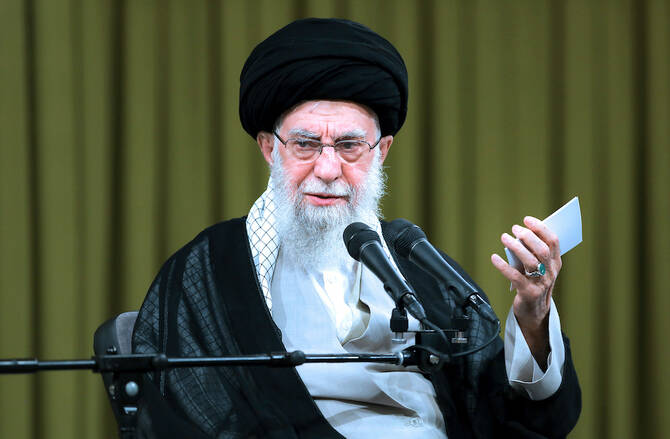
Pezeshkian’s ability to address the protesters’ concerns, though, is limited, as ultimate power lies with the country’s 86-year-old supreme leader, Ali Khamenei, who, despite being in poor health, has the final say in the running of the government.
Another issue the Iranian president must contend with is the prospect of further military action being taken by Israel and the US, with both Israeli Prime Minister Benjamin Netanyahu and US President Donald Trump warning Iran that it would face consequences if it continued work on its controversial nuclear and ballistic missile programs.
Following their talks at Trump’s Mar-a-Lago base in Florida last month, Netanyahu urged Trump to strike again at Iran and bring down the regime.
Trump indicated his main concern would be if Iran attempted to build up its reserves of ballistic weapons and reestablish its nuclear program. “Now, I hear that Iran is trying to build up again,” he said. “And if they are, we’re going to have to knock them down. We’ll knock them down. We’ll knock the hell out of them. But hopefully that’s not happening.”
In previous decades, the sheer ruthlessness of the regime’s response to anti-government protests enabled it to survive. This time, the scale of the economic crisis it faces means it may have to take a very different approach if it wants to maintain the support of the Iranian people.
BY: Con Coughlin is one of Britain’s leading journalists and an international best-selling author. His previous posts include Executive Defense and Foreign Affairs Editor with London’s Daily Telegraph. He is a leading expert on global conflict, international security and the Middle East.
- This column first appeared in Al-Majalla.
Disclaimer: Views expressed by writers in this section are their own and do not necessarily reflect The Times Union‘ point of view