- Chancellor Friedrich Merz Backs Bavarian Politician for 2027 Presidential Election, Highlighting Cross-Party Support and Her Extensive Political Experience
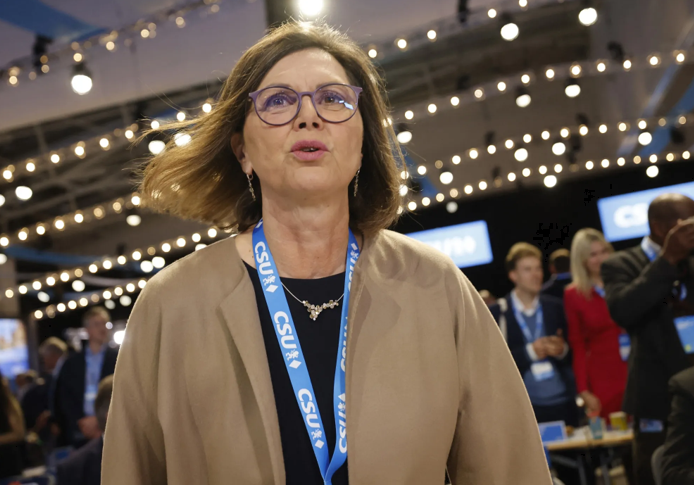
BERLIN: German Chancellor Friedrich Merz has announced his intention to nominate prominent Bavarian politician Ilse Aigner as Germany’s next Federal President in 2027, potentially paving the way for the country to appoint its first woman to the largely ceremonial but constitutionally significant office.
Merz confirmed his decision on Sunday during a dinner attended by senior leaders of his centre-right Christian Democratic Union (CDU), formalising reports that had emerged from party sources the previous week.
Aigner, 61, is a senior member of the Christian Social Union (CSU), the CDU’s sister party in Bavaria, and currently serves as President of the Bavarian State Parliament.
Her prospective nomination is expected to receive broad political support, making her a strong contender in the presidential election scheduled for January 30, 2027.
She would succeed outgoing President Frank-Walter Steinmeier, a Social Democrat who assumed office in 2017 and will complete his constitutionally permitted two five-year terms in March 2027.
Historic Opportunity for Women in German Leadership
Aigner’s potential election would mark a historic development in Germany’s political history, as she would become the first woman to serve as Federal President.
Although the German presidency is largely ceremonial, the office carries considerable constitutional and symbolic importance. The president represents the country at home and abroad and is expected to stand above day-to-day party politics, serving as a unifying figure and a moral voice for the nation.
Under established German political practice, governing coalition parties generally seek agreement on a common presidential candidate to ensure broad parliamentary legitimacy.
The current governing coalition comprises the CDU, CSU and Social Democratic Party (SPD), creating a political environment in which Aigner’s candidacy could attract support beyond her own political alliance.
Extensive Political Experience and Cross-Party Respect
Aigner’s political career and experience in public administration have contributed significantly to her standing across Germany’s political spectrum.
During former Chancellor Angela Merkel’s government, she served as Federal Minister of Food and Agriculture, earning recognition for her political experience and engagement with national policy issues.
Her current leadership of the Bavarian State Parliament has further strengthened her reputation as an experienced parliamentary figure capable of managing political differences through dialogue and institutional cooperation.
Senior Social Democratic figures have also expressed support for her potential presidency.
Dietmar Woidke, a regional SPD leader, described Aigner as the “perfect candidate” for the position in comments reported by Politico.
He praised her understanding of German politics, accessibility and ability to listen to people, noting that her interpersonal qualities had earned her respect across political divisions.
A Potential Unifying Figure Amid Political Polarisation
Aigner’s possible presidency comes at a time of heightened political polarisation in Germany, with the far-right Alternative for Germany (AfD) gaining increased support in opinion polls.
Her approach to parliamentary debates with AfD representatives in Bavaria has attracted attention for combining firmness with courtesy, a quality supporters believe could prove valuable in promoting political dialogue and democratic stability.
Her admirers view her as a potential unifying figure capable of encouraging constructive engagement and strengthening public confidence in democratic institutions.
Her public profile in Bavaria has also been shaped by her participation in traditional cultural events, where she is frequently seen wearing traditional Bavarian attire, reflecting her connection with the region’s cultural identity.
From Technical Profession to National Political Leadership
Born in Bavaria to a family that operated an electricity company, Aigner initially pursued a technical career before entering politics.
Following her technical studies, she worked as an electronics technician for a helicopter manufacturer. She subsequently moved into local and regional politics before advancing to the federal political arena.
Her professional journey, from technical employment to senior government responsibilities, reflects a career spanning public service, parliamentary leadership and national policymaking.
If elected, Aigner would make history as Germany’s first female Federal President, bringing extensive political experience and a background in both regional and federal governance to the country’s highest ceremonial office.
Her anticipated candidacy also represents an important moment for German political representation, as the country prepares for a potential milestone in its democratic and constitutional history.
BY: The Times Union