- Chief Justices of Both Countries Sign Bilateral Cooperation Agreement to Advance Judicial Reforms, Digital Justice, Artificial Intelligence and Institutional Excellence
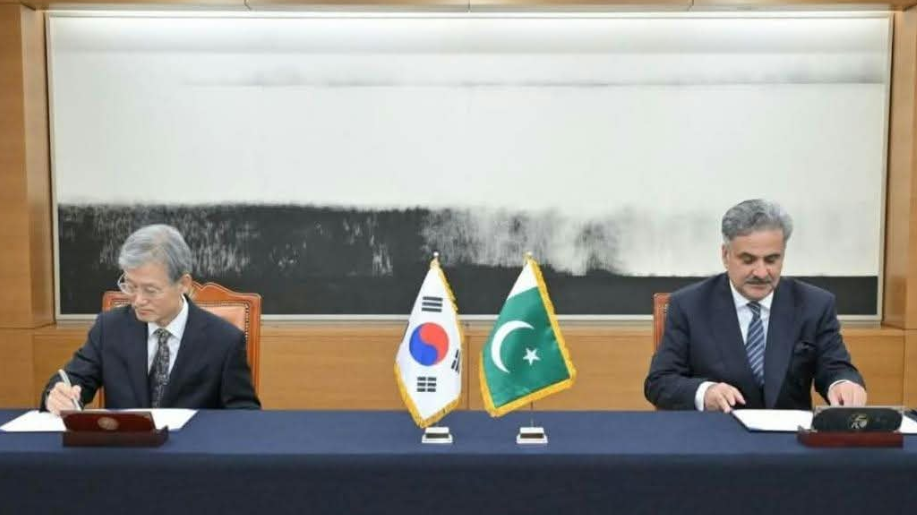
SEOUL: In a significant milestone for Pakistan–Republic of Korea relations, the Supreme Court of Pakistan and the Supreme Court of the Republic of Korea have signed a Memorandum of Understanding (MoU) on Bilateral Judicial Cooperation, opening a new chapter of institutional partnership, professional exchange and technological collaboration between the two countries.
The agreement was signed in Seoul during the official visit of the Chief Justice of Pakistan, who was warmly received by his Korean counterpart, Hon’ble Chief Justice Mr Justice JO Hee-de, at the Supreme Court of the Republic of Korea.
The two Chief Justices held substantive discussions on strengthening institutional relations, promoting mutual learning and exploring new avenues of cooperation between the judiciaries of Pakistan and South Korea. The signing ceremony marked an important step towards building a structured and sustainable framework for judicial engagement.
Landmark Agreement to Deepen Judicial Cooperation
The MoU establishes a comprehensive framework for long-term institutional collaboration, encompassing judicial exchanges, professional capacity building, judicial education, collaborative research and the sharing of institutional experiences and best practices.
Particular emphasis has been placed on judicial reform and modernisation, electronic court systems, digital justice, artificial intelligence and its responsible application in judicial administration.
The agreement also identifies smart courts, judicial analytics and cybersecurity as important areas for cooperation, reflecting the growing role of advanced technology in improving judicial efficiency, transparency and accessibility.
Through this partnership, both Supreme Courts aim to benefit from each other’s institutional experience while exploring innovative approaches to strengthening the administration of justice.
Judicial Exchanges, Professional Training and Knowledge Sharing
The cooperation framework provides for reciprocal judicial delegations, professional attachments, study visits, expert exchanges, joint conferences and seminars, as well as periodic high-level judicial dialogue.
These initiatives are designed to facilitate direct interaction among judges, judicial administrators, legal professionals and institutional experts, creating opportunities for professional development and the exchange of practical knowledge.
The MoU also establishes an institutional mechanism to coordinate and advance mutually agreed activities, ensuring that bilateral commitments translate into meaningful and sustained cooperation.
Focus on Judicial Administration and Institutional Governance
During his official visit, the Chief Justice of Pakistan also met Justice NOH Gyeongpil, Minister of the National Court Administration of the Republic of Korea.
Their discussions focused on judicial administration, institutional governance and the importance of technological innovation in improving court management and strengthening the overall effectiveness of justice delivery.
The interaction provided an opportunity to exchange perspectives on administrative efficiency, modern institutional practices and the development of technology-driven judicial services.
Exploring South Korea’s Advanced Digital Justice Infrastructure
As part of his engagement with South Korea’s judicial technology infrastructure, the Chief Justice of Pakistan visited the Supreme Court of Korea IT Center.
The visit provided first-hand insights into South Korea’s advanced digital court systems, technology-enabled judicial services and the integration of modern information technology into judicial administration.
The engagement also created opportunities to explore potential areas of knowledge transfer and institutional learning, particularly in the context of Pakistan’s ongoing judicial reform and digital transformation initiatives.
South Korea’s experience in developing sophisticated digital infrastructure offers valuable lessons for modernising court operations, improving administrative efficiency and facilitating more accessible justice services.
Pakistan’s Ambassador Plays Key Diplomatic Role
H.E. Syed Moazzam Shah, Ambassador of Pakistan to the Republic of Korea, accompanied the Chief Justice throughout the official visit and participated in the meetings and engagements.
His presence provided important diplomatic support in facilitating institutional interaction and advancing cooperation between the judicial establishments of the two friendly countries.
The visit also reflects the broader strength of Pakistan–South Korea relations, which continue to expand through cooperation in diplomacy, trade, technology, education and institutional development.
A New Chapter in Pakistan–Korea Institutional Relations
The signing of the judicial cooperation MoU represents an important achievement in the Supreme Court of Pakistan’s efforts to strengthen international judicial partnerships and benefit from global institutional expertise.
By establishing structured channels of engagement with South Korea, a country recognised for its technological advancement and modern judicial infrastructure, Pakistan has opened additional opportunities for professional development, institutional innovation and judicial modernisation.
The agreement demonstrates the shared commitment of both countries to promoting stronger judicial institutions, encouraging knowledge exchange and exploring responsible technological solutions to contemporary challenges facing justice systems.
Beyond its immediate institutional significance, the MoU adds a valuable new dimension to Pakistan–Republic of Korea relations, reinforcing the importance of cooperation, mutual respect and shared progress.
BY: The Times Union