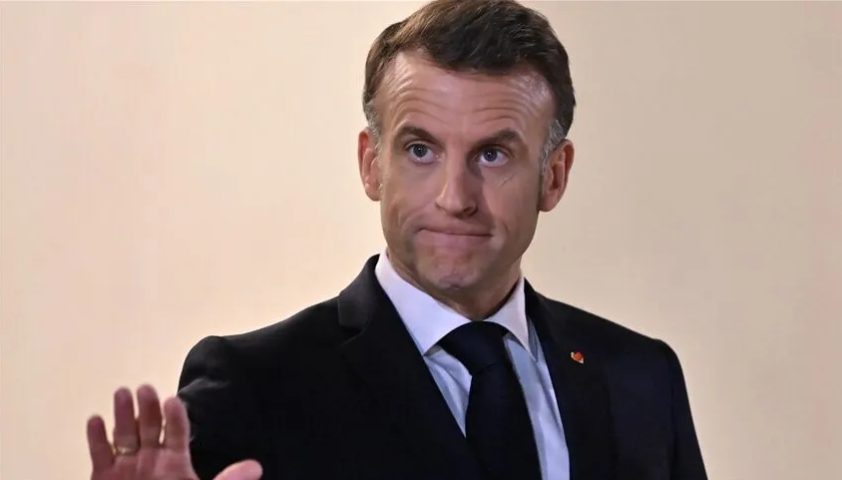
French President Emmanuel Macron’s visit to Damascus last week was the first by an EU head of state since the fall of the Assad government in 2024. Both sides agreed to reappoint ambassadors after more than a decade without formal diplomatic relations. The visit was widely reported as a diplomatic milestone but the more significant detail was who traveled with Macron: officials from the French Development Agency and executives from CMA CGM, Ellipse Projects and TotalEnergies.
That delegation is the part of the story worth examining because it points to a shift from statements of support to actual capital commitments. The question is whether this visit marks a genuine turning point in Syria’s economic recovery or whether it is simply the latest in a series of announcements that have not yet translated into results on the ground.
The clearest evidence of change is the capital that has already moved. CMA CGM has invested about $270 million in the port of Latakia, which it operates under a 30-year concession signed in May 2025, with a further $235 million planned. The company has also agreed to handle air cargo at Damascus International Airport and to operate two dry ports near Damascus and Aleppo. For an economy with a gross domestic product of about $21 billion, these are substantial commitments. In reconstruction economies, the first serious commercial investment tends to matter more than its size because it establishes that the country’s assets can be priced, financed and insured by outside parties.
In reconstruction economies, the first serious commercial investment tends to matter more than its size
Zaid M. Belbagi
These commitments are possible because the international environment around Syria has shifted. The US ended its broad sanctions program in 2025, Congress has repealed the Caesar Act and President Donald Trump has now notified Congress of his intention to rescind Syria’s designation as a state sponsor of terrorism, opening a 45-day review period. Saudi Arabia and Qatar paid off Syria’s outstanding debt to the World Bank, which has since approved a $146 million grant for electricity transmission. The EU has committed about $725 million for 2026-2027.
Sanctions had been the principal barrier to Syria’s reintegration into the global economy, affecting correspondent banking and cargo insurance alike. As that architecture has been removed, the practical obstacles to trade and investment have fallen away.
Gulf capital had already secured positions across Syria’s ports, airports, power grid and telecoms before Macron’s visit. What the visit added was the first substantial European presence in that landscape.
France was not the first to reconsider the reconstruction of Syria and its commitments remain modest by comparison. The Gulf states acted earlier and at considerably greater scale. Syrian President Ahmad Al-Sharaa announced $28 billion in foreign investment at the Future Investment Initiative in Riyadh last October and much of that has since become concrete.
Saudi Arabia signed $2.8 billion in agreements with Damascus in February, covering two airports in Aleppo, a fiber-optic backbone, a joint airline with Flynas that is due to begin operations in the fourth quarter of 2026 and a coastal desalination plant. A consortium led by Qatar’s UCC Holding signed a $7 billion agreement to build four gas power plants with a total capacity of 4 gigawatts, along with a solar plant. The UAE’s DP World took over the port of Tartous under a 30-year, $800 million concession and began operations in November 2025. UAE non-oil trade with Syria reached about $1.4 billion in 2025, more than double the previous year.
Set against these figures, the French commitments are smaller in scale. But they matter for a different reason, as they reduce Syria’s reliance on a single set of investment partners and move its recovery toward a broader base of external support.
The institutional element of the visit was at least as important as the capital commitments. The framework declaration signed in Damascus established permanent bilateral economic committees to identify priority projects, coordinate financing and monitor implementation. The French Development Agency signed a memorandum on institutional capacity building and France will provide technical assistance directly to the Central Bank of Syria.
These commitments are modest relative to the headline investment figures but they address the constraint that most limits how quickly any capital, French or Gulf, can be deployed: Syria does not yet have a banking sector that can process transactions reliably, a ports authority that can enforce contracts consistently or a central bank with fully credible oversight. Without that institutional capacity, investment commitments are difficult to convert into operating projects.
The transition remains incomplete. Two explosions in Damascus during the French president’s visit were a reminder that security conditions are still unsettled. Macron proceeded with his program regardless, which can be read as a signal of confidence, though it does not resolve the underlying risk.
Without institutional capacity, investment commitments are difficult to convert into operating projects
Zaid M. Belbagi
Three conditions will determine whether this visit will be remembered as a turning point. First, security needs to continue improving rather than merely holding steady. Second, the sanctions removal process needs to be completed so that banks and insurers have the legal clarity to commit capital at scale rather than relying on political signals. Third, French engagement needs to draw in other partners rather than stand alone.
Paris has been explicit that it cannot fund a $216 billion reconstruction program by itself. That capacity remains with the Gulf states, whose combined commitments already exceed the total Western and multilateral support by a factor of 30. This has been supported by the political backing the US has extended to Damascus.
Taken together, what has changed since the fall of the Assad government is not the scale of Syria’s reconstruction needs, which the World Bank puts at $216 billion and other estimates place even higher. What has changed is the category the file now sits in. It was previously a humanitarian matter, managed through aid agencies and pledging conferences. It is now an economic matter, managed through concession agreements, joint committees and corporate investment.
The Gulf states established that shift well before Macron’s visit. What his trip to Damascus adds is a second major source of capital and institutional support, reducing Syria’s dependence on any single region and giving the current phase of recovery a broader foundation than it had before.
BY: Zaid M. Belbagi is a political commentator and an adviser to private clients between London and the Gulf Cooperation Council.
Disclaimer: Views expressed by writers in this section are their own and do not necessarily reflect The Times Union‘ point of view