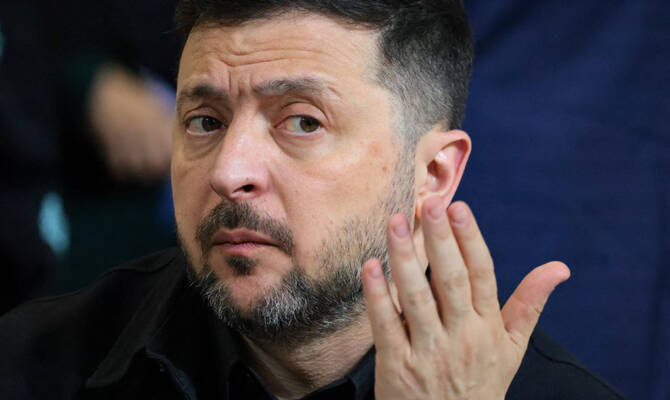
Ukrainian President Volodymyr Zelensky has already secured his place in both his country’s and the world’s history as a courageous and highly competent leader in extraordinarily difficult times. It is hardly conceivable that, without his leadership, Ukraine would have survived Russia’s unprovoked aggression that began in February 2022, let alone remained independent and in a sufficiently strong position to negotiate a future peace agreement, as is now the case.
In the early days of the war, when the US offered Zelensky an evacuation flight out of Kyiv, the Ukrainian leader reportedly replied: “The fight is here; I need ammunition, not a ride.” That instinctive response of a leader rising to the occasion has since become the stuff of legend and will likely be studied in leadership schools for generations to come.
However, in his zeal — and I do not necessarily use the word negatively, since the dire circumstances facing his country demanded such determination — Zelensky can at times come across as confrontational, even with friends and allies, particularly when such disagreements are aired publicly. This appears to be the case in his outright rejection of German Chancellor Friedrich Merz’s proposal to grant Ukraine a new status of “associate member,” which would allow Ukrainian officials to take part in EU summits and ministerial meetings without voting rights.
The proposal would give Ukraine a direct role within EU structures as an interim step toward full membership. Zelensky was not alone in opposing the idea. Several EU member states have also expressed reservations, fearing that such a move could draw them deeper into a war for which they have already committed substantial resources, potentially bringing them into more direct confrontation with Moscow.
One may argue that anything short of full membership is largely symbolic and that Merz is engaging in performative diplomacy rather than providing the level of support necessary either to guarantee Ukraine’s independence or to compel Russia to end the war without benefiting from its aggression. That criticism is not entirely unjustified, even if it somewhat exaggerates the proposal’s lack of practical significance. This would be the first time a country would be offered such a status and, therefore, its substance could be negotiated.
Yet Zelensky’s position is understandable as well. For the Ukrainian leader, the narrative he advances — one that contains considerable truth, but also serves the practical purpose of keeping Europe, the US, and other NATO allies engaged — is that this is not merely Ukraine’s war, but Europe’s war as well. He believes that, through the immense sacrifices Ukrainians have made over more than four years of conflict, the country has effectively shielded Europe from Russian expansionism and, therefore, earned the right to full EU membership, and perhaps eventual NATO membership, too.
As Zelensky wrote on X in response to Merz’s proposal: “Ukraine is fighting for its life, for its independence, and for the Europe that has lived in peace the longest, that protects people, life and culture, and that, thanks to this protection, plays a truly global role.” As a result, he argues: “There can be no complete European project without Ukraine, and Ukraine’s place in the European Union must also be complete, full and equal.”
Zelensky would be ill-advised not to reconsider his initial rejection of the German proposal.
Yossi Mekelberg
While this position is not without logic, it risks becoming counterproductive. Despite Germany’s central role within the EU, unanimity among member states would still be required for Ukraine to enter into any formal arrangement with the bloc. It is far from guaranteed that all member countries would support such a move while the war continues. There are already enough EU governments concerned that provoking a wounded Russia could trigger a stronger reaction from Moscow. Moreover, as European economies grow slowly, many member states that have already heavily supported Kyiv are reluctant to take on further financial and military obligations.
Merz may see this interim arrangement as a way to accelerate Ukraine’s eventual full membership by gradually normalizing the participation of Ukrainian representatives in EU decision-making processes, even without voting rights. The resistance to the proposal from within the EU stems primarily from fears that Ukraine could become an associate member, and perhaps eventually a full member, before the war officially ends.
In such a scenario, Article 42.7 of the EU treaties could potentially be activated. Although Article 42.7 is not as robust as NATO’s Article 5, it nevertheless states that if a member state becomes the victim of armed aggression on its territory, “the other Member States shall have toward it an obligation of aid and assistance by all the means in their power, in accordance with Article 51 of the United Nations Charter.” The language is vague enough not to compel member states to deploy troops, for example, but it would still establish a formal obligation to assist Ukraine in ensuring its security.
Another objection is that, after the rapid rounds of EU enlargement since the mid-1990s — processes that at times compromised the bloc’s strict accession criteria — there is now greater reluctance to allow further shortcuts, even in Ukraine’s unique circumstances. At the same time, many governments view the Ukrainian case as exceptionally risky. To address these concerns, Merz reportedly suggested in his letter a “snap-back mechanism” or sunset clause that could suspend the arrangement if Ukraine were to backslide on rule-of-law standards or accession requirements.
What Merz proposes has considerable merit, and Ukraine’s rejection of the idea may ultimately achieve the opposite of what Zelensky intends. If a peace agreement with Moscow is eventually reached, it will almost certainly require painful concessions from Kyiv. In that context, eventual full EU membership could provide Ukraine with additional long-term security, especially in the absence of NATO membership, helping to deter future Russian attempts to undermine Ukrainian sovereignty after a settlement. An agreement on eventual EU membership could also help Ukrainian leaders present an imperfect peace deal to their own population by demonstrating that the sacrifices endured during the war secured Ukraine’s irreversible integration into Europe.
All things considered, Zelensky would be ill-advised not to reconsider his initial rejection of the German proposal and, instead, seek to negotiate the most favorable possible terms for such an association. Otherwise, Germany may conclude that Merz’s initiative was stillborn before serious discussions with other EU partners even began. At this stage of the war, which could continue unresolved for years, closer institutional ties with the EU would only strengthen Kyiv’s position at the negotiating table. That could prove crucial, while still preserving the long-term objective that Ukraine’s rightful place is fully within Europe.
BY: Writer Yossi Mekelberg is a professor of international relations and an associate fellow of the MENA Program at Chatham House.
Disclaimer: Views expressed by writers in this section are their own and do not necessarily reflect The Times Union‘ point of view