Two past developments can help us understand the present. The first was when Ayatollah Khomeini, after the victory of the revolution, ordered the removal of the Israeli flag from its embassy in Tehran and that it be replaced with a Palestinian one. He changed the nature of his relations with the most challenging issue in the Middle East. The second was when the world watched as Americans became hostages in the embassy of their country in Tehran. The hostage crisis dragged on, irrevocably changing relations between Tehran and Washington.
Iran has never made it a secret. Its own constitution speaks about exporting the revolution and championing the weak. It chants about wiping Israel from existence and expelling the “Great Satan” — America — from the region.
The victory of the Khomeinist revolution was no ordinary development. The revolution was born out of the realm of the world of two camps in a country that boasts massive capabilities and lies at the crosspoint of straits, routes, wealth and roads. Experience has shown that crushing victories against regimes like that of the shah give the victorious an extraordinary dose of arrogance and an insatiable ambition. This is what happened. The victorious fell into the trap of aiming to change the features of the Middle East and even beyond.
Crushing victories against regimes like that of the shah give the victorious an extraordinary dose of arrogance
Ghassan Charbel
Saddam Hussein grew alarmed. Khomeini never hid his ambition to oust the “takfiri Baathist regime,” the same way he did with the Pahlavi regime. Saddam grew anxious and chose not to wait for Iran’s allies to make their way to Baghdad, instead opting to take the battle to Iran itself. The truth is that the Iraq-Iran war only helped delay the regime change that would happen in Iraq in the 21st century.
The war did not deter Khomeini. He forged ahead with his agenda to change the features of the region, especially in countries whose sectarian makeup favored his goals. With Iranian sponsorship and Syrian assistance, Hezbollah was born out of the Israeli invasion of Lebanon in 1982.
A third development helps us understand the present. A suicide bomber blew himself up at the US Marine headquarters in Beirut in 1983, leading Washington to pull its troops from the Multinational Force in Lebanon. The country consequently fell into the clutches of Hafez Assad’s Syria and Khomeini’s Iran.
Assad gave Hezbollah and Iran a golden gift when his agencies carried out or facilitated assassinations against the Lebanese National Resistance Front, effectively allowing Hezbollah to seize sole control of southern Lebanon.
Even as it clashed with Israel, Hezbollah cemented its presence in the Lebanese equation, eventually managing to seize full control of the country’s decision-making. Iran, meanwhile, grew its influence on the eastern shore of the Mediterranean and consolidated it after Syria came under the rule of Bashar Assad.
Lebanon’s features changed further in the 21st century. Israel withdrew from southern Lebanon empty-handed. The American army ousted Saddam’s regime. Rafik Hariri’s assassination only deepened the changes in Lebanon. The battle to change the country’s features was won. The 2006 war against Israel tipped the balance in Hezbollah’s favor. The party soon took control in the country and had the final say in “appointing” presidents and prime ministers.
Iraq also witnessed a major battle to change its features. Factions loyal to Iran took over governments and ruling bodies. Gen. Qassem Soleimani was in charge of the operation to destabilize the system that was put in place by the Americans, who were massively out of their depth. Soleimani ran the game of dismantling alliances, overcoming obstacles and planting explosives that sped up the collapse of the new system and doubled Iran’s influence.
When Daesh reared its head, Soleimani succeeded in turning Grand Ayatollah Ali Al-Sistani’s fatwa into an excuse to form the Popular Mobilization Forces and transform it into an official security agency. Iraq’s features changed and the best evidence of that is the role of the Iraqi factions in the current war.
Israel began to implement its new military creed: attack dangers before they strike and surround Israel with buffer zones
Ghassan Charbel
Ali Khamenei’s time in power was an era of changing the features of the region. The supreme leader banked on two men who were close to his heart and mind: Soleimani and Hassan Nasrallah. Under Khamenei, Yemen’s features changed, even leading to the killing of President Ali Abdullah Saleh. The Palestinian path also changed as Tehran encouraged suicide operations after the signing of the Oslo Accords. It also sent rockets and drones to its allied Palestinian factions.
Soleimani worked hard to eliminate American influence, which he viewed as an obstacle to Iran’s agenda of changing the features of the region. The generals of the Revolutionary Guards boasted about controlling four Arab capitals. Soleimani dreamed of pouncing on Israel with a wave of rockets fired from several countries. One can only understand what Yahya Sinwar did by returning to Soleimani’s agenda. Donald Trump eventually caught on and ordered Soleimani’s killing in Baghdad.
Was Tehran behind Sinwar’s Al-Aqsa Flood Operation? Did it underestimate Israel and the US’ might? Benjamin Netanyahu obviously saw in the flood a historic opportunity to make inroads with Arab countries. The Syrian link in the so-called Axis of Resistance was taken out. Israel began to implement its new military creed: attack dangers before they strike and surround Israel with buffer zones.
Netanyahu concluded that his ability to change the features in Israel’s direct vicinity would remain under threat if features in Tehran itself were not changed. Netanyahu tried tirelessly to convince Trump until the following conclusions were reached: Iran must not have nuclear weapons, it must curb its ballistic missile program and it must sever its ties with its proxies.
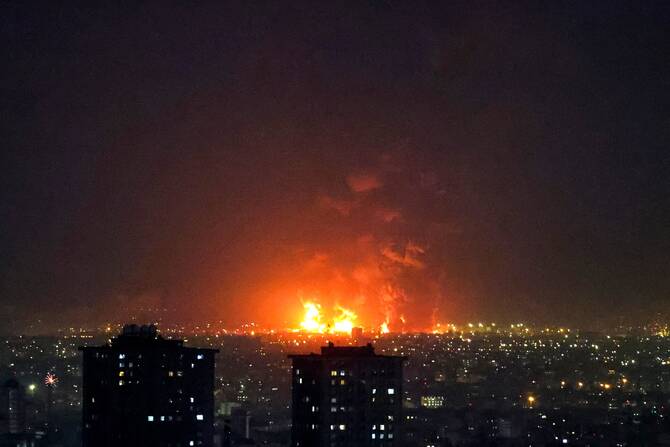
We have now entered the fiery chapter of the war to change features. Iran has changed the features of countries. The US, in partnership with Israel, is now trying to partially or fully change the features of the Iranian regime.
BY: Ghassan Charbel is editor-in-chief of Asharq Al-Awsat newspaper.
This article first appeared in Asharq Al-Awsat.
Disclaimer: Views expressed by writers in this section are their own and do not necessarily reflect The Times Union‘ point of view