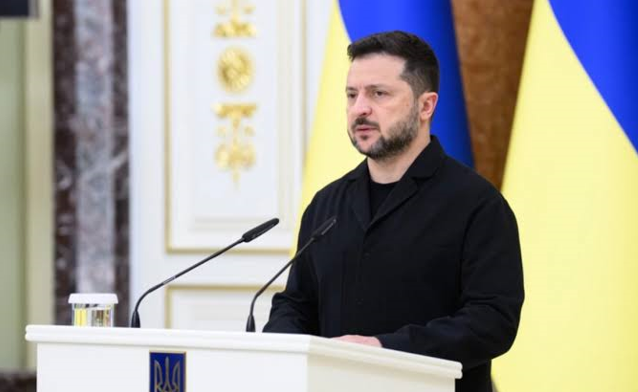
- Ukrainian President Claims Reduced Connectivity Affected Civilian Protection, Military Logistics and Operations in Russian-Occupied Territories
KYIV — Ukrainian President Volodymyr Zelenskyy has said that reduced Starlink satellite internet connection speeds disrupted Ukraine’s ability to intercept Russian jet-powered Shahed drones, potentially affecting efforts to protect civilians from aerial attacks.
According to European Pravda, Zelenskyy said the connectivity restrictions also affected certain Ukrainian military operations in Russian-occupied territories and complicated the delivery of essential supplies to troops stationed on the front lines.
The Ukrainian president stressed that Starlink remained operational, but the reduction in connection speeds had limited the effectiveness of systems used by Ukrainian forces.
Reduced Connectivity Affected Drone Interception Capabilities
Zelenskyy explained that Ukraine uses specialised interceptor drones supported by Starlink connectivity to counter Russian jet-powered Shahed drones, which can travel at speeds exceeding 400 kilometres per hour.
He said the reduced connection speeds had prevented Ukrainian forces from intercepting some incoming drones.
“We use [Starlink] to intercept jet-powered Shaheds that strike our civilians and kill our families,” Zelenskyy said, adding that the restrictions had affected a capability intended to protect civilian lives.
He described the situation as painful and concerning, arguing that reliable communications are essential to the effective operation of high-speed interceptor systems.
Ukrainian Military Operations Also Reportedly Affected
Beyond air defence, Zelenskyy said Starlink connectivity supports Ukrainian operations against Russian military targets in temporarily occupied territories. According to the president, the reduced speeds had also hindered some of these activities.
He further highlighted the importance of satellite communications for frontline logistics, particularly in areas where Russian drone surveillance makes conventional supply routes dangerous.
According to Zelenskyy, Ukraine uses Starlink-supported capabilities to help deliver food and water to troops who may remain deployed in frontline positions for weeks or months.
Kyiv Seeks Clarification from Washington and SpaceX
Zelenskyy said Ukraine’s Defence Ministry was maintaining daily contact with US counterparts regarding the connectivity problems. He added that Kyiv had recently received information indicating that connection speeds had been restored.
“If that is the case, we are very grateful,” the Ukrainian president said.
He also confirmed that Ukraine had approached SpaceX and the White House to request the restoration of the affected capabilities, although, according to his remarks, Kyiv had not received a positive response to its request at that stage.
Conflicting Reports Emerge over Responsibility for Restrictions
The reported restrictions have prompted questions in Washington about the management of satellite communications systems supporting Ukrainian military operations.
Reuters previously reported that an order to restrict the use of the Starshield satellite system, which Ukraine employs for battlefield communications and drone control, had come from the White House. However, other reporting, including an account by Axios, suggested that the Trump administration was not responsible for the incident and that responsibility lay with SpaceX.
The differing accounts have left questions about the decision-making process and the precise circumstances surrounding the connectivity disruption.
Meanwhile, Republican Senator Thom Tillis has reportedly sought an investigation and a report to Congress concerning Pentagon actions related to the Starlink communications problems experienced by Ukrainian forces.
Satellite Communications Remain Strategically Important
The episode highlights the growing importance of commercial satellite networks in modern warfare, particularly for battlefield coordination, unmanned systems, air defence and military logistics.
For Ukraine, reliable satellite connectivity remains a significant operational consideration as it seeks to defend its population and sustain forces along the front lines.
Zelenskyy has characterised the restrictions as a mistake that could result in casualties and destruction. The full circumstances, duration and operational consequences of the reported disruption, however, require further independent verification.
The incident underscores how decisions affecting commercial satellite infrastructure can have significant implications for military operations and civilian protection in an ongoing conflict.
BY: The Times Union – Tetyana Vysotska