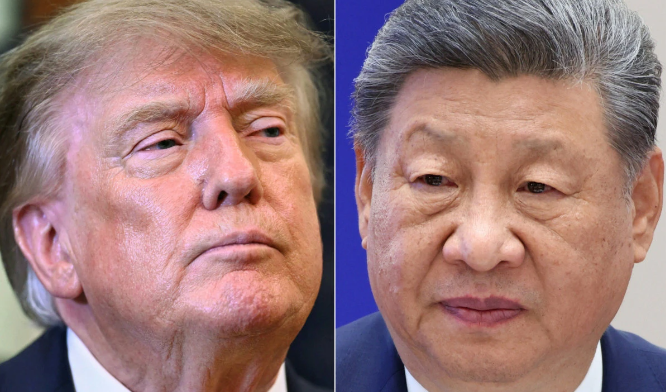
- AI competition, Iran tensions, trade disputes and Taiwan expected to dominate White House talks
WASHINGTON: With a US military honor guard rehearsing for the occasion and a newly completed White House helipad prepared for a high-profile arrival, attention is turning to whether US President Donald Trump and Chinese President Xi Jinping can translate the pageantry of their upcoming summit into substantive progress.
Xi’s planned White House meeting with Trump on September 24 comes amid a complex web of strategic and economic tensions between the world’s two largest economies. The two leaders are expected to discuss the rapidly intensifying global race for artificial intelligence, the impact of Trump’s war with Iran, trade and tariffs, and the longstanding tensions surrounding Taiwan.
At the broader strategic level, the summit reflects an increasingly consequential contest between Washington, which seeks to preserve its position as the world’s leading power, and Beijing, whose growing economic, technological and military influence is reshaping the international order.
“I’ll be discussing almost everything with him,” Trump told reporters aboard Air Force One on Sunday, signaling an exceptionally broad agenda for the September 24 talks.
Limited Expectations for Major Breakthrough
Despite the summit’s high-profile setting, analysts caution that expectations for major agreements remain limited. The meeting could instead serve to maintain a fragile understanding between Washington and Beijing and prevent existing disputes from escalating further.
“I don’t expect much to come out of this,” Jonathan Czin of the Brookings Institution told AFP, suggesting that the encounter could resemble Trump’s May visit to Beijing, where considerable attention was placed on the relationship between the two leaders.
Artificial intelligence is expected to feature prominently in the discussions. Both Washington and Beijing are investing heavily in advanced AI technologies, while concerns are growing internationally over the security, economic and strategic implications of the technology.
However, Peking University professor Wang Dong said major agreements on AI regulation or limitations remain difficult to achieve, as both countries are concerned that concessions could weaken their position in the race for technological leadership.
Iran and Sanctions Add to Tensions
Iran is also expected to form part of the summit agenda, particularly as Washington seeks to enforce sanctions against countries and entities maintaining economic ties with Tehran.
US Treasury Secretary Scott Bessent is scheduled to meet Chinese Vice Premier He Lifeng ahead of the summit, with Iran sanctions among the issues expected to feature in their discussions.
Reports that Chinese entities provided Iran with satellite intelligence linked to an attack on a US military base in Jordan have added another layer of tension. Trump, however, has played down the allegations, saying Xi had “behaved reasonably well” and noting that the United States also conducts intelligence operations against China.
Trade Remains Central to the Relationship
Trade is likely to be another major focus as Washington and Beijing continue efforts to contain the economic consequences of US tariffs and retaliatory measures.
Yue Su of the Economist Intelligence Unit told AFP that there could be scope for progress on tariffs, Chinese agricultural purchases and selected export controls.
Any limited trade understanding could help stabilize economic relations, although fundamental disagreements over market access, technology restrictions, industrial policy and supply chains remain unresolved.
Taiwan: The Most Sensitive Strategic Issue
Beyond economics and technology, Taiwan remains one of the most serious sources of strategic tension between Washington and Beijing.
China claims Taiwan as part of its territory, while the island maintains its own elected government and democratic institutions. The possibility of military conflict over Taiwan remains a major concern for the United States, China and regional allies, particularly given Taiwan’s importance to the global semiconductor industry.
Wang said Taiwan would remain among the most sensitive issues in the US-China relationship, despite the leaders’ efforts to maintain dialogue.
Trump and Xi’s previous meeting in Beijing was marked publicly by cordial exchanges, but Xi also warned of the possibility of “conflict” over Taiwan, underscoring the strategic differences beneath the diplomatic engagement.
Diplomatic Theatre and High-Profile Welcome
The White House is preparing an elaborate reception for Xi, including a formal military ceremony and a state dinner.
Trump had pushed for a new granite helicopter landing pad on the White House South Lawn to be completed in time for the Chinese president’s visit. Military personnel have also been rehearsing ahead of the official welcome ceremony.
The White House’s planned $400 million ballroom, however, will not be completed in time for the summit. Trump has previously said the finished facility will surpass Beijing’s Great Hall of the People, where Xi hosted him during his May visit.
Former US Deputy Secretary of State Kurt Campbell described the upcoming encounter as being heavily focused on public symbolism, saying it was “less a summit and more a spectacle” designed for domestic and international audiences.
Further Leaders’ Meetings Could Offer Concrete Outcome
While expectations for major agreements remain cautious, the summit could pave the way for additional high-level meetings and continued engagement.
Trump and Xi are expected to meet again in November during the Asia-Pacific Economic Cooperation (APEC) forum in Shenzhen, China. The Kremlin has also floated the possibility of a three-way meeting involving Russian President Vladimir Putin.
Trump is additionally expected to invite Xi to the G20 summit scheduled for December at his Doral resort in Miami.
Against the backdrop of intensifying competition over technology, trade, security and global influence, the September summit will therefore be closely watched for signs of whether Washington and Beijing can stabilize their relationship—or merely manage tensions without resolving their underlying disputes.
BY: The Times Union