- First-Ever Meeting of US, Chinese and Russian Leaders Highlights Shared Responsibility for International Stability
- Leaders Discuss UN Reforms, Energy Security and Nuclear Risk Reduction, but Major Conflicts Remain Unresolved
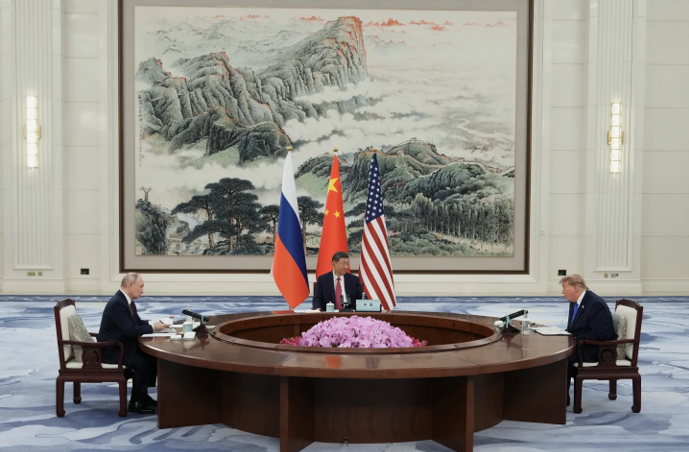
SHENZHEN, CHINA: In a historic diplomatic development, US President Donald Trump, Chinese President Xi Jinping and Russian President Vladimir Putin held their first-ever trilateral meeting on Thursday, bringing together the leaders of three major global powers to discuss international peace, security and the future of the global order.
The meeting, held on the sidelines of the Asia-Pacific Economic Cooperation (APEC) summit, lasted more than an hour and focused on shared responsibilities arising from the three countries’ positions as major powers and their historical roles as victors of the Second World War.
Although the summit generated considerable diplomatic attention, the joint peace declaration and official statements released after the meeting offered limited details of concrete agreements. The leaders expressed support for strengthening international cooperation, reforming the United Nations, increasing energy supplies and reducing nuclear risks.
However, the declaration did not directly address Russia’s war in Ukraine or the US-led war in Iran, two major international conflicts with significant implications for global security.
Three Global Powers Emphasise Shared Responsibility for International Peace
Opening the trilateral discussions, President Vladimir Putin highlighted the historical and international responsibilities shared by the United States, China and Russia.
He observed that the three countries were united not only by their status as victors of the Second World War but also by their responsibility for maintaining international peace and security.
Putin also emphasised their historic role in establishing the United Nations and the importance of preserving and strengthening the international legal system.
He said the three countries shared important interests in resolving regional conflicts, including the conflict in Ukraine.
The leaders also reportedly supported the principle that major powers should respect the legitimate security concerns of all countries and resolve differences through dialogue, negotiations and cooperation.
Xi Jinping Strengthens China’s Diplomatic Leadership
Hosting the unprecedented gathering provided President Xi Jinping with an important opportunity to reinforce China’s diplomatic influence and its role in international affairs.
According to China’s state news agency Xinhua, Xi described the discussions as positive and fruitful, noting that the three leaders shared common perspectives on safeguarding international peace.
Emphasising the importance of continued diplomatic engagement, Xi said: “As long as dialogue does not stop, doors remain open, there is hope for peace.”
He further expressed confidence that the understanding developed during the meeting could produce positive results in the future.
China has increasingly positioned itself as an advocate of diplomatic engagement, international cooperation and a more inclusive global governance system.
However, sensitive issues, including Taiwan and China’s territorial claims, were not addressed in the broadly worded trilateral declaration.
Trump Describes Summit as a Historic Opportunity for Global Cooperation
President Donald Trump welcomed the meeting as a historic diplomatic achievement, suggesting that direct engagement among the three leaders could open new opportunities for addressing some of the world’s most challenging international issues.
Before the trilateral discussions, Trump held a separate meeting with Putin and expressed optimism about the possibilities emerging from their engagement.
He indicated that the summit represented the beginning of a broader diplomatic process rather than a final resolution of existing international disputes.
Iran and Ukraine were among the issues Trump said he wanted to discuss with the Chinese and Russian leaders.
Trump also reiterated the importance of reopening the Strait of Hormuz, a strategically vital international shipping route for global energy supplies, and preventing Iran from acquiring nuclear weapons.
Nevertheless, there was no public indication that China or Russia had committed to specific measures to help resolve the Iran conflict.
Ukraine Conflict Remains a Major Challenge for International Diplomacy
The war in Ukraine remained an important subject during the leaders’ separate bilateral engagements, although it was not the principal focus of their trilateral discussions.
Following the summit, President Trump participated remotely in a meeting in Berlin involving US representatives Jared Kushner and Steve Witkoff, Ukrainian President Volodymyr Zelenskyy and more than 40 European leaders supporting Ukraine.
According to US envoy Steve Witkoff, Trump informed the Berlin gathering that he had discussed the possibility of finding a peaceful resolution to the Ukraine conflict with both Xi Jinping and Vladimir Putin.
The discussions highlighted the importance of maintaining diplomatic channels among major international stakeholders while efforts continue to find a sustainable solution to the conflict.
Putin Uses Historic Gathering to Reinforce Russia’s Global Standing
For President Vladimir Putin, the trilateral summit represented a significant diplomatic opportunity to demonstrate Russia’s continued international influence and its position as a major global power alongside the United States and China.
His participation in the APEC summit, together with separate meetings with Trump and Xi, provided an important platform for Moscow to strengthen its diplomatic engagement with the world’s leading powers.
Putin’s discussions with both leaders also reflected areas of shared interest, particularly international security, energy cooperation and opposition to what they described as the misuse of international judicial jurisdiction.
The Kremlin also highlighted Putin’s warm diplomatic exchanges with Xi, releasing footage of the Chinese president accompanying the Russian leader to his vehicle following their discussions.
United Nations Reform and Nuclear Risk Reduction Feature in Declaration
One of the key outcomes highlighted in the post-summit statements was the leaders’ agreement on the importance of reforming the United Nations and strengthening international cooperation.
The declaration also referred to increasing oil supplies and reducing nuclear risks, reflecting the strategic importance of energy security and nuclear stability in an increasingly complex international environment.
The three countries also expressed opposition to what they described as the abuse of jurisdiction by the International Criminal Court and supported immunity from prosecution for state officials, according to the official statements.
However, the declaration did not provide detailed proposals concerning the scope or implementation of the proposed UN reforms.
Historic Dialogue Offers Opportunity for a More Stable Global Order
The unprecedented meeting among the leaders of the United States, China and Russia represents an important diplomatic moment, bringing together three countries whose political, economic and military influence significantly shapes international affairs.
Despite differences over regional conflicts, security policies and the international order, their willingness to engage directly demonstrates the continuing importance of dialogue among major powers.
While the summit did not produce publicly announced solutions to the wars in Ukraine and Iran, discussions on UN reform, energy security, nuclear risk reduction and international cooperation provide a basis for further diplomatic engagement.
The success of this historic initiative will ultimately depend on whether the three countries can translate their shared commitments into practical measures that strengthen international stability, prevent military escalation and promote a more peaceful and cooperative global order.
BY: The Times Union – AP