Iran is meeting with the US in Switzerland. Lebanon is one aspect of the talks. The US and Iran this week announced they are creating a “deconfliction cell” to ensure their deal goes through, but the Lebanese government has had very little agency in the entire process. The Nawaf Salam-Joseph Aoun government did not read events properly and bet on the wrong horse. They bet on the Americans. They thought the US’ support would allow them to contain Hezbollah and repel the Israelis. They were wrong. Politics requires a more nuanced approach.
Monday’s official statement revealed that the US and Iran had “agreed on the creation of a deconfliction cell, between the parties, the Lebanese Republic and facilitated by the mediators, to ensure the adherence to the termination of military operations in Lebanon.” However, no Lebanese official is present in Switzerland. Hezbollah is well represented by Iran and Israel’s interests are represented by the US. The Lebanese state seems missing from the equation. It is merely on the receiving end.
The Lebanese government has chosen to appease the Israelis, hoping that, at some point, the Americans will pressure them to withdraw from Lebanon. This seems more like wishful thinking than a realistic expectation. Israel Katz, Israel’s defense minister, has already made it clear that Tel Aviv has no intention of leaving any of the territory it has seized in Gaza, Lebanon, Syria or the West Bank. Prime Minister Benjamin Netanyahu has also reiterated that Israel will not leave Lebanon.
It was definitely a mistake for Lebanon to negotiate with the Israelis on its own. As much as this could be seen as sovereign behavior and that the state was taking the fate of the country into its own hands, in reality, Lebanon is not eligible to enter such negotiations. To start with, the state has no leverage — Israel has all the leverage. Lebanon cannot impose anything or offer anything to Israel. Can Lebanon offer Hezbollah’s disarmament? No. The army commander has already declared that Hezbollah cannot be disarmed by force as this would create an internal clash. And the government cannot pressure Hezbollah to disarm willingly.
It was definitely a mistake for Lebanon to negotiate with the Israelis on its own. To start with, the state has no leverage
Dr. Dania Koleilat Khatib
The government has also chosen to isolate itself. According to former security officer Jamil Al-Sayyed, Salam delayed asking for a ceasefire in Lebanon to be included on the agenda during the negotiations in Islamabad. He believed that would constitute undue interference in Lebanese affairs. The following day, April 9, after Israel had conducted a huge bombing raid in Beirut that injured more than 1,000 people and killed about 360, Salam called Pakistani Prime Minister Shehbaz Sharif and asked for a ceasefire to become part of the negotiations.
Salam should have sent a delegation to Islamabad, as other countries like Saudi Arabia, Egypt and Turkiye did. Regional negotiations regarding the war were also held during April’s Antalya Diplomacy Forum. Foreign ministers and high-level officials from Egypt, Syria, Jordan, the UAE, Saudi Arabia and Qatar were present. But Beirut did not send its foreign minister to take part in the discussions.
Lebanese Deputy Prime Minister Tarek Mitri has said that the Cabinet refused to file a complaint against Israel, even though he urged them to do so. According to Walid Jumblatt, the seasoned Lebanese Druze leader, some Lebanese in Washington are “more Israeli than the Israelis” themselves. His media office rushed to clarify that he was referring to some researchers who work for American pro-Israel think tanks and not the negotiating team. However, anyone who follows Jumblatt can see that, like many others, he is very critical of a government that has not been vocal enough about the Israeli aggression. So far, we have not seen the Lebanese representative at the UN make any statement or confront the Israeli envoy.
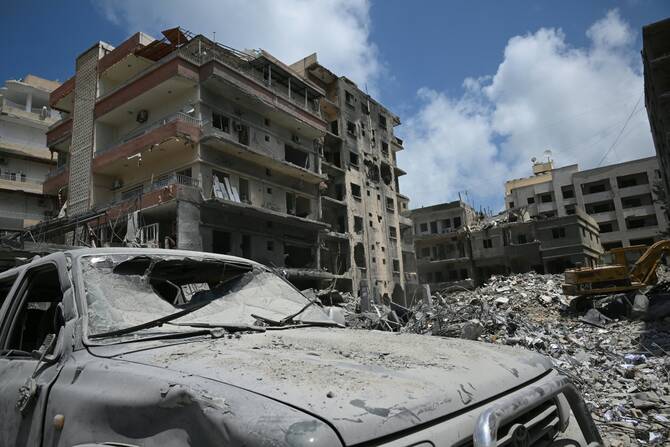
This attitude has created divisions within Lebanese society. While some factions blame Hezbollah for pushing Lebanon into this war, others think that the Lebanese state is being compliant with Israel. Israel does not help either. It keeps bombing the country after ceasefires have been agreed. It also keeps making statements and spreading news with the aim of discrediting the Lebanese government.
The government has also taken a confrontational approach toward Iran. This shows a lack of pragmatism, as Iran controls Hezbollah
Dr. Dania Koleilat Khatib
Israel Hayom on Sunday published an article that stated that the negotiations with Lebanon in Washington are intended to remove Israel’s total withdrawal as a precondition for the US’ negotiations with Iran. It said the two tracks “could be headed for a collision course.” From the looks of it, Israel is using the negotiations with the Lebanese state to legitimize its actions.
In addition to being divisive, the current government has also failed on other fronts. It has failed to properly handle the issue of those displaced by the war. The displaced are everywhere on the streets of Beirut. It has been found that 85 percent of the refugees have not been offered proper shelter.
The government has also taken a confrontational approach toward Iran. It submitted a letter to the UN Security Council criticizing Tehran for interfering in its internal affairs. This shows a lack of pragmatism, as Iran is the one that controls Hezbollah. It expelled the Iranian ambassador and declared him persona non grata, but Iran stayed defiant and kept the ambassador in Beirut. Anyone who knows anything about politics knows that one does not take decisions one cannot implement, as it only shows weakness.
And Lebanon has failed to garner regional support. It entered into direct negotiations with Israel without the backing of Middle Eastern states.
The Lebanese government is now realizing that it has backed the wrong horse. Aoun, after his previous confrontational tone toward Iran, last week said that Lebanon welcomes any country’s effort to bring an end to the war, including Iran. The government is coming to realize that its bilateral talks with Israel will not result in anything substantial. Lebanon can only get anything half-decent as part of a regional deal. However, it is already committed to the bilateral track. And Israel will likely use those talks to legitimize its actions in Lebanon.
BY: Writer Dr. Dania Koleilat Khatib is a specialist in US-Arab relations with a focus on lobbying. She is co-founder of the Research Center for Cooperation and Peace Building, a Lebanese nongovernmental organization focused on Track II.
Disclaimer: Views expressed by writers in this section are their own and do not necessarily reflect The Times Union‘ point of view