India assumed the BRICS presidency in January this year, with the annual summit scheduled to take place in New Delhi in September. This year also marks the 20th anniversary of the first meeting of foreign ministers. Starting with five founding members — Brazil, Russia, India, China and South Africa — BRICS admitted five new members in 2024: Iran, Egypt, Ethiopia, Indonesia and the UAE. In 2024, BRICS also accepted 13 states from Latin America, Africa, Central Asia and South Asia as “partner countries,” reflecting the global representation of BRICS+.
The BRICS members’ total population is 3.9 billion — about 48 percent of the global total — while its combined gross domestic product in terms of purchasing power parity is $78 trillion, about 40 percent of global GDP. For comparison, the corresponding figure for the G7 grouping of developed countries is $61 trillion, about 28 percent of the global total. BRICS members also produce 30 percent of the world’s oil.
Over the last two decades, BRICS has forcefully represented the interests of the Global South, largely by providing financial support through its New Development Bank, which has approved $32 billion in funding for 96 projects. BRICS also has a Contingent Reserve Arrangement, with an initial funding of $100 billion, which provides a safety net to protect against members’ short-term balance of payments concerns.
From its inception, BRICS has sought reform of the world’s political and economic institutions so that they reflect the prowess and interests of developing countries. This will remain the central concern of the Indian presidency. Drawing from the BRICS acronym, Prime Minister Narendra Modi has said that India will promote “Building for Resilience, Innovation, Cooperation and Sustainability,” with its approach being “people-centric and humanity-first.”
The Indian presidency is taking place at a particularly divisive and conflictual period in world affairs
Talmiz Ahmad
The Indian presidency is taking place at a particularly divisive and conflictual period in world affairs, which is defined by fierce ongoing conflicts in Ukraine and across the Middle East; political and economic competition between the US and China and consequent crucial supply chain disruptions; the imposition of severe tariffs by the US on several nations that threaten global economic stability; and the systematic devaluation of international organizations concerned with peace, economic stability and progress, and human welfare. US President Donald Trump has declared BRICS “anti-American” and warned it against de-dollarization policies.
Nearer home, during the presidency, Indian leaders will have to handle the diverse positions on major regional and global matters of BRICS’ own members. In a Carnegie India report, commentator Vrinda Sahai described this challenge as “resolving the underlying tension between expansion and institutional coherency.” Thus, the meeting of BRICS foreign ministers in March did not produce a joint statement due to differences among members on the ongoing conflicts in the Middle East.
These differences are not likely to daunt Indian policymakers. In its approach to BRICS, India does not take a stridently anti-Western position but rather sees itself as a bridge between BRICS and the West on the one hand and among the diverse countries of the Global South on the other by seeking to obtain mutually accommodative positions and projects. As South African observer Aaliyah Vayez has noted, India seeks “institutional reform rather than ideological confrontation.”
Intra-BRICS cooperation will be at the heart of all the grouping’s political, economic and social initiatives
Talmiz Ahmad
India’s focus areas are contained in Modi’s elaboration of the BRICS acronym. Resilience refers to strengthening members’ capacity to handle economic, health and climate challenges through expanding trade interdependence, with a focus on global supply chains for critical minerals and technology. Innovation prioritizes expanding access to technology, particularly through improving public digital infrastructure and pursuing biotechnology and green initiatives. Intra-BRICS cooperation will be at the heart of all the grouping’s political, economic and social initiatives, embracing trade, investment and food security.
Sustainability will shape these initiatives. As the Brazilian commentator Lucas Carlos Lima has noted, development and climate challenges must be synergized and viewed not as moral imperatives but as “criterion of political and legal rationality.” This will require greater coordination in national policymaking among the BRICS members in the areas of agriculture, industry and logistical infrastructure, particularly connectivity corridors. The last of these now has a central place in the BRICS members’ priorities, with smart cities, railways, ports, undersea cables and maritime routes being viewed as playing a significant role in promoting economic growth and strategic outreach.
Thus, the New Development Bank and the China-led Asian Infrastructure Investment Bank have together provided $71 billion to support such projects. As a BRICS Today report has pointed out, these projects are “fundamentally reshaping the geopolitical landscape of trade, moving it toward a multipolar network of hubs and corridors.”
While some Western policymakers and commentators predict that BRICS will evolve into a solid anti-Western bloc, most observers note that its members are very diverse and cherish their commitment to strategic autonomy, with none of them seeking to be part of a confrontational group. At the same time, they see considerable value in BRICS membership: broader economic engagement, the ability to obtain development financing on easier terms and often in local currencies, and generally enjoying greater autonomy and influence in a non-Western institution.
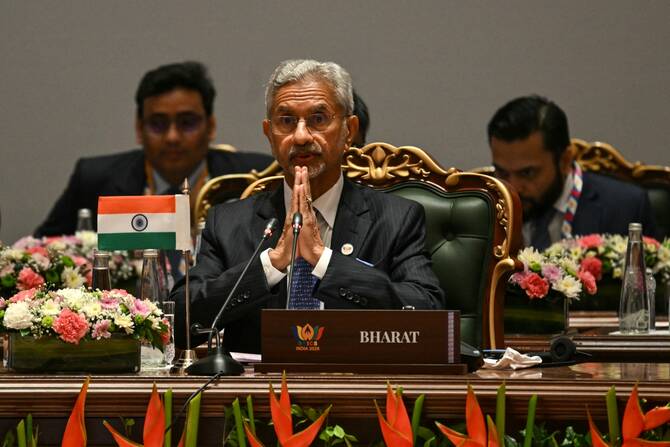
Indian External Affairs Minister S. Jaishankar views BRICS as a “constructive platform for dialogue and development, complementing the broader multilateral system.” While many BRICS members find US political and economic policies onerous and irksome, none of them wishes to delink from Washington — what they most fervently want is an international order that gives them dignity and influence. This is what India’s BRICS presidency is expected to promote.
BY: Writer Talmiz Ahmad is a former Indian diplomat.
Disclaimer: Views expressed by writers in this section are their own and do not necessarily reflect The Times Union‘ point of view